Kłusek-Oksiuta Monika, Bialokoz-Kalinowska Irena, Tarasów Eugeniusz, Wojtkowska Malgorzata, Werpachowska Irena, Lebensztejn Dariusz Marek
Department of Pediatrics, Gastroenterology and Allergology, Medical University of Bialystok, 17 Waszyngtona St., Bialystok, 15-274, Poland.
Department of Pediatrics and Developmental Disorders, Medical University of Bialystok, Bialystok, Poland.
Ital J Pediatr. 2014 Nov 17;40:84. doi: 10.1186/s13052-014-0084-4.
Ectopic hepatic lipid accumulation is closely related to the development of insulin resistance, which is regarded as one of the most significant risk factors of non-alcoholic fatty liver disease (NAFLD). The current study has shown that fat tissue constitutes an important endocrine organ with its own production and metabolism of many biologically active substances, among which adipokines play an important role. Classic adipokines (e.g. leptin, adiponectin, resistin) are fat-derived hormones which serum level is altered in patients with NAFLD. The role of novel adipokines in the pathomechanism of this disease is not clear. Therefore, the aim of our study was to evaluate the serum concentrations of chemerin, omentin and vaspin in obese children with NAFLD.
Forty-five obese children, aged 7-17 years old, were admitted to our Department with suspected liver disease (hepatomegaly, and/or ultrasonographic liver brightness, and/or increased ALT activity). Viral hepatitides, as well as autoimmune and metabolic liver diseases were excluded. Fasting serum levels of chemerin, omentin and vaspin were determined. The grade of liver steatosis in ultrasound was graded according to Saverymuttu. (1)HMR spectroscopy was performed with a 1.5 T scanner and with PRESS sequencing.
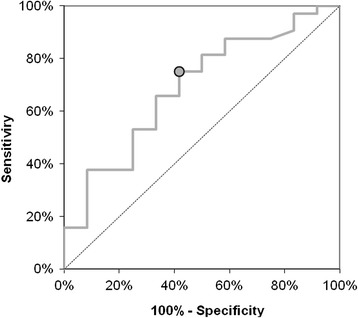
Fatty liver was confirmed in 39 children by ultrasound and in 33 patients by (1)HMRS (19 of them also had increased ALT activity /NAFLD/). Chemerin and vaspin levels were significantly higher in children with NAFLD compared to the control group (n = 30). The concentration of chemerin was significantly higher in children with advanced liver steatosis compared to non-hepatopathic patients (p = 0,02). Significant positive correlations were found between the total liver lipids in (1)HMRS and chemerin (r = 0,33; p = 0,02) and vaspin (r = 0,4; p = 0,006). The ability of serum chemerin (cut-off = 190 ng/ml, Se = 75%, Sp = 58%) to differentiate children with fatty liver in (1)HMRS from those without steatosis was significant (AUC = 0,7, p = 0,04). Omentin and vaspin did not allow a useful prediction to be made.
Chemerin seems to be the most suitable non-invasive biomarker in predicting both intrahepatic lipid content in obese children and advanced liver steatosis in children with NAFLD.
肝脏异位脂质蓄积与胰岛素抵抗的发生密切相关,胰岛素抵抗被认为是非酒精性脂肪性肝病(NAFLD)最重要的危险因素之一。目前的研究表明,脂肪组织是一个重要的内分泌器官,自身能产生和代谢多种生物活性物质,其中脂肪因子起重要作用。经典脂肪因子(如瘦素、脂联素、抵抗素)是脂肪衍生的激素,NAFLD患者血清水平会发生改变。新型脂肪因子在该疾病发病机制中的作用尚不清楚。因此,我们研究的目的是评估NAFLD肥胖儿童血清中趋化素、网膜素和内脏脂肪素的浓度。
45名7 - 17岁的肥胖儿童因疑似肝脏疾病(肝肿大和/或肝脏超声回声增强和/或ALT活性升高)入住我科。排除病毒性肝炎以及自身免疫性和代谢性肝病。测定空腹血清趋化素、网膜素和内脏脂肪素水平。肝脏脂肪变性程度根据萨韦勒穆图法进行超声分级。(1)使用1.5T扫描仪和PRESS序列进行磁共振波谱分析。
39名儿童经超声确诊为脂肪肝,33名经(1)磁共振波谱分析确诊(其中19名ALT活性也升高/NAFLD/)。与对照组(n = 30)相比,NAFLD儿童的趋化素和内脏脂肪素水平显著更高。与无肝病患者相比,晚期肝脏脂肪变性儿童的趋化素浓度显著更高(p = 0.02)。在(1)磁共振波谱分析中,肝脏总脂质与趋化素(r = 0.33;p = 0.02)和内脏脂肪素(r = 0.4;p = 0.006)之间存在显著正相关。血清趋化素(临界值 = 190 ng/ml,敏感性 = 75%,特异性 = 58%)区分(1)磁共振波谱分析中有脂肪肝儿童和无脂肪变性儿童的能力显著(曲线下面积 = 0.7,p = 0.04)。网膜素和内脏脂肪素无法进行有效预测。
趋化素似乎是预测肥胖儿童肝内脂质含量和NAFLD儿童晚期肝脏脂肪变性最合适的非侵入性生物标志物。