Mazure Carolyn M, Weinberger Andrea H, Pittman Brian, Sibon Igor, Swendsen Joel
Department of Psychiatry, Yale University School of Medicine, New Haven, Conn., USA.
Cerebrovasc Dis. 2014;38(4):240-6. doi: 10.1159/000365838. Epub 2014 Nov 13.
Post-stroke depression (PSD) is associated with poor clinical and functional outcomes, and women are likely to experience PSD more than men. Although stress is related to depression, and women report greater emotional reactivity to stressful life events, the link between stress and gender is yet to be examined relative to PSD. Further, electronic momentary assessment (EMA), a mobile technology, has not been used to assess stressful life events and PSD in real time and in the natural environments of daily life. The purpose of the current study was to examine gender differences in the relationship of stress and PSD using EMA.
Individuals admitted to the Stroke Center at the University of Bordeaux were contacted for participation in a prospective study of symptoms and experiences in daily life using ambulatory monitoring. Forty-three post-stroke patients (47% female) completed electronic assessments of life events, perceived stress, and depressive symptoms (i.e., sad mood, anhedonia, fatigue, concentration difficulties, appetite change, negative thoughts, hopelessness) during their daily life for one week. Patients also completed a clinician-administered standardized depression scale at baseline and three-month follow-up.
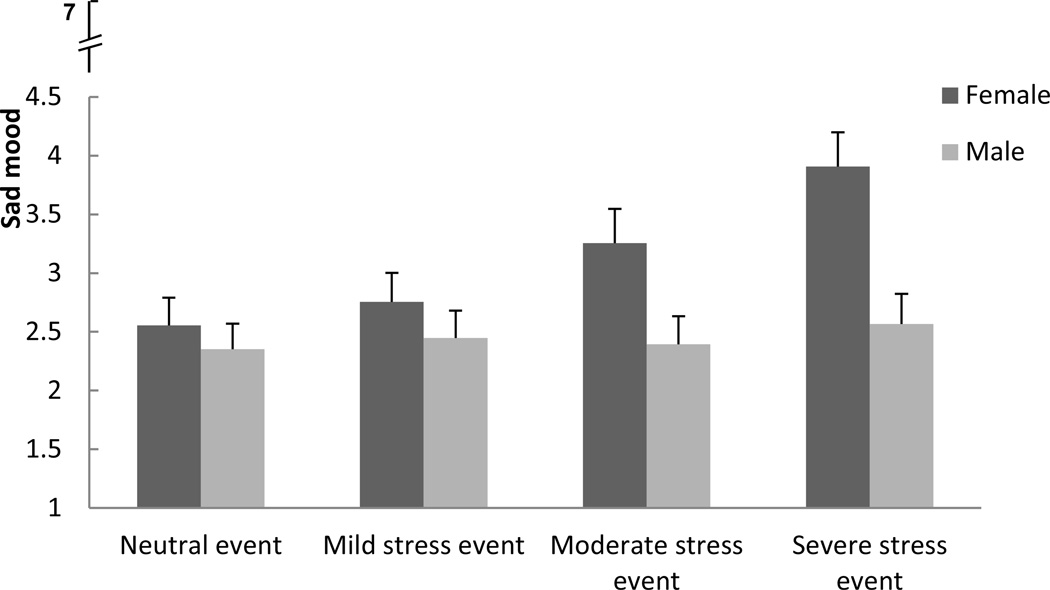
Using EMA, participants responded to 83.7% of the electronic interviews for a total of 1,140 observations across diverse daily life contexts. Stressful events of any degree of negativity were reported at over one-third (37.3%) of all EMA assessments. The severity of depressive symptoms as assessed in daily life through EMA was greater in women following stroke than in men. Further, there was a significant association between EMA-assessed depressive symptoms and daily life stress for women, but not men. This association was due primarily to three specific depressive symptoms: sad mood, fatigue, and appetite change. No difference was observed between men and women in standardized depression assessments administered during clinic visits at baseline or three-month follow-up.
Greater reactivity to stressful life events and a link between stress reactivity and depressive symptoms were found in female as compared to male post-stroke patients. Gender differences in depressive symptoms were identified using EMA data collected during daily life as contrasted with the use of a standard assessment during clinic visits. Mobile technologies may help to identify important real-time behaviors and symptoms that are not observable by standard clinical assessments employed at regular clinic visits. Further, future research should examine the overall and gender-specific benefits of stress-based interventions to reduce the risk of PSD for adults.
中风后抑郁(PSD)与不良的临床和功能预后相关,女性比男性更易患PSD。尽管压力与抑郁有关,且女性对压力性生活事件的情绪反应更强,但相对于PSD而言,压力与性别的关系尚未得到研究。此外,电子即时评估(EMA)作为一种移动技术,尚未被用于在日常生活的自然环境中实时评估压力性生活事件和PSD。本研究的目的是使用EMA来研究压力与PSD关系中的性别差异。
联系了波尔多大学中风中心收治的个体,邀请他们参与一项使用动态监测对日常生活中的症状和经历进行的前瞻性研究。43名中风后患者(47%为女性)在一周的日常生活中完成了对生活事件、感知压力和抑郁症状(即悲伤情绪、快感缺失、疲劳、注意力不集中、食欲改变、消极思维、绝望)的电子评估。患者还在基线和三个月随访时完成了由临床医生管理的标准化抑郁量表评估。
使用EMA,参与者对83.7%的电子访谈做出了回应,在不同的日常生活情境中总共进行了1140次观察。在所有EMA评估中,超过三分之一(37.3%)的评估报告了任何程度消极性的压力事件。通过EMA在日常生活中评估的抑郁症状严重程度在中风后的女性中比男性更大。此外,EMA评估的抑郁症状与女性的日常生活压力之间存在显著关联,但男性不存在这种关联。这种关联主要归因于三种特定的抑郁症状:悲伤情绪、疲劳和食欲改变。在基线或三个月随访的门诊就诊期间进行的标准化抑郁评估中,未观察到男性和女性之间存在差异。
与男性中风后患者相比,女性对压力性生活事件的反应更强,且压力反应与抑郁症状之间存在关联。与门诊就诊时使用标准评估相比,使用日常生活中收集的EMA数据识别出了抑郁症状的性别差异。移动技术可能有助于识别常规门诊就诊时使用的标准临床评估无法观察到的重要实时行为和症状。此外,未来的研究应考察基于压力的干预措施对降低成年人PSD风险的总体和性别特异性益处。