Wang Xiaona, Ye Ping, Cao Ruihua, Yang Xu, Xiao Wenkai, Zhang Yun, Bai Yongyi, Wu Hongmei
Department of Geriatric Cardiology, Chinese PLA General Hospital, Beijing, China.
PLoS One. 2014 Nov 17;9(11):e113148. doi: 10.1371/journal.pone.0113148. eCollection 2014.
Elevated plasma total homocysteine (tHcy) and metabolic syndrome (MetS) are both associated with cardiovascular disease, but the association between tHcy and MetS is not well characterized. The aim of this study was to determine the relationship between tHcy and MetS.
To further estimate the time-dependent association of tHcy and MetS, we analyzed the tHcy level and MetS in 1499 subjects from a 4.8-year longitudinal study in Beijing, People's Republic of China.
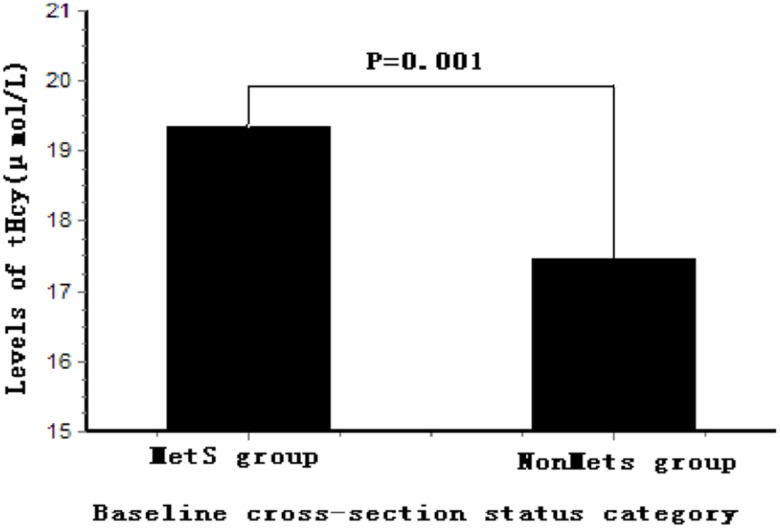
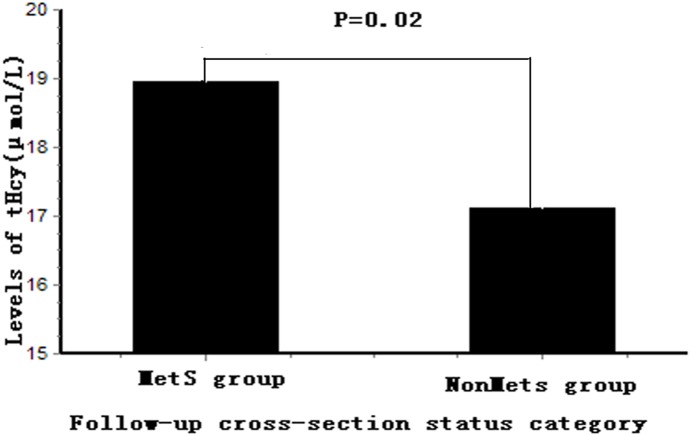
In multiple linear regression analysis, baseline tHcy levels associated with age, BMI, SBP, DBP, LDL-C and Cr independently over 4.8-years follow-up; age, BMI, SBP, DBP and Cr were found to be associated with tHcy levels independently at the end of follow-up. Logistic regression analysis showed that there was no association between the baseline tHcy level and MetS over the 4.8-year follow-up (odds ratio (OR), 1.32; 95% confidence interval (CI), 0.79-2.19; P = 0.282); rather, there was an association only with hypertension as a MetS component (OR, 1.53; 95% CI, 1.06-2.21; P = 0.024). tHcy levels were associated with MetS at both cross-sectional baseline (OR, 1.38; 95% CI, 1.02-1.88; P = 0.038) and cross-sectional follow-up (OR, 1.60; 95% CI, 1.02-2.50; P = 0.041). The tHcy levels of MetS subjects were higher than those of non-MetS subjects at both cross-sectional baseline (19.35 ± 7.92 µmol/L vs. 17.45 ± 6.70 µmol/L, respectively; P = 0.001) and cross-sectional follow-up (18.95 ± 7.15 µmol/L vs. 17.11 ± 5.98 µmol/L, respectively; P = 0.02).
The tHcy level was not predictive of the incidence of MetS; however, it may be a risk factor for hypertension as a MetS component. Furthermore, tHcy levels were associated with MetS at cross-sectional baseline and follow-up, which suggests that a higher level of tHcy might be concomitant with MetS.
血浆总同型半胱氨酸(tHcy)升高和代谢综合征(MetS)均与心血管疾病相关,但tHcy与MetS之间的关联尚未得到充分阐明。本研究旨在确定tHcy与MetS之间的关系。
为进一步评估tHcy与MetS的时间依赖性关联,我们对来自中国北京一项为期4.8年的纵向研究中的1499名受试者的tHcy水平和MetS进行了分析。
在多元线性回归分析中,在4.8年的随访期间,基线tHcy水平分别独立地与年龄、体重指数(BMI)、收缩压(SBP)、舒张压(DBP)、低密度脂蛋白胆固醇(LDL-C)和肌酐(Cr)相关;在随访结束时,发现年龄、BMI、SBP、DBP和Cr分别独立地与tHcy水平相关。逻辑回归分析显示,在4.8年的随访期间,基线tHcy水平与MetS之间无关联(比值比(OR)为1.32;95%置信区间(CI)为0.79 - 2.19;P = 0.282);相反,仅与作为MetS组分的高血压存在关联(OR为1.53;95%CI为1.06 - 2.21;P = 0.024)。在横断面基线(OR为1.38;95%CI为1.02 - 1.88;P = 0.038)和横断面随访(OR为1.60;95%CI为1.02 - 2.50;P = 0.041)时,tHcy水平均与MetS相关。在横断面基线(分别为19.35±7.92μmol/L和17.45±6.70μmol/L;P = 0.001)和横断面随访(分别为18.95±7.15μmol/L和17.11±5.98μmol/L;P = 0.02)时,MetS受试者的tHcy水平均高于非MetS受试者。
tHcy水平不能预测MetS的发生率;然而,它可能是作为MetS组分的高血压的一个危险因素。此外,在横断面基线和随访时tHcy水平均与MetS相关,这表明较高水平的tHcy可能与MetS并存。