Bachanova V, Burns L J, Wang T, Carreras J, Gale R P, Wiernik P H, Ballen K K, Wirk B, Munker R, Rizzieri D A, Chen Y-B, Gibson J, Akpek G, Costa L J, Kamble R T, Aljurf M D, Hsu J W, Cairo M S, Schouten H C, Bacher U, Savani B N, Wingard J R, Lazarus H M, Laport G G, Montoto S, Maloney D G, Smith S M, Brunstein C, Saber W
Blood and Marrow Transplant Program, University of Minnesota, Minneapolis, MN, USA.
1] Center for International Blood and Marrow Transplant Research, Department of Medicine, Medical College of Wisconsin, Milwaukee, WI, USA [2] Division of Biostatistics, Institute for Health and Society, Medical College of Wisconsin, Milwaukee, WI, USA.
Bone Marrow Transplant. 2015 Feb;50(2):197-203. doi: 10.1038/bmt.2014.259. Epub 2014 Nov 17.
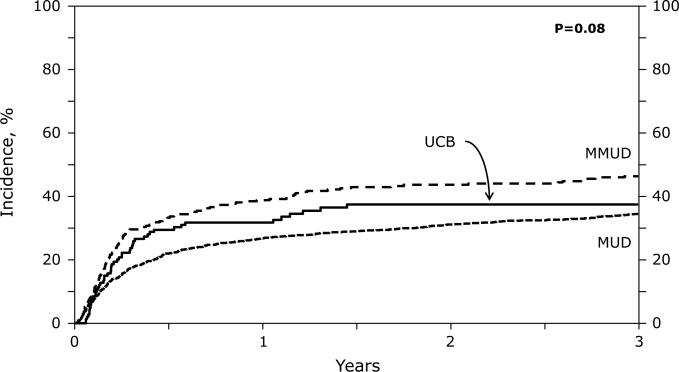
Alternative donor transplantation is increasingly used for high-risk lymphoma patients. We analyzed 1593 transplant recipients (2000-2010) and compared transplant outcomes in recipients of 8/8 allele HLA-A, -B, -C and DRB1 matched unrelated donors (MUDs; n=1176), 7/8 allele HLA mismatched unrelated donors (MMUDs; n=275) and umbilical cord blood donors (1 or 2 units UCB; n=142). Adjusted 3-year non-relapse mortality of MMUD (44%) was higher as compared with MUD (35%; P=0.004), but similar to UCB recipients (37%; P=0.19), although UCB had lower rates of neutrophil and platelet recovery compared with unrelated donor groups. With a median follow-up of 55 months, 3-year adjusted cumulative incidence of relapse was lower after MMUD compared with MUD (25% vs 33%, P=0.003) but similar between UCB and MUD (30% vs 33%; P=0.48). In multivariate analysis, UCB recipients had lower risks of acute and chronic GVHD compared with adult donor groups (UCB vs MUD: hazard ratio (HR)=0.68, P=0.05; HR=0.35; P<0.001). Adjusted 3-year OS was comparable (43% MUD, 37% MMUD and 41% UCB). These data highlight the observation that patients with lymphoma have acceptable survival after alternative donor transplantation. MMUD and UCB can extend the curative potential of allotransplant to patients who lack suitable HLA matched sibling or MUD.
替代供体移植越来越多地用于高危淋巴瘤患者。我们分析了1593例移植受者(2000 - 2010年),并比较了8/8等位基因HLA - A、- B、- C和DRB1匹配的无关供体(MUD;n = 1176)、7/8等位基因HLA不匹配的无关供体(MMUD;n = 275)和脐带血供体(1或2单位脐血;n = 142)受者的移植结局。与MUD(35%;P = 0.004)相比,MMUD调整后的3年非复发死亡率(44%)更高,但与脐血受者(37%;P = 0.19)相似,尽管与无关供体组相比,脐血的中性粒细胞和血小板恢复率较低。中位随访55个月后,与MUD相比,MMUD后3年调整后的累积复发率较低(25%对33%,P = 0.003),但脐血和MUD之间相似(30%对33%;P = 0.48)。在多变量分析中,与成人供体组相比,脐血受者发生急性和慢性移植物抗宿主病的风险较低(脐血对MUD:风险比(HR)= 0.68,P = 0.05;HR = 0.35;P < 0.001)。调整后的3年总生存率相当(MUD为43%,MMUD为37%,脐血为41%)。这些数据突出了这样一个观察结果,即淋巴瘤患者在替代供体移植后有可接受的生存率。MMUD和脐血可以将同种异体移植的治愈潜力扩展到缺乏合适的HLA匹配同胞或MUD的患者。