Cömert Alper, Hyttinen Jari
Tampere University of Technology, Department of Electronics and Communications Engineering, BioMediTech, Tampere, Finland.
Biomed Eng Online. 2014 Nov 18;13:149. doi: 10.1186/1475-925X-13-149.
The motion artifact is an ever-present challenge in the mobile monitoring of surface potentials. Skin-electrode impedance is investigated as an input parameter to detect the motion artifact and to reduce it using various methods. However, the impact of the used impedance measurement frequency on the relationship between measured impedance and the motion artifact and the relationship between the impedance and the motion is not well understood.
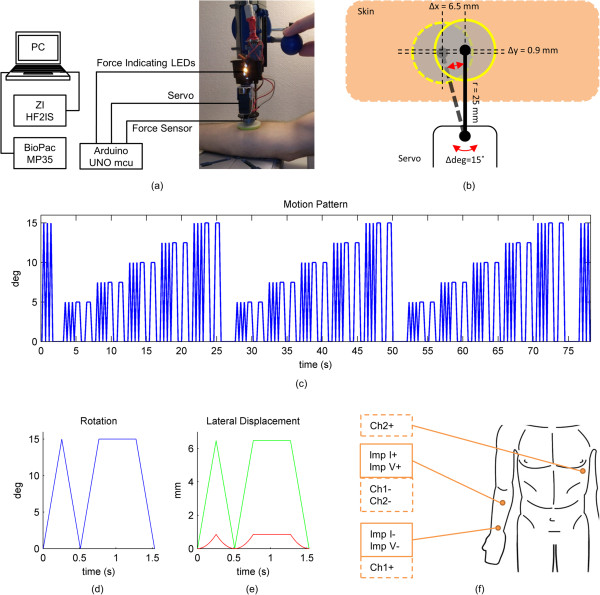
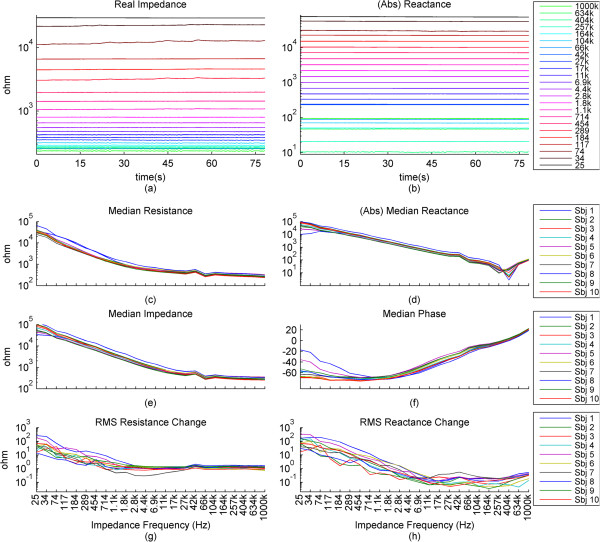
In this paper, for the first time, we present the simultaneous measurement of impedance at 8 current frequencies during the application of controlled motion to the electrode at monitored electrode mounting force. Three interwoven frequency groupings are used to obtain a spectrum of 24 frequencies between 25 Hz and 1 MHz for ten volunteers. Consequently, the surface potential and one channel of ECG are measured from the electrode subject to controlled motion. The signals are then analyzed in time and frequency domain.
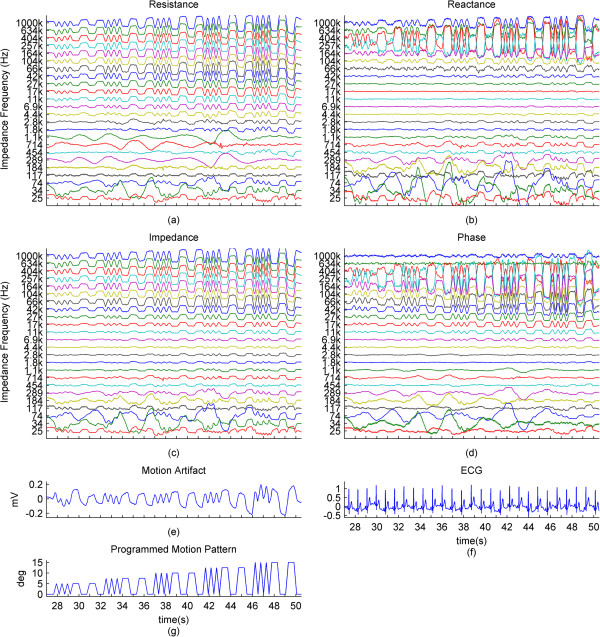
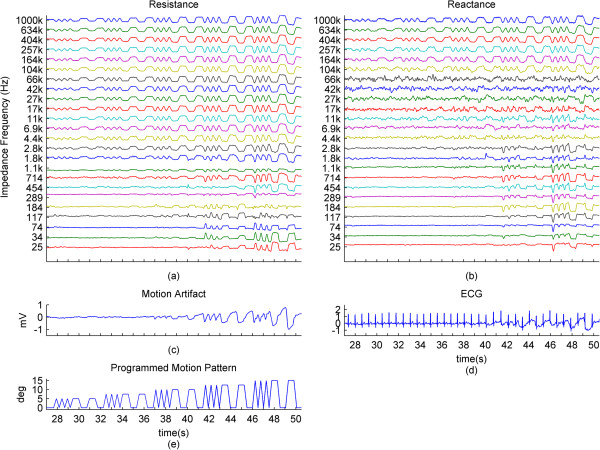
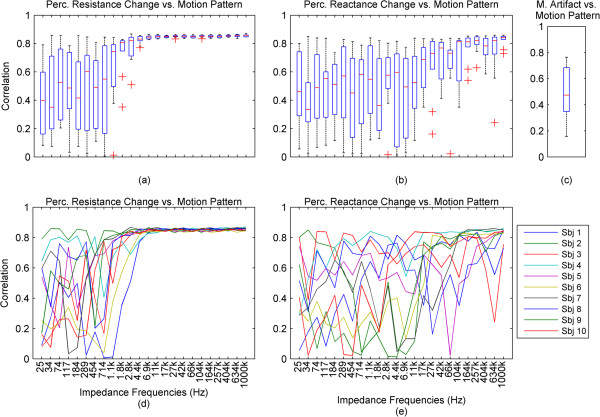
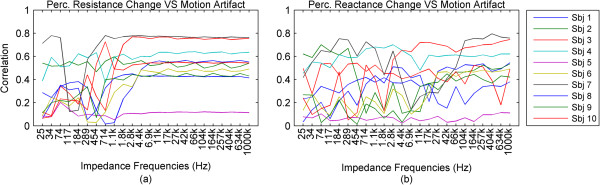
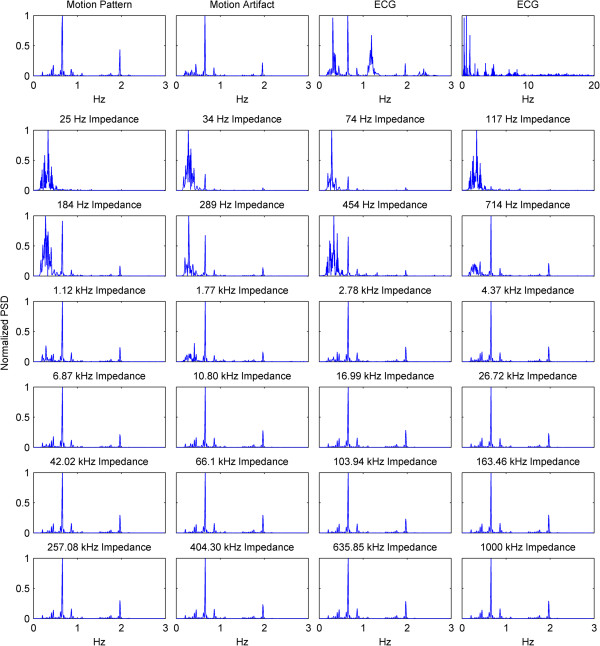
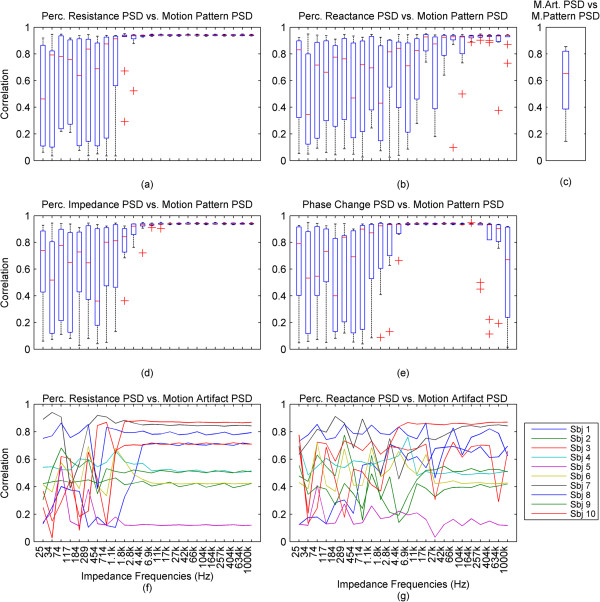
The results show that the different frequencies of impedance measurements do not reflect the motion in the same manner. The best correlation between impedance and the applied motion was seen at impedance current frequencies above 17 kHz. For resistance this relationship existed for frequencies above 11 kHz, Reactance did not show good time domain correlation, but had good frequency domain correlation at frequencies higher than 42 kHz. Overall, we found that the impedance signal correlated well with the applied motion; however impedance had lower correlation to actual motion artifact signal.
Based on our results, we can conclude that the current frequency used for the impedance measurement has a great effect on the relationship of the measurement to the applied motion and its relationship with the resulting motion artifact. Therefore, when flat textile contact biopotential electrodes are used, frequencies higher than 17 kHz are best suited for impedance measurements intended for the estimation of electrode motion or motion artifact. For resistance, the best frequencies to use are higher than 11 kHz.
运动伪迹是体表电位移动监测中一直存在的挑战。皮肤 - 电极阻抗作为一个输入参数进行研究,以检测运动伪迹并采用各种方法对其进行减少。然而,所使用的阻抗测量频率对测量阻抗与运动伪迹之间的关系以及阻抗与运动之间的关系的影响尚未得到充分理解。
在本文中,我们首次展示了在以监测电极安装力向电极施加受控运动期间,同时在8个电流频率下测量阻抗。使用三个交织的频率分组,为十名志愿者获得25Hz至1MHz之间的24个频率的频谱。因此,从经受受控运动的电极测量体表电位和心电图的一个通道。然后在时域和频域中对信号进行分析。
结果表明,不同频率的阻抗测量对运动的反映方式不同。在高于17kHz的阻抗电流频率下,阻抗与施加的运动之间的相关性最佳。对于电阻,这种关系在高于11kHz的频率下存在,电抗在时域中没有显示出良好的相关性,但在高于42kHz的频率下具有良好的频域相关性。总体而言,我们发现阻抗信号与施加的运动相关性良好;然而,阻抗与实际运动伪迹信号的相关性较低。
基于我们的结果,我们可以得出结论,用于阻抗测量的电流频率对测量与施加运动之间的关系及其与产生的运动伪迹之间的关系有很大影响。因此,当使用扁平织物接触生物电位电极时,高于17kHz的频率最适合用于旨在估计电极运动或运动伪迹的阻抗测量。对于电阻,最佳使用频率高于11kHz。