Liu Xiao, Wang Zhenze, Zhao Ping, Fan Zhanming, Sun Anqiang, Zhan Fan, Fan Yubo, Deng Xiaoyan
Key Laboratory for Biomechanics and Mechanobiology of the Ministry of Education, School of Biological Science and Medical Engineering, Beihang University, Beijing, China.
Radiologic Department, Beijing Anzhen Hospital, Capital Medical University, Beijing, China.
PLoS One. 2014 Nov 18;9(11):e112395. doi: 10.1371/journal.pone.0112395. eCollection 2014.
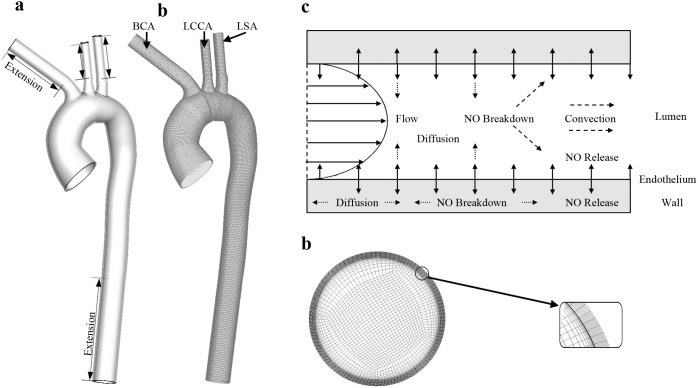
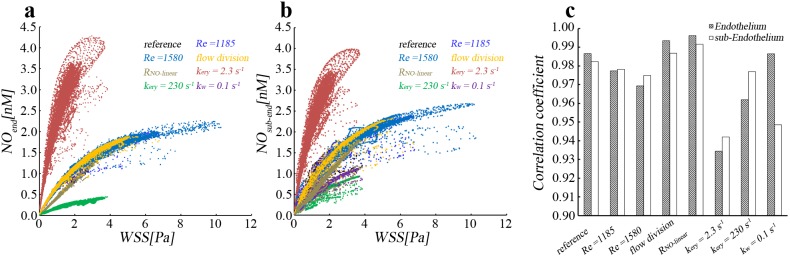
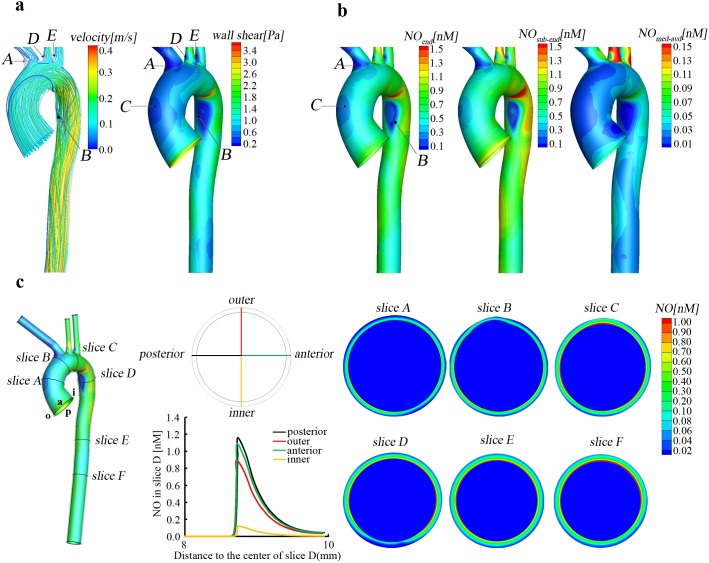
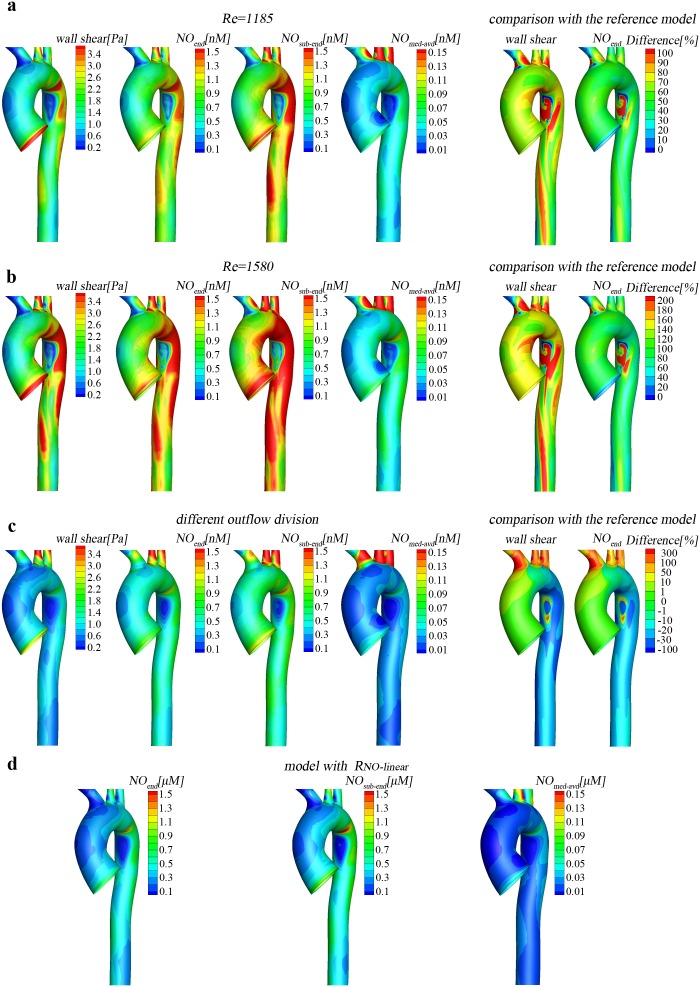
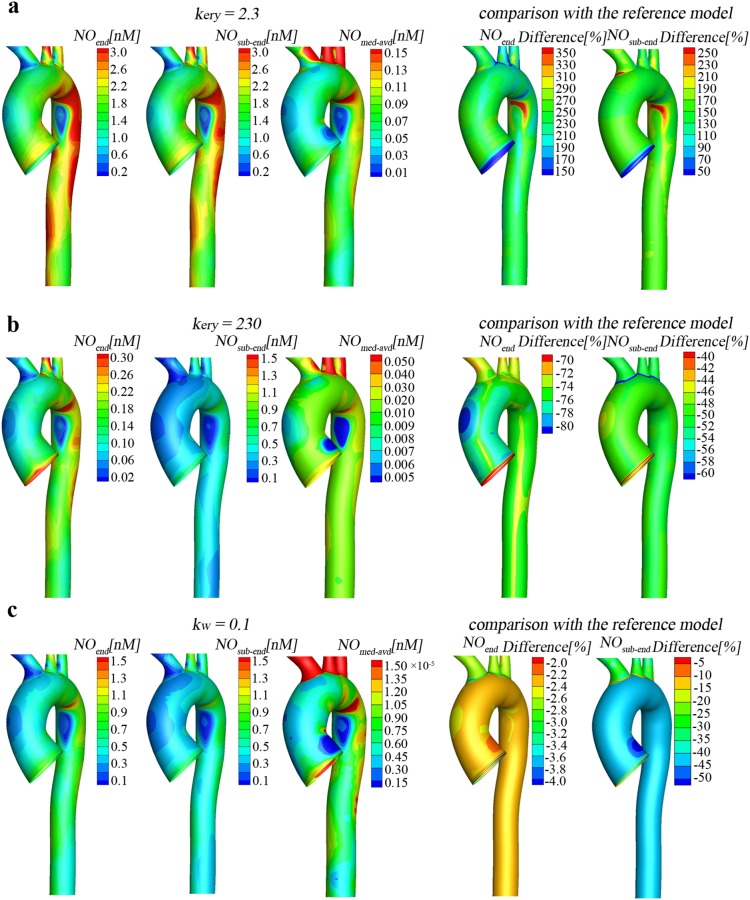
Despite the crucial role of nitric oxide (NO) in the homeostasis of the vasculature, little quantitative information exists concerning NO transport and distribution in medium and large-sized arteries where atherosclerosis and aneurysm occur and hemodynamics is complex. We hypothesized that local hemodynamics in arteries may govern NO transport and affect the distribution of NO in the arteries, hence playing an important role in the localization of vascular diseases. To substantiate this hypothesis, we presented a lumen/wall model of the human aorta based on its MRI images to simulate the production, transport and consumption of NO in the arterial lumen and within the aortic wall. The results demonstrated that the distribution of NO in the aorta was quite uneven with remarkably reduced NO bioavailability in regions of disturbed flow, and local hemodynamics could affect NO distribution mainly via flow dependent NO production rate of endothelium. In addition, erythrocytes in the blood could moderately modulate NO concentration in the aorta, especially at the endothelial surface. However, the reaction of NO within the wall could only slightly affect NO concentration on the luminal surface, but strongly reduce NO concentration within the aortic wall. A strong positive correlation was revealed between wall shear stress and NO concentration, which was affected by local hemodynamics and NO reaction rate. In conclusion, the distribution of NO in the aorta may be determined by local hemodynamics and modulated differently by NO scavengers in the lumen and within the wall.
尽管一氧化氮(NO)在脉管系统的稳态中起着关键作用,但关于NO在发生动脉粥样硬化和动脉瘤且血流动力学复杂的中大型动脉中的运输和分布,几乎没有定量信息。我们推测,动脉中的局部血流动力学可能控制NO的运输并影响NO在动脉中的分布,从而在血管疾病的定位中发挥重要作用。为了证实这一假设,我们基于人类主动脉的MRI图像提出了一个管腔/壁模型,以模拟动脉管腔和主动脉壁内NO的产生、运输和消耗。结果表明,NO在主动脉中的分布非常不均匀,在血流紊乱区域NO的生物利用度显著降低,局部血流动力学主要通过内皮细胞依赖血流的NO产生率来影响NO的分布。此外,血液中的红细胞可以适度调节主动脉中的NO浓度,尤其是在内皮表面。然而,NO在壁内的反应只能轻微影响管腔表面的NO浓度,但会强烈降低主动脉壁内的NO浓度。壁面剪应力与NO浓度之间存在很强的正相关,这受到局部血流动力学和NO反应速率的影响。总之,NO在主动脉中的分布可能由局部血流动力学决定,并受到管腔和壁内NO清除剂的不同调节。