Walsh Judi, Hepper Erica G, Marshall Benjamin J
School of Psychology, University of East Anglia, Lawrence Stenhouse Building, Norwich Research Park, Norwich, UK.
School of Psychology, University of Surrey, Guilford, UK.
BMC Pregnancy Childbirth. 2014 Nov 19;14:383. doi: 10.1186/s12884-014-0383-1.
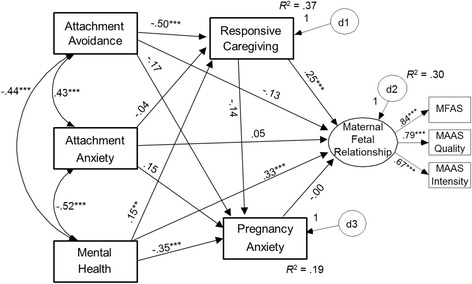
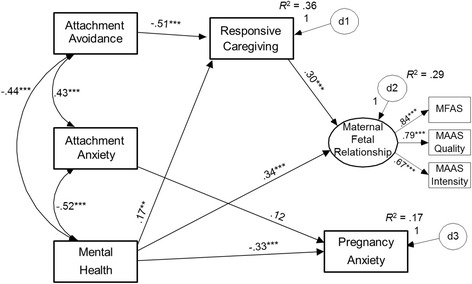
Maternal-fetal relationships have been associated with psychosocial outcomes for women and children, but there has been a lack of conceptual clarity about the nature of the maternal relationship with the unborn child, and inconsistent findings assessing its predictors. We proposed and tested a model whereby maternal-fetal relationship quality was predicted by factors relating to the quality of the couple relationship and psychological health. We hypothesized that the contribution of individual differences in romantic attachment shown in past research would be mediated by romantic caregiving responsiveness, as maternal-fetal relationships reflect the beginnings of the caregiving system.
258 women in pregnancy (13, 23, and 33-weeks gestation) completed online measures of attachment to partner, caregiving responsiveness to partner, mental health, and thoughts about their unborn baby. Structural equation modeling was used to test a model of maternal-fetal relationships.
Maternal-fetal relationship quality was higher for women at 23-weeks than 13-weeks gestation. Women in first pregnancies had higher self-reported scores of psychological functioning and quality of maternal-fetal relationships than women in subsequent pregnancies. Structural equation models indicated that the quality of the maternal-fetal relationship was best predicted by romantic caregiving responsiveness to partner and women's own psychological health, and that the association between adult romantic attachment avoidance and maternal-fetal relationships was fully mediated by caregiving responsiveness to partner, even after controlling for other factors. These data support the hypothesis that maternal-fetal relationships better reflect the operation of the caregiving system than the care-seeking (i.e., attachment) system.
Models of maternal-fetal relationships and interventions with couples should consider the role of caregiving styles of mothers to partners and the relationship between expectant parents alongside other known predictors, particularly psychological health.
母婴关系与妇女和儿童的心理社会结局相关,但对于母亲与未出生胎儿关系的本质,在概念上缺乏清晰性,且评估其预测因素的研究结果并不一致。我们提出并检验了一个模型,即母婴关系质量由与夫妻关系质量和心理健康相关的因素预测。我们假设,过往研究中显示的浪漫依恋个体差异的作用将通过浪漫照顾反应性来介导,因为母婴关系反映了照顾系统的开端。
258名孕期女性(妊娠13周、23周和33周)完成了关于对伴侣的依恋、对伴侣的照顾反应性、心理健康以及对未出生婴儿的想法的在线测量。采用结构方程模型来检验母婴关系模型。
妊娠23周的女性的母婴关系质量高于妊娠13周的女性。初产妇自我报告的心理功能得分和母婴关系质量高于经产妇。结构方程模型表明,母婴关系质量最好由对伴侣的浪漫照顾反应性和女性自身的心理健康来预测,并且即使在控制其他因素后,成人浪漫依恋回避与母婴关系之间的关联也完全由对伴侣的照顾反应性介导。这些数据支持了以下假设:与寻求关爱(即依恋)系统相比,母婴关系能更好地反映照顾系统的运作。
母婴关系模型以及针对夫妻的干预措施应考虑母亲对伴侣的照顾方式的作用,以及准父母之间的关系,同时兼顾其他已知的预测因素,尤其是心理健康。