Zhang YingJun, Chen YuYang, Chen DongTai, Jiang Yu, Huang Wan, Ouyang HanDong, Xing Wei, Zeng MuSheng, Xie XiaoMing, Zeng Weian
Anesthesiology Department, State Key Laboratory in South China, Sun Yat-Sen University Cancer Center, 651 Dongfeng East Road, Guangzhou, PR China.
BMC Cancer. 2014 Nov 18;14:844. doi: 10.1186/1471-2407-14-844.
Previous studies have shown that preoperative anemia is correlated with the prognoses of various solid tumors. This study was performed to determine the effect of preoperative anemia on relapse and survival in patients with breast cancer.
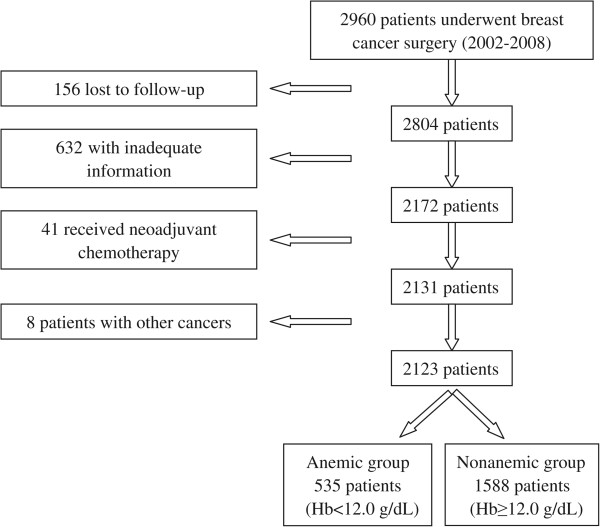
A total of 2960 patients with breast cancer who underwent surgery between 2002 and 2008 at the Sun Yat-sen University Cancer Center (Guangzhou, PR China) were evaluated in a retrospective analysis. A total of 2123 qualified patients were divided into an anemic group [hemoglobin (Hb) < 12.0 g/dL, N = 535)] and a nonanemic group (Hb ≥ 12.0 g/dL, N = 1588). The effects of anemia on local relapse-free survival (LRFS), lymph node metastasis-free survival (LNMFS), distant metastasis-free survival (DMFS), relapse-free survival (RFS), and overall survival (OS) were assessed using Kaplan-Meier analysis. Independent prognostic factors were identified in the final multivariate Cox proportional hazards regression model.
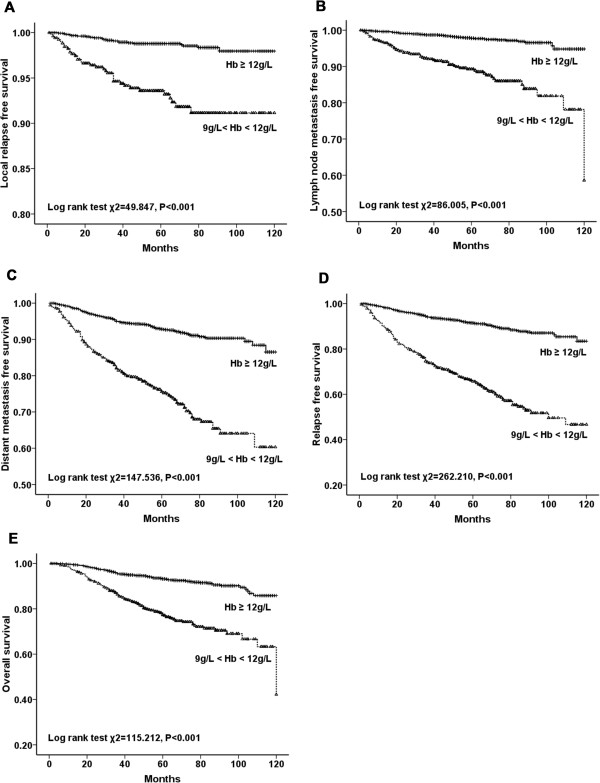
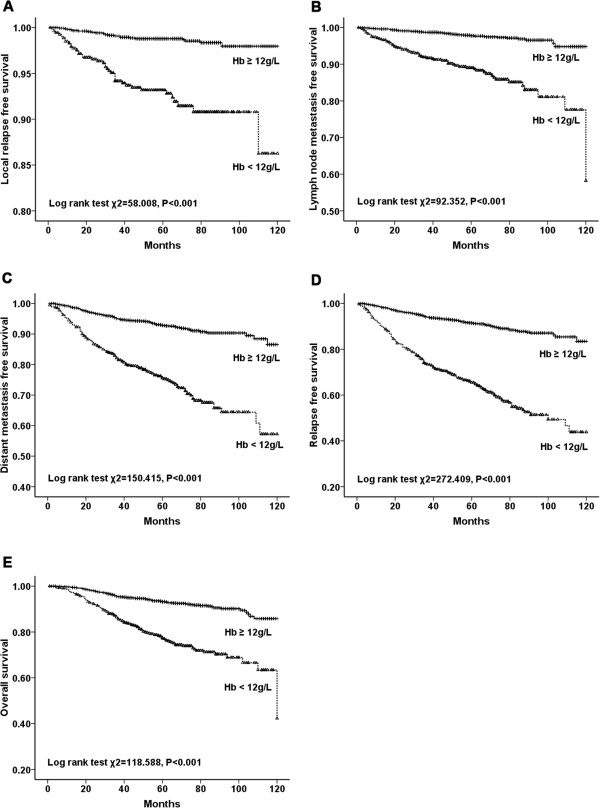
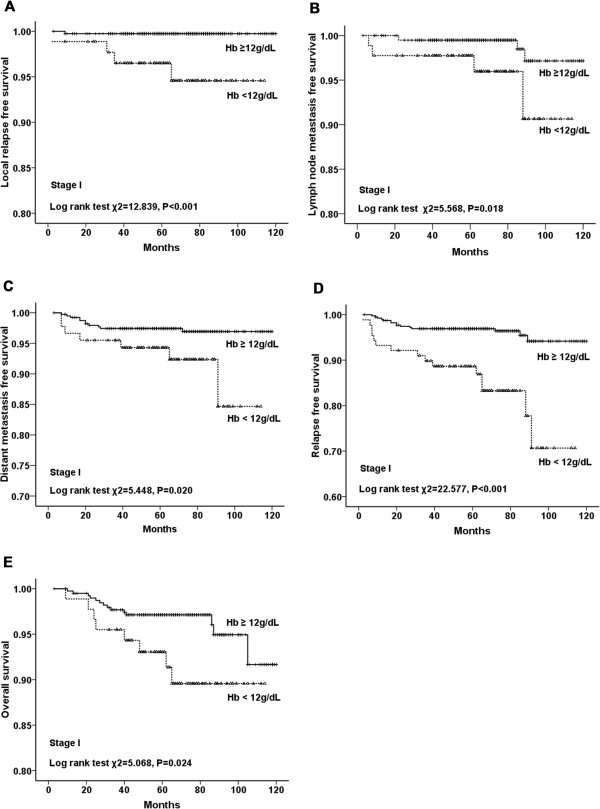
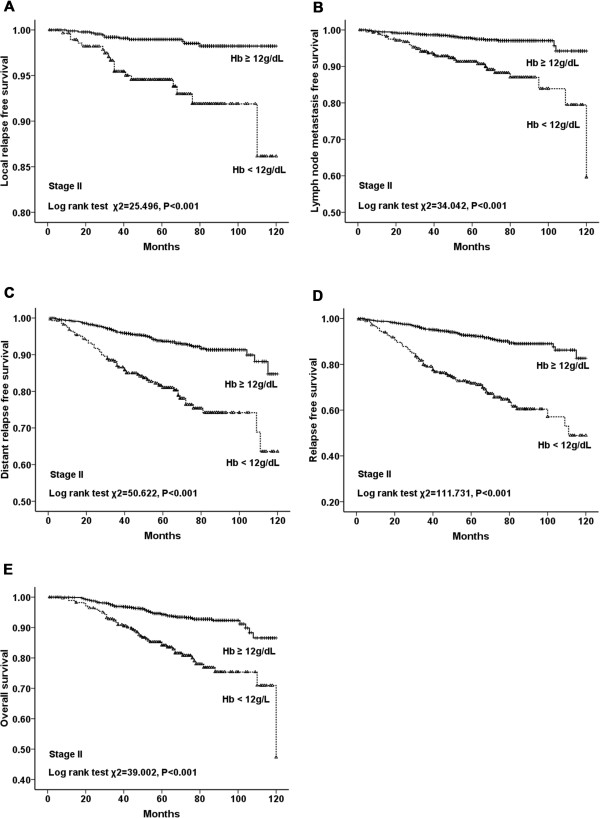
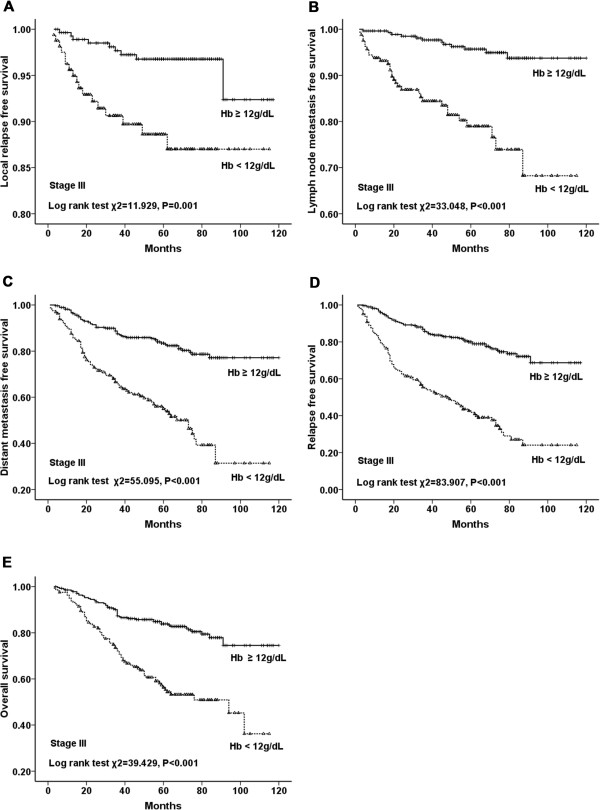
Among the 2123 women who qualified for the analysis, 535 (25.2%) had a Hb level < 12.0 g/dL. The Kaplan-Meier curves showed that anemic patients had worse LRFS, LNMFS, DMFS, RFS, and OS than nonanemic patients, even in the same clinical stage of breast cancer. Cox proportional hazards regression model indicated that preoperative anemia was an independent prognostic factor of LRFS, LNMFS, DMFS, RFS, and OS for patients with breast cancer.
Preoperative anemia was independently associated with poor prognosis of patients with breast cancer.
既往研究表明,术前贫血与多种实体瘤的预后相关。本研究旨在确定术前贫血对乳腺癌患者复发和生存的影响。
对2002年至2008年期间在中山大学肿瘤防治中心(中国广州)接受手术的2960例乳腺癌患者进行回顾性分析。将2123例符合条件的患者分为贫血组[血红蛋白(Hb)<12.0 g/dL,N = 535]和非贫血组(Hb≥12.0 g/dL,N = 1588)。采用Kaplan-Meier分析评估贫血对局部无复发生存率(LRFS)、无淋巴结转移生存率(LNMFS)、无远处转移生存率(DMFS)、无复发生存率(RFS)和总生存率(OS)的影响。在最终的多变量Cox比例风险回归模型中确定独立预后因素。
在2123例符合分析条件的女性中,535例(25.2%)的Hb水平<12.0 g/dL。Kaplan-Meier曲线显示,即使在相同临床分期的乳腺癌患者中,贫血患者的LRFS、LNMFS、DMFS、RFS和OS也比非贫血患者差。Cox比例风险回归模型表明,术前贫血是乳腺癌患者LRFS、LNMFS、DMFS、RFS和OS的独立预后因素。
术前贫血与乳腺癌患者的不良预后独立相关。