Zhang X, Pérez-Rodríguez P, Semagn K, Beyene Y, Babu R, López-Cruz M A, San Vicente F, Olsen M, Buckler E, Jannink J-L, Prasanna B M, Crossa J
International Maize and Wheat Improvement Center (CIMMYT), Mexico, Mexico.
Colegio de Postgraduados, Montecillo, Estado de Mexico, Mexico.
Heredity (Edinb). 2015 Mar;114(3):291-9. doi: 10.1038/hdy.2014.99. Epub 2014 Nov 19.
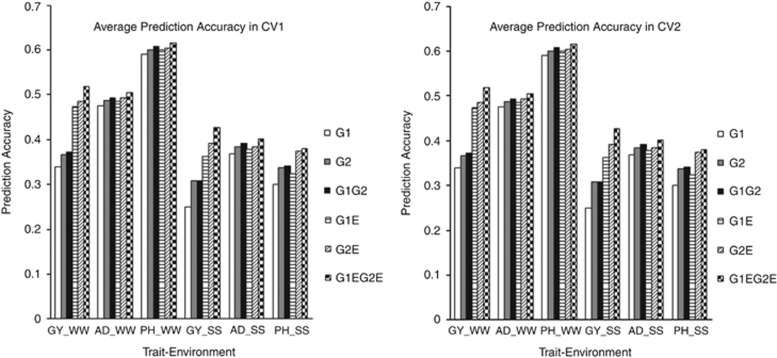
One of the most important applications of genomic selection in maize breeding is to predict and identify the best untested lines from biparental populations, when the training and validation sets are derived from the same cross. Nineteen tropical maize biparental populations evaluated in multienvironment trials were used in this study to assess prediction accuracy of different quantitative traits using low-density (200 markers) and genotyping-by-sequencing (GBS) single-nucleotide polymorphisms (SNPs), respectively. An extension of the Genomic Best Linear Unbiased Predictor that incorporates genotype × environment (GE) interaction was used to predict genotypic values; cross-validation methods were applied to quantify prediction accuracy. Our results showed that: (1) low-density SNPs (200 markers) were largely sufficient to get good prediction in biparental maize populations for simple traits with moderate-to-high heritability, but GBS outperformed low-density SNPs for complex traits and simple traits evaluated under stress conditions with low-to-moderate heritability; (2) heritability and genetic architecture of target traits affected prediction performance, prediction accuracy of complex traits (grain yield) were consistently lower than those of simple traits (anthesis date and plant height) and prediction accuracy under stress conditions was consistently lower and more variable than under well-watered conditions for all the target traits because of their poor heritability under stress conditions; and (3) the prediction accuracy of GE models was found to be superior to that of non-GE models for complex traits and marginal for simple traits.
当训练集和验证集来自同一杂交组合时,基因组选择在玉米育种中最重要的应用之一是预测和鉴定双亲群体中未经测试的最佳品系。本研究使用了在多环境试验中评估的19个热带玉米双亲群体,分别使用低密度(约200个标记)和简化基因组测序(GBS)单核苷酸多态性(SNP)来评估不同数量性状的预测准确性。使用包含基因型×环境(GE)互作的基因组最佳线性无偏预测器扩展来预测基因型值;采用交叉验证方法来量化预测准确性。我们的结果表明:(1)对于具有中到高遗传力的简单性状,低密度SNP(约200个标记)在双亲玉米群体中基本足以获得良好的预测,但对于复杂性状和在低到中等遗传力的胁迫条件下评估的简单性状,GBS的表现优于低密度SNP;(2)目标性状的遗传力和遗传结构影响预测性能,复杂性状(籽粒产量)的预测准确性始终低于简单性状(抽雄期和株高),并且由于胁迫条件下遗传力较差,所有目标性状在胁迫条件下的预测准确性始终低于且比充分灌溉条件下更具变异性;(3)对于复杂性状,GE模型的预测准确性优于非GE模型,对于简单性状则略优。