Barón Anna E, Asdigian Nancy L, Gonzalez Victoria, Aalborg Jenny, Terzian Tamara, Stiegmann Regan A, Torchia Enrique C, Berwick Marianne, Dellavalle Robert P, Morelli Joseph G, Mokrohisky Stefan T, Crane Lori A, Box Neil F
Department of Biostatistics and Informatics, Colorado School of Public Health, University of Colorado Anschutz Medical Campus, Aurora, Colorado.
Department of Community and Behavioral Health, Colorado School of Public Health, University of Colorado Anschutz Medical Campus, Aurora, Colorado.
Cancer Epidemiol Biomarkers Prev. 2014 Dec;23(12):2829-39. doi: 10.1158/1055-9965.EPI-14-0633.
Melanocytic nevi (moles) and freckles are well known biomarkers of melanoma risk, and they are influenced by similar UV light exposures and genetic susceptibilities to those that increase melanoma risk. Nevertheless, the selective interactions between UV exposures and nevus and freckling genes remain largely undescribed.
We conducted a longitudinal study from ages 6 through 10 years in 477 Colorado children who had annual information collected for sun exposure, sun protection behaviors, and full body skin exams. MC1R and HERC2/OCA2 rs12913832 were genotyped and linear mixed models were used to identify main and interaction effects.
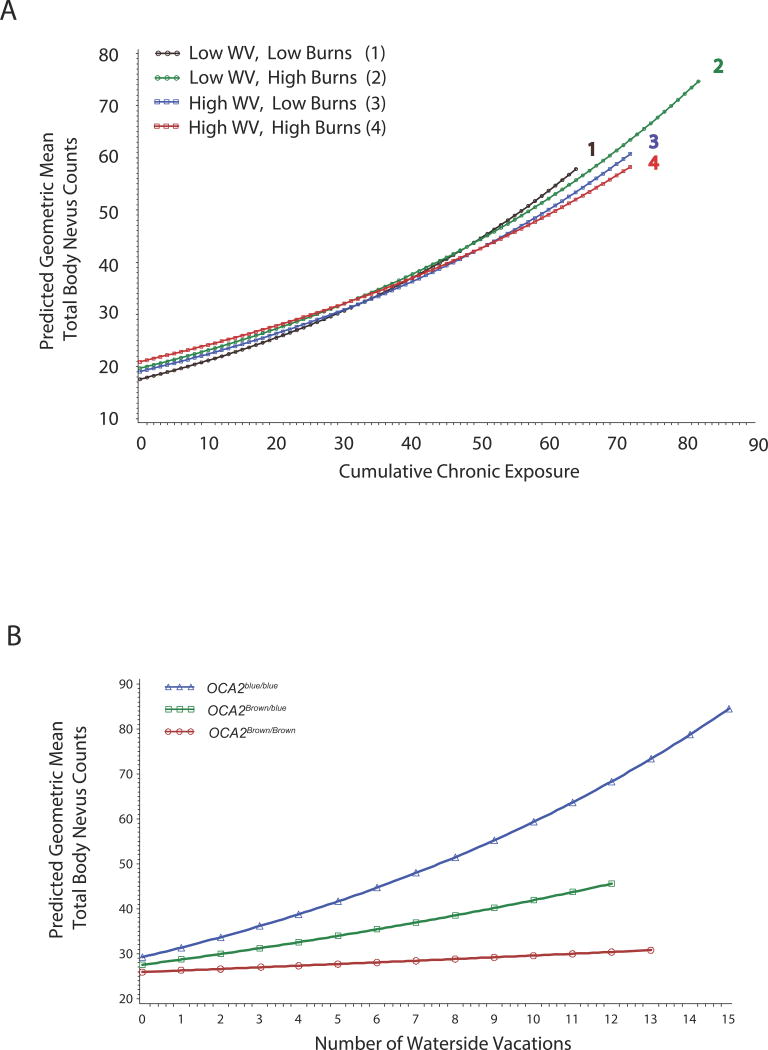
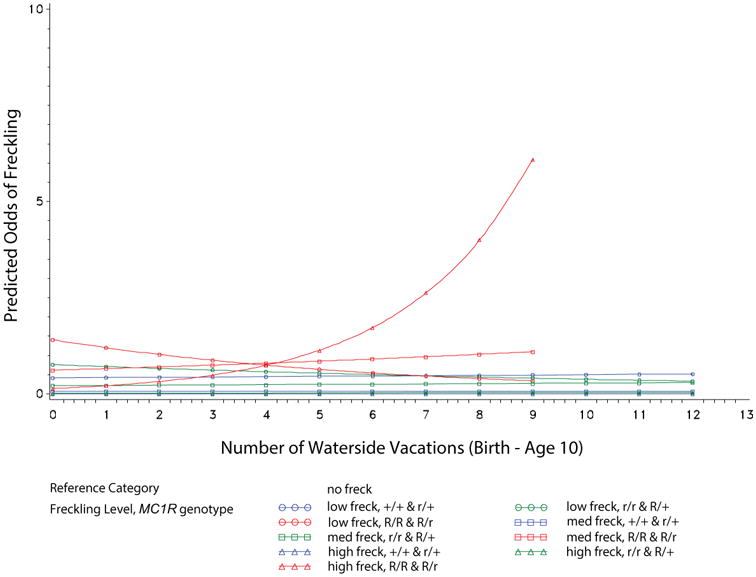
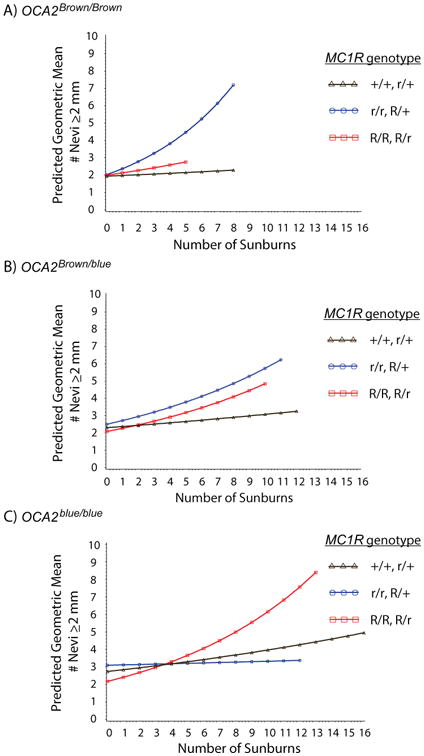
All measures of sun exposure (chronic, sunburns, and waterside vacations) contributed to total nevus counts, and cumulative chronic exposure acted as the major driver of nevus development. Waterside vacations strongly increased total nevus counts in children with rs12913832 blue eye color alleles and facial freckling scores in those with MC1R red hair color variants. Sunburns increased the numbers of larger nevi (≥2 mm) in subjects with certain MC1R and rs12913832 genotypes.
Complex interactions between different UV exposure profiles and genotype combinations determine nevus numbers and size, and the degree of facial freckling.
Our findings emphasize the importance of implementing sun-protective behavior in childhood regardless of genetic make-up, although children with particular genetic variants may benefit from specifically targeted preventive measures to counteract their inherent risk of melanoma. Moreover, we demonstrate, for the first time, that longitudinal studies are a highly powered tool to uncover new gene-environment interactions that increase cancer risk.
黑素细胞痣(痣)和雀斑是黑色素瘤风险的著名生物标志物,它们受到与增加黑色素瘤风险的紫外线暴露和遗传易感性相似的影响。然而,紫外线暴露与痣和雀斑基因之间的选择性相互作用在很大程度上仍未得到描述。
我们对科罗拉多州的477名儿童进行了一项从6岁到10岁的纵向研究,这些儿童每年收集有关阳光暴露、防晒行为和全身皮肤检查的信息。对MC1R和HERC2/OCA2 rs12913832进行基因分型,并使用线性混合模型来确定主要和相互作用效应。
所有阳光暴露指标(长期暴露、晒伤和海滨度假)都导致痣总数增加,累积长期暴露是痣发展的主要驱动因素。海滨度假使携带rs12913832蓝眼颜色等位基因的儿童痣总数大幅增加,使携带MC1R红发颜色变体的儿童面部雀斑评分增加。晒伤使具有某些MC1R和rs12913832基因型的受试者中较大痣(≥2毫米)的数量增加。
不同紫外线暴露模式与基因型组合之间的复杂相互作用决定了痣的数量和大小以及面部雀斑程度。
我们的研究结果强调了在儿童时期实施防晒行为的重要性,无论基因构成如何,尽管具有特定基因变体的儿童可能受益于针对性的预防措施,以抵消其固有的黑色素瘤风险。此外,我们首次证明,纵向研究是揭示增加癌症风险的新基因-环境相互作用的强大工具。