Hambali Nur Ashikyn, Yahaya Hafizal, Mahmood Mohamad Rusop, Terasako Tomoaki, Hashim Abdul Manaf
Malaysia-Japan International Institute of Technology, Universiti Teknologi Malaysia, Jalan Semarak, Kuala Lumpur 54100, Malaysia.
Faculty of Electrical Engineering, Universiti Teknologi MARA, Shah Alam, 40450 Selangor, Malaysia.
Nanoscale Res Lett. 2014 Nov 11;9(1):609. doi: 10.1186/1556-276X-9-609. eCollection 2014.
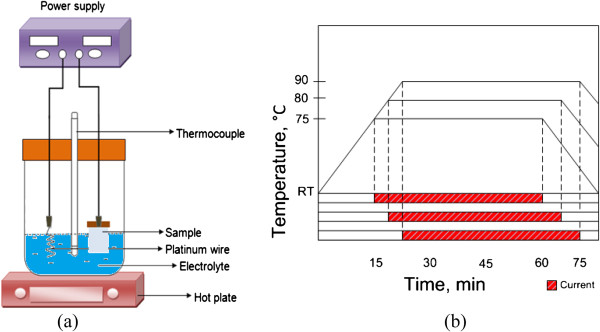
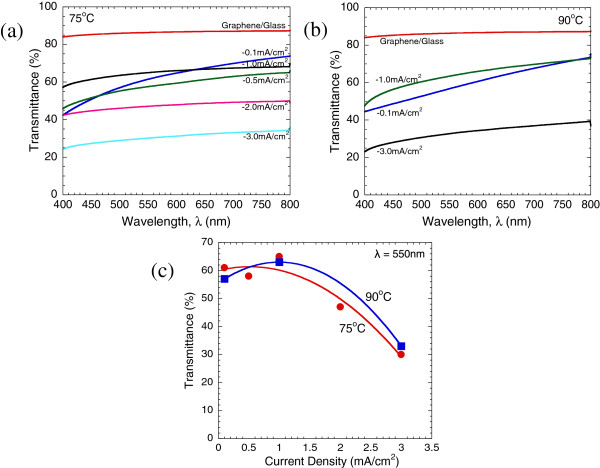
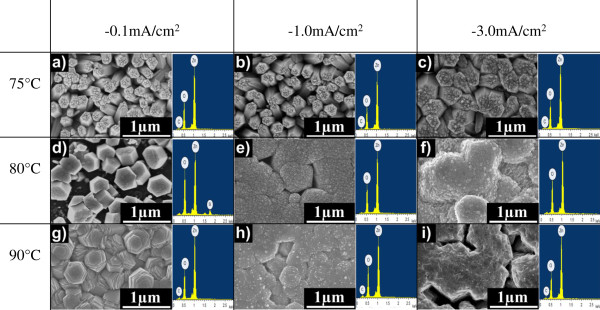
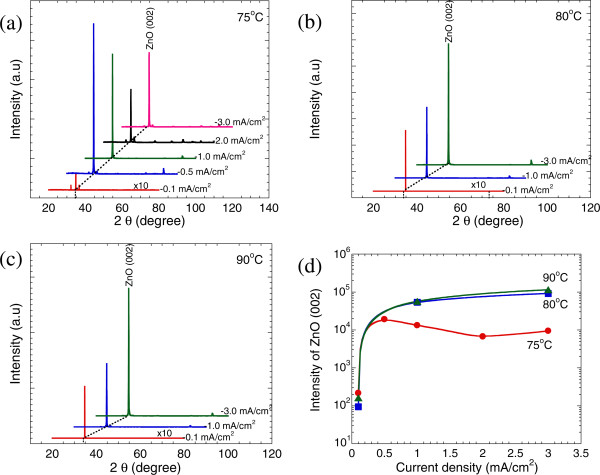
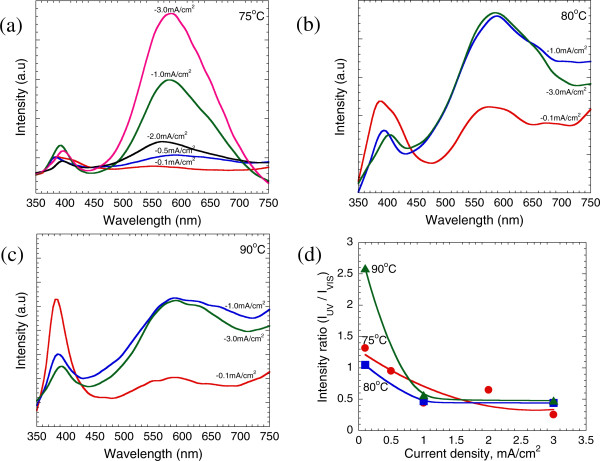
The electrochemical growth of zinc oxide (ZnO) nanostructures on graphene on glass using zinc nitrate hexahydrate was studied. The effects of current densities and temperatures on the morphological, structural, and optical properties of the ZnO structures were studied. Vertically aligned nanorods were obtained at a low temperature of 75°C, and the diameters increased with current density. Growth temperature seems to have a strong effect in generating well-defined hexagonal-shape nanorods with a smooth top edge surface. A film-like structure was observed for high current densities above -1.0 mA/cm(2) and temperatures above 80°C due to the coalescence between the neighboring nanorods with large diameter. The nanorods grown at a temperature of 75°C with a low current density of -0.1 mA/cm(2) exhibited the highest density of 1.45 × 10(9) cm(-2). X-ray diffraction measurements revealed that the grown ZnO crystallites were highly oriented along the c-axis. The intensity ratio of the ultraviolet (UV) region emission to the visible region emission, I UV/I VIS, showed a decrement with the current densities for all grown samples. The samples grown at the current density below -0.5 mA/cm(2) showed high I UV/I VIS values closer to or higher than 1.0, suggesting their fewer structural defects. For all the ZnO/graphene structures, the high transmittance up to 65% was obtained at the light wavelength of 550 nm. Structural and optical properties of the grown ZnO structures seem to be effectively controlled by the current density rather than the growth temperature. ZnO nanorod/graphene hybrid structure on glass is expected to be a promising structure for solar cell which is a conceivable candidate to address the global need for an inexpensive alternative energy source.
研究了使用六水合硝酸锌在玻璃上的石墨烯上进行氧化锌(ZnO)纳米结构的电化学生长。研究了电流密度和温度对ZnO结构的形态、结构和光学性质的影响。在75°C的低温下获得了垂直排列的纳米棒,其直径随电流密度增加。生长温度似乎对生成具有光滑顶部边缘表面的明确六边形纳米棒有很强的影响。由于相邻大直径纳米棒之间的聚结,在高于-1.0 mA/cm²的高电流密度和高于80°C的温度下观察到薄膜状结构。在75°C温度和-0.1 mA/cm²的低电流密度下生长的纳米棒表现出最高密度,为1.45×10⁹ cm⁻²。X射线衍射测量表明,生长的ZnO微晶沿c轴高度取向。对于所有生长的样品,紫外(UV)区域发射与可见区域发射的强度比I UV/I VIS随着电流密度而降低。在低于-0.5 mA/cm²的电流密度下生长的样品显示出接近或高于1.0的高I UV/I VIS值,表明其结构缺陷较少。对于所有ZnO/石墨烯结构,在550 nm的光波长下获得了高达65%的高透过率。生长的ZnO结构的结构和光学性质似乎由电流密度而非生长温度有效控制。玻璃上的ZnO纳米棒/石墨烯混合结构有望成为太阳能电池的一种有前途的结构,这是满足全球对廉价替代能源需求的一个可设想的候选结构。