Bradshaw Catherine P, Waasdorp Tracy E, O'Brennan Lindsey M
Johns Hopkins Center for the Prevention of Youth Violence, Johns Hopkins Bloomberg School of Public Health.
J Educ Psychol. 2013 Aug;105(3):839-849. doi: 10.1037/a0032091.
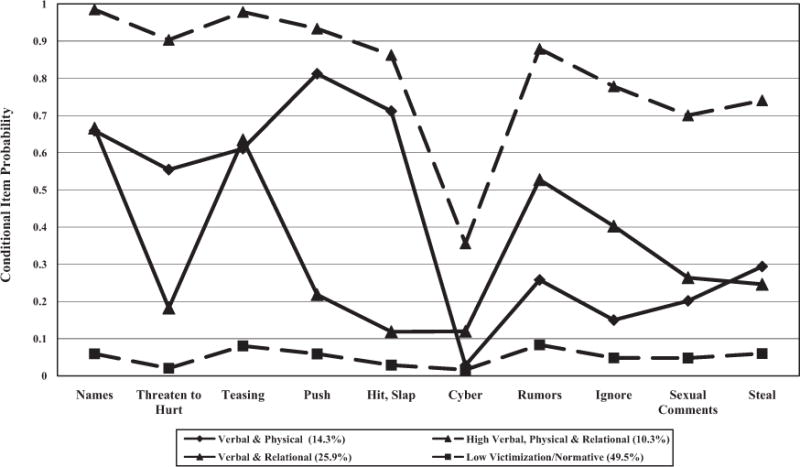
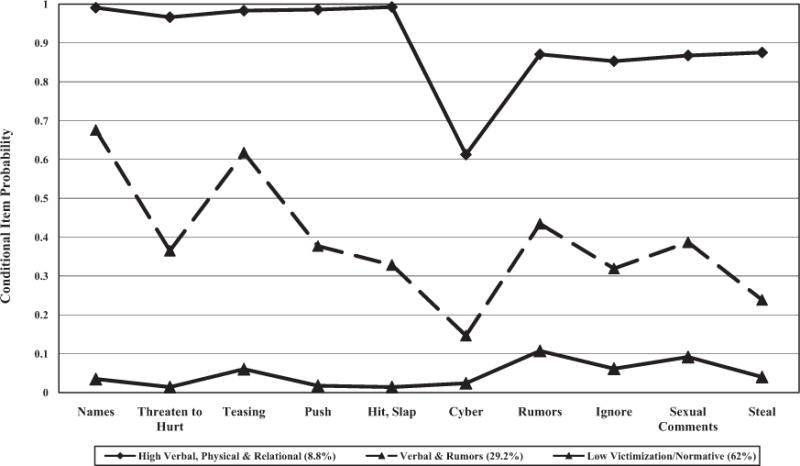
There is growing interest in gender differences in the experience of various forms of peer victimization; however, much of the work to date has used traditional variable-centered approaches by focusing on scales or individual forms of victimization in isolation. The current study explored whether there were discrete groups of adolescents who experience distinct forms of peer victimization by bullying (e.g., physical, verbal, relational) among middle and high school-age youth, and whether membership in a particular victimization group was associated with internalizing problems and aggression. Latent class analyses examining 10 different forms of victimization were conducted on a diverse sample of middle school ( = 11,408) and high school ( = 5,790) students. All forms of victimization were less common among high school students, except cyberbullying and sexual comments/gestures. The analyses revealed that there were 4 distinct victimization patterns for middle school students (Verbal and Physical; Verbal and Relational; High Verbal, Physical, and Relational; and Low Victimization/Normative), whereas high school students fell into a similar pattern with the exception of a Verbal and Physical class. These patterns of victimization were functionally associated with co-occurring internalizing problems and aggression. There were also some notable gender and developmental differences in the pattern of victimization and its relation with adjustment problems. These findings enhance our understanding of the complex patterns of peer victimization that are experienced by middle and high school students. Implications for educational researchers and school-based bullying interventions are discussed.
人们对各种形式的同伴受害经历中的性别差异越来越感兴趣;然而,迄今为止的许多研究都采用了传统的以变量为中心的方法,孤立地关注量表或个别形式的受害情况。本研究探讨了在初中和高中阶段的青少年中,是否存在经历不同形式同伴欺凌受害(如身体、言语、关系方面)的离散青少年群体,以及特定受害群体的成员身份是否与内化问题和攻击行为有关。对来自初中(n = 11408)和高中(n = 5790)学生的多样化样本进行了潜在类别分析,考察了10种不同形式的受害情况。除网络欺凌和性评论/手势外,所有形式的受害情况在高中生中都不太常见。分析表明,初中生有4种不同的受害模式(言语和身体;言语和关系;高言语、身体和关系;以及低受害/正常),而高中生除了言语和身体类别外,也呈现出类似的模式。这些受害模式在功能上与同时出现的内化问题和攻击行为相关。在受害模式及其与适应问题的关系方面,也存在一些显著的性别和发展差异。这些发现增进了我们对初中和高中学生所经历的同伴受害复杂模式的理解。文中还讨论了对教育研究人员和基于学校的欺凌干预措施的启示。