Drogue Benoît, Sanguin Hervé, Chamam Amel, Mozar Michael, Llauro Christel, Panaud Olivier, Prigent-Combaret Claire, Picault Nathalie, Wisniewski-Dyé Florence
Ecologie Microbienne, UMR CNRS 5557/USC INRA 1364, Université Lyon 1 Villeurbanne, France.
Laboratoire de Génome et Développement des Plantes, UMR 5096 CNRS/IRD/Université de Perpignan Via Domitia Perpignan, France.
Front Plant Sci. 2014 Nov 6;5:607. doi: 10.3389/fpls.2014.00607. eCollection 2014.
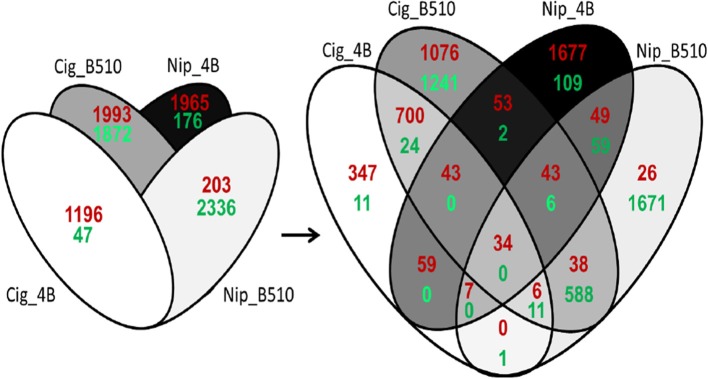
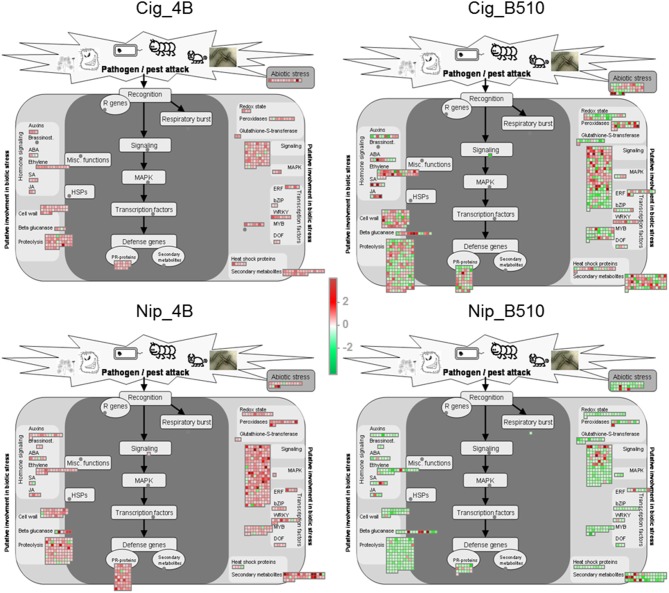
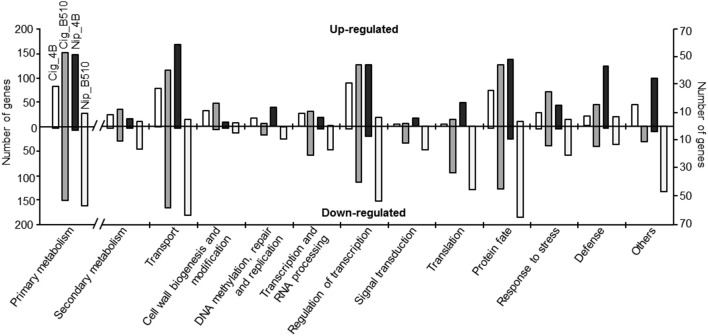
Cooperation involving Plant Growth-Promoting Rhizobacteria results in improvements of plant growth and health. While pathogenic and symbiotic interactions are known to induce transcriptional changes for genes related to plant defense and development, little is known about the impact of phytostimulating rhizobacteria on plant gene expression. This study aims at identifying genes significantly regulated in rice roots upon Azospirillum inoculation, considering possible favored interaction between a strain and its original host cultivar. Genome-wide analyzes of Oryza sativa japonica cultivars Cigalon and Nipponbare were performed, by using microarrays, seven days post-inoculation with Azospirillum lipoferum 4B (isolated from Cigalon) or Azospirillum sp. B510 (isolated from Nipponbare) and compared to the respective non-inoculated condition. A total of 7384 genes were significantly regulated, which represent about 16% of total rice genes. A set of 34 genes is regulated by both Azospirillum strains in both cultivars, including a gene orthologous to PR10 of Brachypodium, and these could represent plant markers of Azospirillum-rice interactions. The results highlight a strain-dependent response of rice, with 83% of the differentially expressed genes being classified as combination-specific. Whatever the combination, most of the differentially expressed genes are involved in primary metabolism, transport, regulation of transcription and protein fate. When considering genes involved in response to stress and plant defense, it appears that strain B510, a strain displaying endophytic properties, leads to the repression of a wider set of genes than strain 4B. Individual genotypic variations could be the most important driving force of rice roots gene expression upon Azospirillum inoculation. Strain-dependent transcriptional changes observed for genes related to auxin and ethylene signaling highlight the complexity of hormone signaling networks in the Azospirillum-rice cooperation.
与促植物生长根际细菌的合作可促进植物生长并增强健康。虽然已知病原性和共生性相互作用会诱导与植物防御和发育相关基因的转录变化,但关于植物刺激根际细菌对植物基因表达的影响却知之甚少。本研究旨在确定接种固氮螺菌后水稻根中显著调控的基因,同时考虑菌株与其原始宿主品种之间可能存在的有利相互作用。在接种来自Cigalon的脂环酸芽孢杆菌4B或来自日本晴的固氮螺菌属B510七天后,利用微阵列对粳稻品种Cigalon和日本晴进行全基因组分析,并与各自的未接种对照条件进行比较。共有7384个基因受到显著调控,约占水稻基因总数的16%。在两个品种中,一组34个基因受两种固氮螺菌菌株共同调控,其中包括一个与短柄草PR10直系同源的基因,这些基因可能代表了固氮螺菌与水稻相互作用的植物标记。结果突出了水稻的菌株依赖性反应,83%的差异表达基因被归类为组合特异性。无论组合如何,大多数差异表达基因都参与初级代谢、运输、转录调控和蛋白质命运。在考虑参与应激反应和植物防御的基因时,显示出内生特性的菌株B510似乎比菌株4B导致更广泛的基因抑制。个体基因型变异可能是接种固氮螺菌后水稻根基因表达的最重要驱动力。观察到的与生长素和乙烯信号相关基因的菌株依赖性转录变化突出了固氮螺菌与水稻合作中激素信号网络的复杂性。