Razanadrakoto Lyra, Cormier Françoise, Laurienté Vanessa, Dondi Elisabetta, Gardano Laura, Katzav Shulamit, Guittat Lionel, Varin-Blank Nadine
INSERM, UMR 978, Bobigny, France.
PRES SPC, Labex Inflamex, Université Paris 13, UFR SMBH, Bobigny, France.
Oncotarget. 2015 Feb 10;6(4):2524-37. doi: 10.18632/oncotarget.2629.
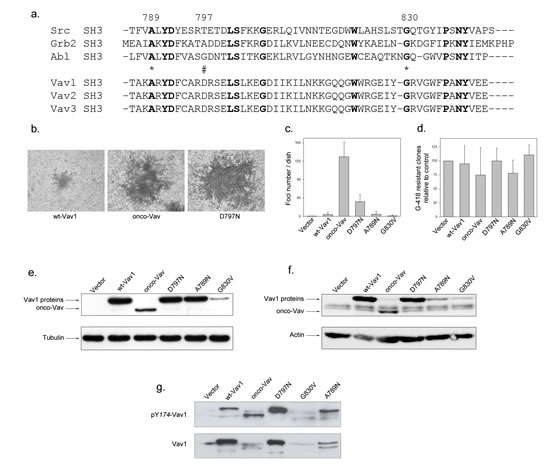
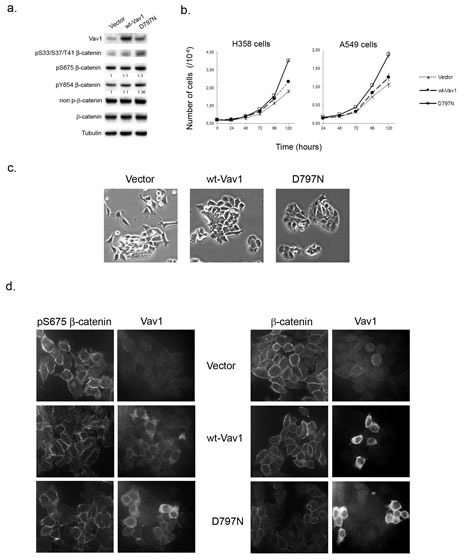
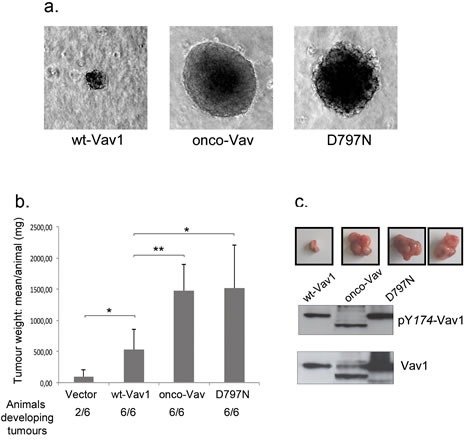
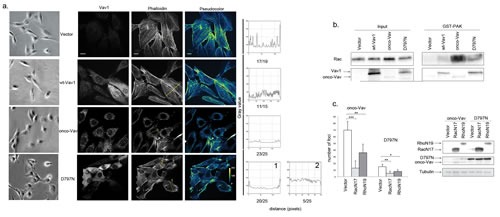
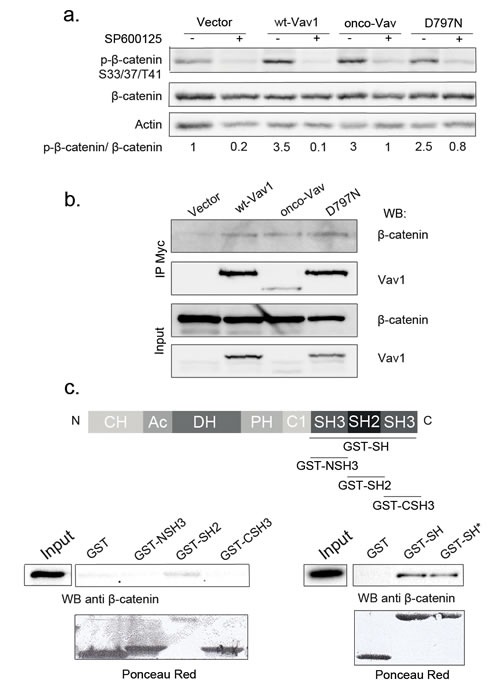
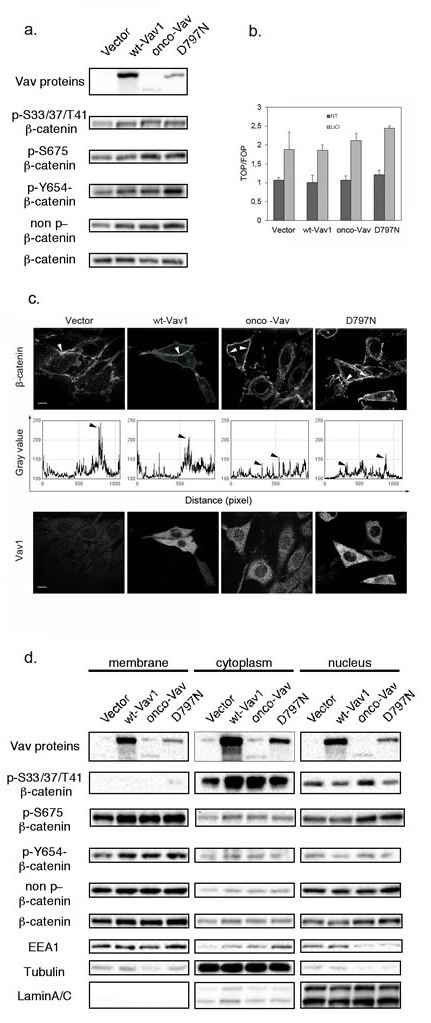
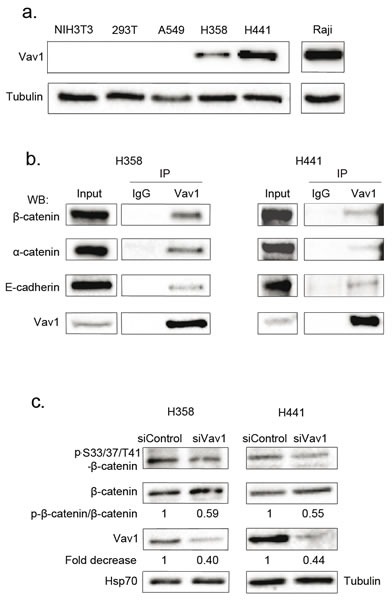
Vav family members function as remarkable scaffold proteins that exhibit both GDP/GTP exchange activity for Rho/Rac GTPases and numerous protein-protein interactions via three adaptor Src-homology domains. The exchange activity is under the unique regulation by phosphorylation of tyrosine residues hidden by intra-molecular interactions. Deletion of the autoinhibitory N-terminal region results in an oncogenic protein, onco-Vav, leading to a potent activation of Rac GTPases whereas the proto-oncogene barely leads to transformation. Substitution of conserved residues of the SH2-SH3 adaptor region in onco-Vav reverses oncogenicity. While a unique substitution D797N did not affect transformation induced by onco-Vav, we demonstrate that this single substitution leads to transformation in the Vav1 proto-oncogene highlighting the pivotal role of the adaptor region. Moreover, we identified the cell junction protein β-catenin as a new Vav1 interacting partner. We show that the oncogenicity of activated Vav1 proto-oncogene is associated with a non-degradative phosphorylation of β-catenin at residues important for its functions and its redistribution along the cell membrane in fibroblasts. In addition, a similar interaction is evidenced in epithelial lung cancer cells expressing ectopically Vav1. In these cells, Vav1 is also involved in the modulation of β-catenin phosphorylation. Altogether, our data highlight that only a single mutation in the proto-oncogene Vav1 enhances tumorigenicity.
Vav家族成员作为卓越的支架蛋白,对Rho/Rac GTP酶表现出GDP/GTP交换活性,并通过三个衔接子Src同源结构域进行大量蛋白质-蛋白质相互作用。这种交换活性受到分子内相互作用所隐藏的酪氨酸残基磷酸化的独特调控。原癌基因Vav1的自抑制性N端区域缺失会产生致癌蛋白onco-Vav,导致Rac GTP酶的强力激活,而原癌基因几乎不会导致细胞转化。onco-Vav中SH2-SH3衔接子区域保守残基的取代可逆转致癌性。虽然独特的取代D797N不影响onco-Vav诱导的细胞转化,但我们证明这种单一取代会导致Vav1原癌基因发生细胞转化,突出了衔接子区域的关键作用。此外,我们鉴定出细胞连接蛋白β-连环蛋白是一种新的Vav1相互作用伴侣。我们表明,激活的Vav1原癌基因的致癌性与β-连环蛋白在对其功能重要的残基处的非降解性磷酸化及其在成纤维细胞中沿细胞膜的重新分布有关。此外,在异位表达Vav1的上皮肺癌细胞中也证实了类似的相互作用。在这些细胞中,Vav1也参与β-连环蛋白磷酸化的调节。总之,我们的数据突出表明,原癌基因Vav1中仅一个突变就会增强肿瘤发生能力。