Physiology-Pharmacology Research Center, Rafsanjan University of Medical Sciences, Rafsanjan, Iran.
Pharmaceutical Research Center, School of Pharmacy, Mashhad University of Medical Sciences, Mashhad, Iran.
Iran J Basic Med Sci. 2014 Jul;17(7):476-82.
Hypothermia and decompressive craniectomy (DC) have been shown to be neuroprotective. This study was designed to evaluate neuroprotective effects of delayed singular or combination of DC and local hypothermia on stroke.
Cerebral ischemia was induced in 48 Wistar rats assigned to 4 groups: control, decompressive craniectomy (DC), local hypothermia (LH), combination of hypothermia and craniectomy (HC). Infarct size and BBB disruption were measured 48 hr after ischemia insult. Neurological deficits were assessed at 24 and 48 hr after stroke by using sticky tape test, hanging-wire test and Bederson's scoring system. BBB disruption was measured by Evans blue dye leakage.
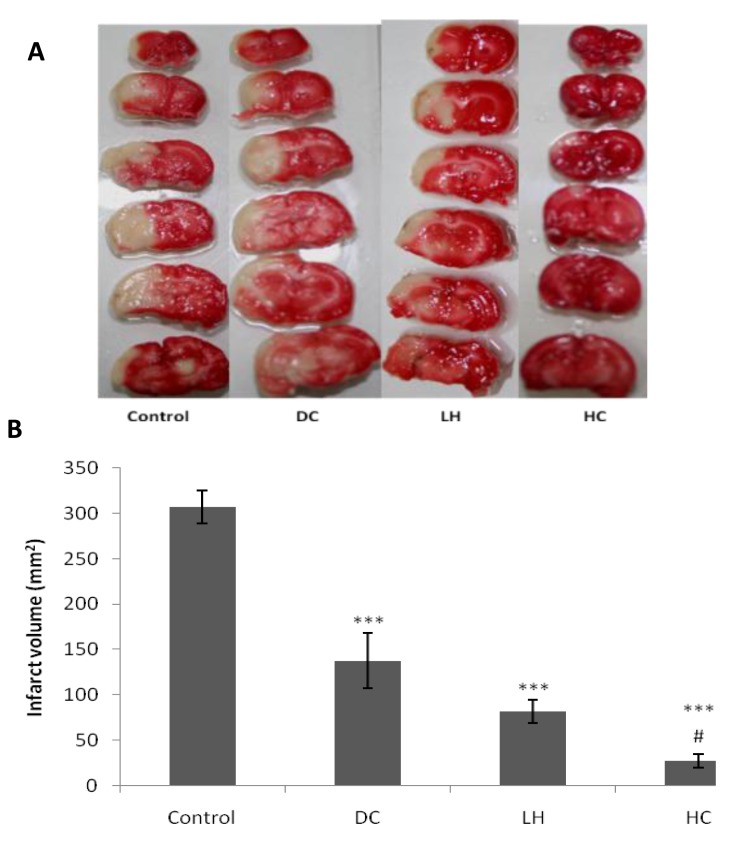
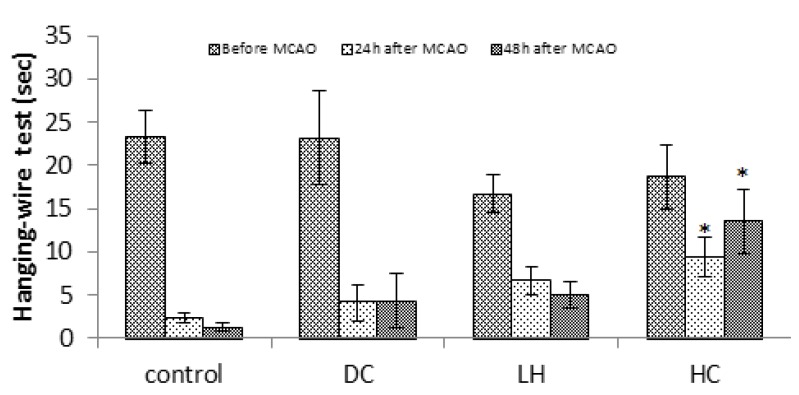
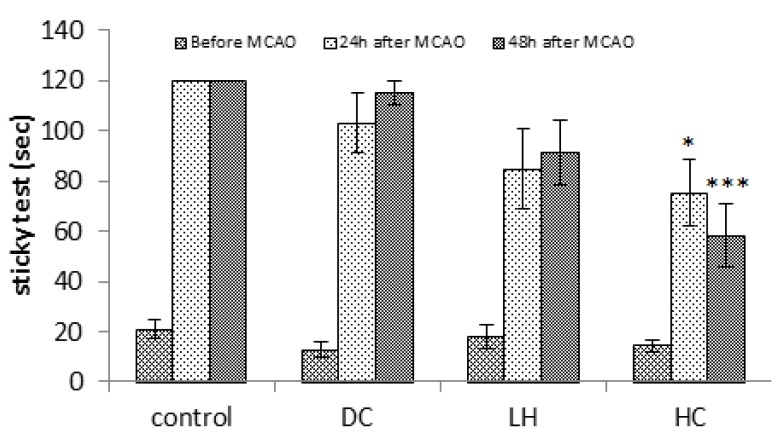
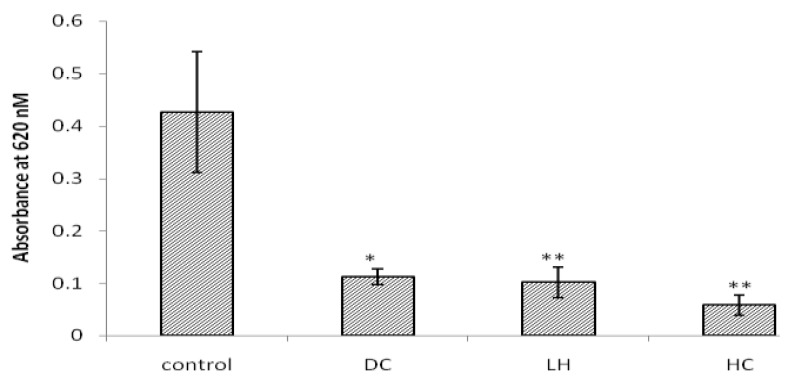
Although infarct size was significantly reduced in LH, DC and HC groups (P<0.001), combination therapy was more neuroprotective compared to craniectomy alone (P<0.01). BBB disruption was significantly reduced in DC (P< 0.05) and LH and HC (P< 0.01).While sticky tape test (P<0.05 at 24 hr; P<0.001 at 48 hr) and hanging-wire test (P<0.05) showed better behavioral performance only in HC, Bederson test showed improved behavioral functions of both LH (P<0.05 at 24 hr and P<0.01 at 48 hr) and HC animals (P<0.01). Neurological deficits were also decreased in LH (P<0.05) or HC (P<0.05 at 24 hr; P<0.01 at 48 hr) groups compared to the DC group at the same time.
Based on our data, although both delayed local hypothermia and craniectomy are protective after stoke, combination therapy of them is more neuroprotective than given alone.
低温和去骨瓣减压术(DC)已被证明具有神经保护作用。本研究旨在评估迟发性单一或 DC 与局部低温联合治疗对中风的神经保护作用。
将 48 只 Wistar 大鼠分为 4 组:对照组、去骨瓣减压组(DC)、局部低温组(LH)、低温联合去骨瓣减压组(HC)。在缺血损伤后 48 小时测量梗死体积和 BBB 破坏。在中风后 24 和 48 小时通过胶带测试、悬线测试和 Bederson 评分系统评估神经功能缺损。BBB 破坏通过 Evans 蓝染料渗漏测量。
尽管 LH、DC 和 HC 组的梗死体积明显减小(P<0.001),但联合治疗比单独去骨瓣减压更具神经保护作用(P<0.01)。DC(P<0.05)、LH 和 HC(P<0.01)组 BBB 破坏明显减少。虽然胶带测试(24 小时时 P<0.05;48 小时时 P<0.001)和悬线测试(P<0.05)仅在 HC 组中显示出更好的行为表现,但 Bederson 测试显示 LH(24 小时时 P<0.05,48 小时时 P<0.01)和 HC 动物(P<0.01)的行为功能得到改善。与 DC 组相比,LH(P<0.05)或 HC 组(24 小时时 P<0.05;48 小时时 P<0.01)在同一时间的神经功能缺损也减少。
根据我们的数据,尽管迟发性局部低温和去骨瓣减压术后均有保护作用,但联合治疗比单独使用更具神经保护作用。