Huang Fu-Chen
Department of Pediatrics, Kaohsiung Chang Gung Memorial Hospital and Chang Gung University College of Medicine, 123, Ta-pei Road, Niao-sung District, Kaohsiung, Taiwan.
BMC Microbiol. 2014 Nov 30;14:275. doi: 10.1186/s12866-014-0275-6.
The human opportunistic pathogen, Pseudomonas aeruginosa (P. aeruginosa) carries the highest case fatality rate of all gram-negative infections. Unfortunately, antimicrobial therapy has not been demonstrated to improve clinical outcome and the emergence of multidrug resistant P. aeruginosa has become a major concern in the hospital setting. Fever and diarrhea are the two most common initial symptoms in P. aeruginosa sepsis in previously healthy infants and children. This implies that intestinal epithelial cells in first contact with the pathogen may play an important role in innate immunity to P. aeruginosa infection. Human beta-defensins-2 (hBD-2) and interleukin-8 (IL-8) are crucial for host defense at mucosa but IL-8 may give rise to characteristic pathology of colitis.
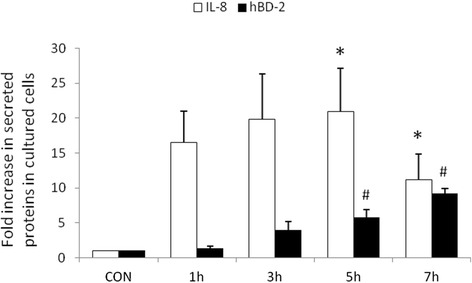
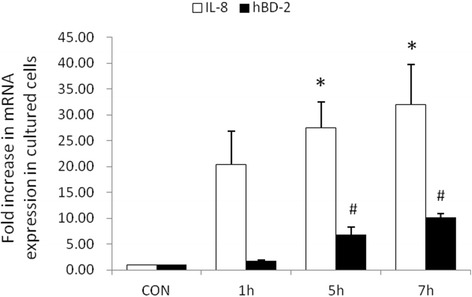
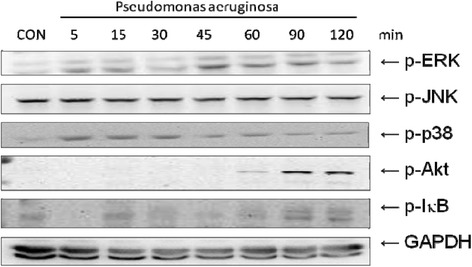
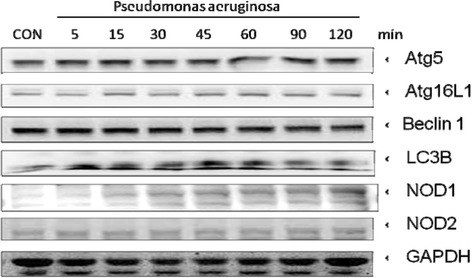
Pseudomonas aeruginosa strain PAO1 was used to infect SW480, an intestinal epithelial cell. IL-8 and hBD-2 mRNA expression and protein secretion were then assessed in SW480 cells using RT-PCR and enzyme-linked immunosorbent assay (ELISA), respectively. Intracellular signaling pathways and nucleotide-binding oligomerization domain (NOD) 1 protein expression were analyzed by Western blot in SW480 cells in the presence or absence of inhibitors or transfected with siRNA. We demonstrate that prolonged infection by P. aeruginosa results in suppression of IL-8 but enhancement of hBD-2, either protein secretion and mRNA expression, in SW480 cells. Inhibitors of ERK suppressed but inhibitor of PI3K enhanced P. aeruginosa-induced IL-8 mRNA expression in SW480 cells while both signaling had no effect on P. aeruginosa-induced hBD-2 expression in SW480 cells. On the other hand, NOD 1 was illustrated to get involved in P. aeruginosa-induced hBD-2 mRNA expression and protein production in SW480 cells.
The P. aeruginosa-induced antimicrobial peptide in IECs continuously protect the host against prolonged infection, while modulation of proinflammatory responses prevents the host from the detrimental effects of overwhelming inflammation. Thus, P. aeruginosa-induced innate immunity in IECs represents a host protective mechanism, which may provide new insight into the pathogenesis of inflammatory bowel diseases.
人类机会致病菌铜绿假单胞菌导致的革兰氏阴性菌感染病死率最高。遗憾的是,抗菌治疗尚未被证明能改善临床结局,且多重耐药铜绿假单胞菌的出现已成为医院环境中的一个主要问题。发热和腹泻是既往健康的婴幼儿铜绿假单胞菌败血症最常见的两种初始症状。这意味着首次接触病原体的肠道上皮细胞可能在针对铜绿假单胞菌感染的固有免疫中发挥重要作用。人β-防御素-2(hBD-2)和白细胞介素-8(IL-8)对黏膜的宿主防御至关重要,但IL-8可能引发结肠炎的特征性病理变化。
使用铜绿假单胞菌PAO1菌株感染肠道上皮细胞SW480。然后分别使用逆转录-聚合酶链反应(RT-PCR)和酶联免疫吸附测定(ELISA)评估SW480细胞中IL-8和hBD-2的mRNA表达及蛋白分泌情况。在存在或不存在抑制剂或转染小干扰RNA(siRNA)的情况下,通过蛋白质印迹法分析SW480细胞中的细胞内信号通路和核苷酸结合寡聚化结构域(NOD)1蛋白表达。我们证明,铜绿假单胞菌的长时间感染导致SW480细胞中IL-8受到抑制,但hBD-2在蛋白分泌和mRNA表达方面均增强。细胞外信号调节激酶(ERK)抑制剂抑制了铜绿假单胞菌诱导的SW480细胞中IL-8的mRNA表达,而磷脂酰肌醇-3激酶(PI3K)抑制剂则增强了该表达,同时这两种信号传导对铜绿假单胞菌诱导的SW480细胞中hBD-2的表达均无影响。另一方面,研究表明NOD 1参与了铜绿假单胞菌诱导的SW480细胞中hBD-2的mRNA表达和蛋白产生。
铜绿假单胞菌诱导的肠道上皮细胞抗菌肽持续保护宿主免受长时间感染,而对促炎反应的调节可防止宿主受到过度炎症的有害影响。因此,铜绿假单胞菌诱导的肠道上皮细胞固有免疫代表了一种宿主保护机制,这可能为炎症性肠病的发病机制提供新的见解。