Honarvar Hadis, Garousi Javad, Gunneriusson Elin, Höidén-Guthenberg Ingmarie, Altai Mohamed, Widström Charles, Tolmachev Vladimir, Frejd Fredrik Y
Unit of Biomedical Radiation Sciences, Rudbeck Laboratory, Uppsala University, SE-75185 Uppsala, Sweden.
Affibody AB, SE-17163 Solna, Sweden.
Int J Oncol. 2015 Feb;46(2):513-20. doi: 10.3892/ijo.2014.2782. Epub 2014 Nov 27.
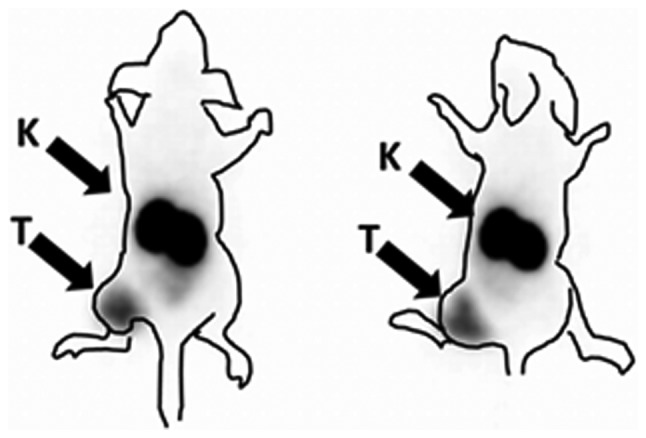
Carbonic anhydrase IX (CAIX) is a transmembrane enzyme involved in regulation of tissue pH balance. In cancer, CAIX expression is associated with tumor hypoxia. CAIX is also overexpressed in renal cell carcinoma and is a molecular target for the therapeutic antibody cG250 (girentuximab). Radionuclide imaging of CAIX expression might be used for identification of patients who may benefit from cG250 therapy and from treatment strategies for hypoxic tumors. Affibody molecules are small (7 kDa) scaffold proteins having a high potential as probes for radionuclide molecular imaging. The aim of the present study was to evaluate feasibility of in vivo imaging of CAIX-expression using radiolabeled Affibody molecules. A histidine-glutamate-histidine-glutamate-histidine-glutamate (HE)3-tag-containing CAIX-binding Affibody molecule (HE)3-ZCAIX:1 was labeled with (99m)Tc(CO)3. Its binding properties were evaluated in vitro using CAIX-expressing SK-RC-52 renal carcinoma cells. (99m)Tc-(HE)3-ZCAIX:1 was evaluated in NMRI nu/nu mice bearing SK-RC-52 xenografts. The in vivo specificity test confirmed CAIX-mediated tumor targeting. (99m)Tc-(HE)3-ZCAIX:1 cleared rapidly from blood and normal tissues except for kidneys. At optimal time-point (4 h p.i.), the tumor uptake was 9.7 ± 0.7% ID/g, and tumor-to-blood ratio was 53 ± 10. Experimental imaging of CAIX-expressing SK-RC-52 xenografts at 4 h p.i. provided high contrast images. The use of radioiodine label for ZCAIX:1 enabled the reduction of renal uptake, but resulted in significantly lower tumor uptake and tumor-to-blood ratio. Results of the present study suggest that radiolabeled Affibody molecules are promising probes for imaging of CAIX-expression in vivo.
碳酸酐酶IX(CAIX)是一种参与调节组织pH平衡的跨膜酶。在癌症中,CAIX的表达与肿瘤缺氧相关。CAIX在肾细胞癌中也过表达,并且是治疗性抗体cG250(吉妥昔单抗)的分子靶点。CAIX表达的放射性核素成像可用于识别可能从cG250治疗和缺氧肿瘤治疗策略中获益的患者。亲和体分子是小的(7 kDa)支架蛋白,具有作为放射性核素分子成像探针的高潜力。本研究的目的是评估使用放射性标记的亲和体分子对CAIX表达进行体内成像的可行性。一种含组氨酸-谷氨酸-组氨酸-谷氨酸-组氨酸-谷氨酸(HE)3标签的CAIX结合亲和体分子(HE)3-ZCAIX:1用(99m)Tc(CO)3进行标记。使用表达CAIX的SK-RC-52肾癌细胞在体外评估其结合特性。在携带SK-RC-52异种移植瘤的NMRI nu/nu小鼠中评估(99m)Tc-(HE)3-ZCAIX:1。体内特异性试验证实了CAIX介导的肿瘤靶向性。(99m)Tc-(HE)3-ZCAIX:1除肾脏外从血液和正常组织中快速清除。在最佳时间点(注射后4小时),肿瘤摄取为9.