Department of Radiooncology and Radiation Therapy, University of Heidelberg, Heidelberg, Germany.
PLoS One. 2010 Dec 31;5(12):e15962. doi: 10.1371/journal.pone.0015962.
Carbonic anhydrase IX (CAIX) is a transmembrane enzyme found to be overexpressed in various tumors and associated with tumor hypoxia. Ligands binding this target may be used to visualize hypoxia, tumor manifestation or treat tumors by endoradiotherapy.
Phage display was performed with a 12 amino acid phage display library by panning against a recombinant extracellular domain of human carbonic anhydrase IX. The identified peptide CaIX-P1 was chemically synthesized and tested in vitro on various cell lines and in vivo in Balb/c nu/nu mice carrying subcutaneously transplanted tumors. Binding, kinetic and competition studies were performed on the CAIX positive human renal cell carcinoma cell line SKRC 52, the CAIX negative human renal cell carcinoma cell line CaKi 2, the human colorectal carcinoma cell line HCT 116 and on human umbilical vein endothelial cells (HUVEC). Organ distribution studies were carried out in mice, carrying SKRC 52 tumors. RNA expression of CAIX in HCT 116 and HUVEC cells was investigated by quantitative real time PCR.
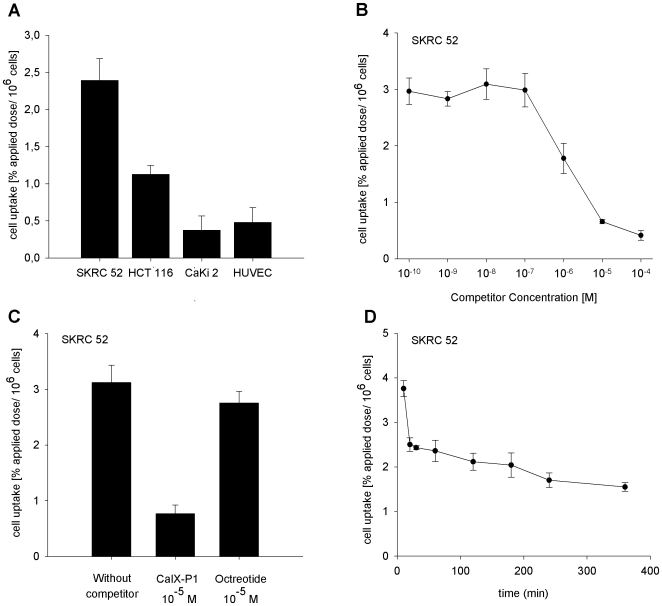
In vitro binding experiments of (125)I-labeled-CaIX-P1 revealed an increased uptake of the radioligand in the CAIX positive renal cell carcinoma cell line SKRC 52. Binding of the radioligand in the colorectal carcinoma cell line HCT 116 increased with increasing cell density and correlated with the mRNA expression of CAIX. Radioligand uptake was inhibited up to 90% by the unlabeled CaIX-P1 peptide, but not by the negative control peptide octreotide at the same concentration. No binding was demonstrated in CAIX negative CaKi 2 and HUVEC cells. Organ distribution studies revealed a higher accumulation in SKRC 52 tumors than in heart, spleen, liver, muscle, intestinum and brain, but a lower uptake compared to blood and kidney.
These data indicate that CaIX-P1 is a promising candidate for the development of new ligands targeting human carbonic anhydrase IX.
碳酸酐酶 IX(CAIX)是一种跨膜酶,在各种肿瘤中过度表达,并与肿瘤缺氧相关。结合该靶点的配体可用于可视化缺氧、肿瘤表现或通过内放射治疗治疗肿瘤。
通过针对人碳酸酐酶 IX 的重组细胞外结构域进行噬菌粒展示,对 12 个氨基酸噬菌体展示文库进行筛选。鉴定出的肽 CaIX-P1 经化学合成并在各种细胞系中进行体外测试,并在皮下移植肿瘤的 Balb/c nu/nu 小鼠体内进行测试。在 CAIX 阳性的人肾透明细胞癌细胞系 SKRC 52、CAIX 阴性的人肾透明细胞癌细胞系 CaKi 2、人结直肠癌细胞系 HCT 116 和人脐静脉内皮细胞(HUVEC)上进行结合、动力学和竞争研究。在携带 SKRC 52 肿瘤的小鼠中进行器官分布研究。通过定量实时 PCR 研究 CAIX 在 HCT 116 和 HUVEC 细胞中的 RNA 表达。
(125)I 标记的-CaIX-P1 的体外结合实验显示,放射性配体在 CAIX 阳性肾透明细胞癌细胞系 SKRC 52 中的摄取增加。在结直肠癌细胞系 HCT 116 中,放射性配体的结合随着细胞密度的增加而增加,并与 CAIX 的 mRNA 表达相关。未标记的 CaIX-P1 肽可抑制放射性配体的摄取高达 90%,而相同浓度的阴性对照肽奥曲肽则不能。在 CAIX 阴性的 CaKi 2 和 HUVEC 细胞中未观察到结合。器官分布研究显示,与心脏、脾脏、肝脏、肌肉、肠和大脑相比,SKRC 52 肿瘤中的放射性配体积聚更高,但与血液和肾脏相比,摄取量较低。
这些数据表明,CaIX-P1 是开发针对人碳酸酐酶 IX 的新配体的有前途的候选物。