Palacio-Castañeda Valentina, Oude Egberink Rik, Sait Arbaaz, Andrée Lea, Sala Benedetta Maria, Hassani Besheli Negar, Oosterwijk Egbert, Nilvebrant Johan, Leeuwenburgh Sander C G, Brock Roland, Verdurmen Wouter P R
Department of Biochemistry, Radboud Institute for Molecular Life Sciences, Radboud University Medical Center, Geert Grooteplein 28, 6525 GA Nijmegen, The Netherlands.
Department of Dentistry-Regenerative Biomaterials, Radboud Institute for Molecular Life Sciences,Radboud University Medical Center, Philips van Leydenlaan 25, 6525 EX Nijmegen, The Netherlands.
Pharmaceutics. 2021 Nov 17;13(11):1944. doi: 10.3390/pharmaceutics13111944.
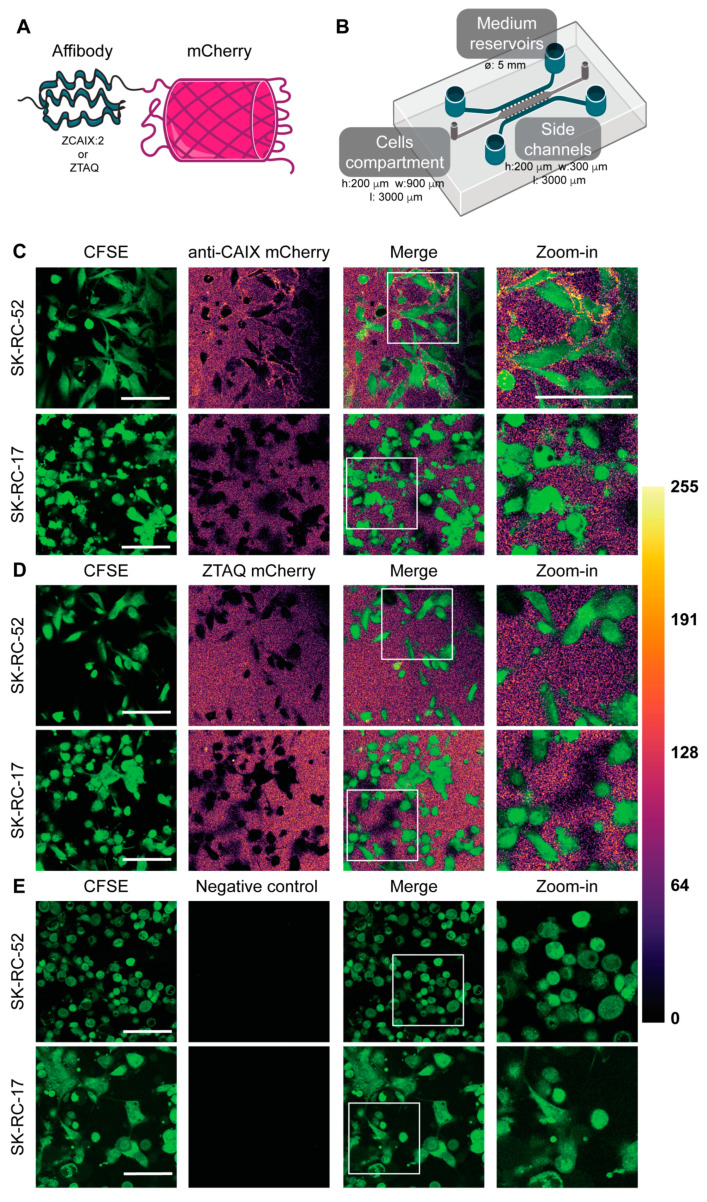
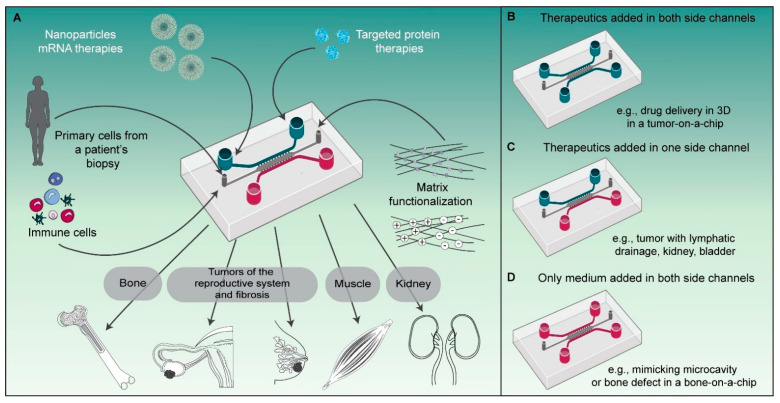
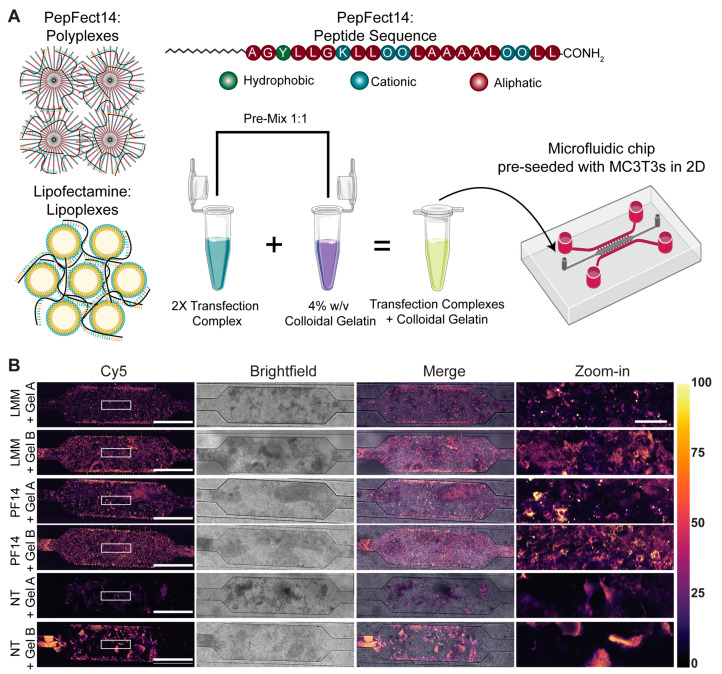
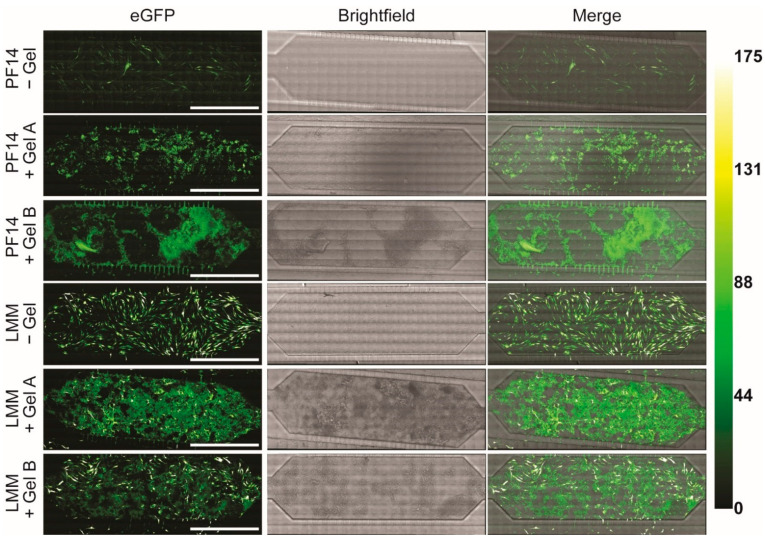
To investigate the delivery of next-generation macromolecular drugs, such as engineered proteins and mRNA-containing nanoparticles, there is an increasing push towards the use of physiologically relevant disease models that incorporate human cells and do not face ethical dilemmas associated with animal use. Here, we illustrate the versatility and ease of use of a microfluidic platform for studying drug delivery using high-resolution microscopy in 3D. Using this microfluidic platform, we successfully demonstrate the specific targeting of carbonic anhydrase IX (CAIX) on cells overexpressing the protein in a tumor-mimicking chip system using affibodies, with CAIX-negative cells and non-binding affibodies as controls. Furthermore, we demonstrate this system's feasibility for testing mRNA-containing biomaterials designed to regenerate bone defects. To this end, peptide- and lipid-based mRNA formulations were successfully mixed with colloidal gelatin in microfluidic devices, while translational activity was studied by the expression of a green fluorescent protein. This microfluidic platform enables the testing of mRNA delivery from colloidal biomaterials of relatively high densities, which represents a first important step towards a bone-on-a-chip platform. Collectively, by illustrating the ease of adaptation of our microfluidic platform towards use in distinct applications, we show that our microfluidic chip represents a powerful and flexible way to investigate drug delivery in 3D disease-mimicking culture systems that recapitulate key parameters associated with in vivo drug application.
为了研究下一代大分子药物(如工程蛋白和含mRNA的纳米颗粒)的递送,人们越来越倾向于使用包含人类细胞且不存在与动物使用相关伦理困境的生理相关疾病模型。在此,我们展示了一种微流控平台的多功能性和易用性,该平台可用于在三维空间中使用高分辨率显微镜研究药物递送。利用这个微流控平台,我们成功地在一个模拟肿瘤的芯片系统中,使用亲和体证明了碳酸酐酶IX(CAIX)在过表达该蛋白的细胞上的特异性靶向作用,以CAIX阴性细胞和非结合亲和体作为对照。此外,我们证明了该系统对于测试旨在修复骨缺损的含mRNA生物材料的可行性。为此,基于肽和脂质的mRNA制剂在微流控装置中成功地与胶体明胶混合,同时通过绿色荧光蛋白的表达研究翻译活性。这个微流控平台能够测试来自相对高密度胶体生物材料的mRNA递送,这是迈向芯片上骨平台的重要第一步。总体而言,通过说明我们的微流控平台易于适应不同应用,我们表明我们的微流控芯片是一种强大而灵活的方式,可用于在三维模拟疾病培养系统中研究药物递送,该系统概括了与体内药物应用相关的关键参数。