Morioka Travis Y, Lee Alice J, Bertisch Suzanne, Buettner Catherine
F. Edward Hébert School of Medicine, Uniformed Services University of the Health Sciences, Bethesda, MD, USA.
Harvard Catalyst Clinical Research Center, Beth Israel Deaconess Medical Center, Boston, MA, USA.
Atherosclerosis. 2015 Jan;238(1):77-82. doi: 10.1016/j.atherosclerosis.2014.11.012. Epub 2014 Nov 20.
Past studies examining the effect of vitamin D on statin myalgia have been variable; however, these studies were done in limited samples not representative of the general population. We aimed to evaluate whether vitamin D status modifies the association between statin use and musculoskeletal pain in a sample representative of the general population.
We conducted a cross-sectional study using the National Health and Nutrition Examination Survey 2001-2004. Musculoskeletal symptoms and statin use were self-reported. Vitamin D status was assessed using serum 25 hydroxyvitamin D (25[OH]D), categorized as <15 ng/mL or ≥15 ng/mL. To evaluate if vitamin D status modifies the association between statin use and prevalent musculoskeletal pain, we performed multivariable-adjusted logistic regression models stratified by 25(OH)D status.
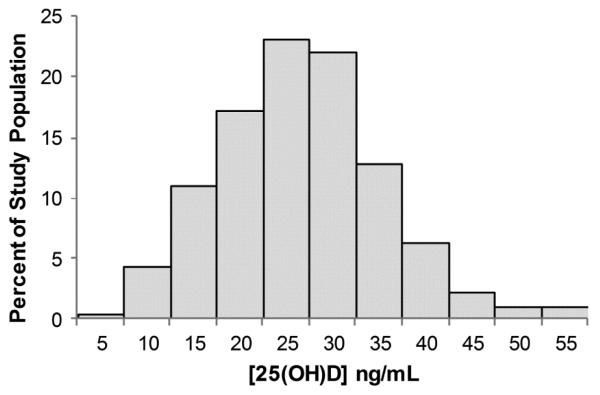
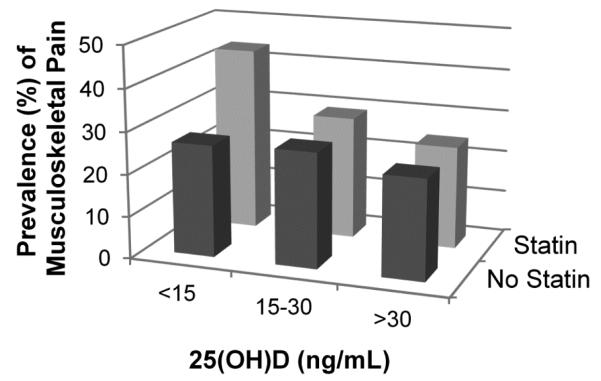
Among 5907 participants ≥40 years old, mean serum 25(OH)D was 23.6 ng/mL (95% CI, 22.9-24.3). In stratified multivariable-adjusted logistic regression models, individuals with 25(OH)D <15 ng/mL, using a statin had a significantly higher odds of musculoskeletal pain compared to those not using a statin (adjusted odds ratio [aOR], 1.90; 95% CI, 1.18-3.05). Among those with 25(OH)D ≥15 ng/mL, we found no significant association between statin use and musculoskeletal pain (aOR, 0.91; 95% CI, 0.71-1.16).
Among adults ≥ 40 years old with 25(OH)D <15 ng/mL, statin users had nearly 2 times greater odds of reporting musculoskeletal pain compared to non-statin users. Our findings support the hypothesis that vitamin D deficiency modifies the risk of musculoskeletal symptoms experienced with statin use.
既往研究探讨维生素D对他汀类药物所致肌痛的影响,结果不一;然而,这些研究的样本有限,不能代表一般人群。我们旨在评估在一个代表一般人群的样本中,维生素D状态是否会改变他汀类药物使用与肌肉骨骼疼痛之间的关联。
我们使用2001 - 2004年美国国家健康和营养检查调查进行了一项横断面研究。肌肉骨骼症状和他汀类药物使用情况通过自我报告获得。维生素D状态通过血清25羟维生素D(25[OH]D)进行评估,分为<15 ng/mL或≥15 ng/mL。为了评估维生素D状态是否会改变他汀类药物使用与普遍存在的肌肉骨骼疼痛之间的关联,我们进行了按25(OH)D状态分层的多变量调整逻辑回归模型。
在5907名年龄≥40岁的参与者中,血清25(OH)D平均水平为23.6 ng/mL(95%CI,22.9 - 24.3)。在分层多变量调整逻辑回归模型中,25(OH)D<15 ng/mL且使用他汀类药物的个体与未使用他汀类药物的个体相比,肌肉骨骼疼痛的几率显著更高(调整优势比[aOR],1.90;95%CI,1.18 - 3.05)。在25(OH)D≥15 ng/mL的人群中,我们未发现他汀类药物使用与肌肉骨骼疼痛之间存在显著关联(aOR,0.91;95%CI,0.71 - 1.16)。
在年龄≥40岁且25(OH)D<15 ng/mL的成年人中,他汀类药物使用者报告肌肉骨骼疼痛的几率几乎是非他汀类药物使用者的2倍。我们的研究结果支持以下假设:维生素D缺乏会改变使用他汀类药物时出现肌肉骨骼症状的风险。