Schomers Malte R, Kirilina Evgeniya, Weigand Anne, Bajbouj Malek, Pulvermüller Friedemann
Brain Language Laboratory, Department of Philosophy and Humanities, Freie Universität Berlin, 14195 Berlin, Germany Berlin School of Mind and Brain, Humboldt-Universität zu Berlin, 10099 Berlin, Germany.
Dahlem Institute for Neuroimaging of Emotion, Freie Universität Berlin, 14195 Berlin, Germany.
Cereb Cortex. 2015 Oct;25(10):3894-902. doi: 10.1093/cercor/bhu274. Epub 2014 Dec 1.
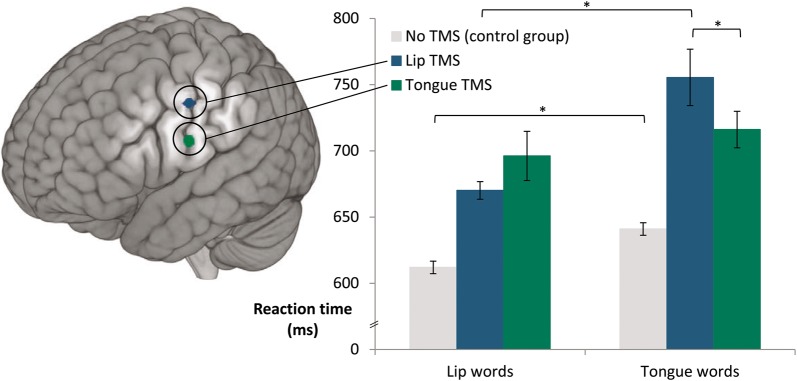
Classic wisdom had been that motor and premotor cortex contribute to motor execution but not to higher cognition and language comprehension. In contrast, mounting evidence from neuroimaging, patient research, and transcranial magnetic stimulation (TMS) suggest sensorimotor interaction and, specifically, that the articulatory motor cortex is important for classifying meaningless speech sounds into phonemic categories. However, whether these findings speak to the comprehension issue is unclear, because language comprehension does not require explicit phonemic classification and previous results may therefore relate to factors alien to semantic understanding. We here used the standard psycholinguistic test of spoken word comprehension, the word-to-picture-matching task, and concordant TMS to articulatory motor cortex. TMS pulses were applied to primary motor cortex controlling either the lips or the tongue as subjects heard critical word stimuli starting with bilabial lip-related or alveolar tongue-related stop consonants (e.g., "pool" or "tool"). A significant cross-over interaction showed that articulatory motor cortex stimulation delayed comprehension responses for phonologically incongruent words relative to congruous ones (i.e., lip area TMS delayed "tool" relative to "pool" responses). As local TMS to articulatory motor areas differentially delays the comprehension of phonologically incongruous spoken words, we conclude that motor systems can take a causal role in semantic comprehension and, hence, higher cognition.
传统观点认为,运动皮层和运动前区皮层对运动执行有贡献,但对高级认知和语言理解没有贡献。相比之下,来自神经影像学、患者研究和经颅磁刺激(TMS)的越来越多的证据表明感觉运动相互作用,具体而言,发音运动皮层对于将无意义的语音分类为音素类别很重要。然而,这些发现是否与理解问题相关尚不清楚,因为语言理解并不需要明确的音素分类,因此先前的结果可能与语义理解无关的因素有关。我们在这里使用了口语单词理解的标准心理语言学测试、单词与图片匹配任务以及与发音运动皮层一致的TMS。当受试者听到以双唇唇相关或齿龈舌相关塞音开头的关键单词刺激(例如,“pool”或“tool”)时,TMS脉冲被应用于控制嘴唇或舌头的初级运动皮层。一个显著的交叉交互作用表明,相对于一致的单词,发音运动皮层刺激延迟了语音不一致单词的理解反应(即,嘴唇区域TMS相对于“pool”反应延迟了“tool”的反应)。由于对发音运动区域的局部TMS差异性地延迟了语音不一致口语单词的理解,我们得出结论,运动系统在语义理解以及因此在高级认知中可以起到因果作用。