Ludwig Boltzmann Institute for Experimental and Clinical Traumatology, AUVA Research Center , Vienna , Austria ; Austrian Cluster for Tissue Regeneration , Vienna , Austria.
Austrian Cluster for Tissue Regeneration , Vienna , Austria ; Institute of Material Science and Technology, Vienna University of Technology , Vienna , Austria.
Front Bioeng Biotechnol. 2014 Nov 14;2:52. doi: 10.3389/fbioe.2014.00052. eCollection 2014.
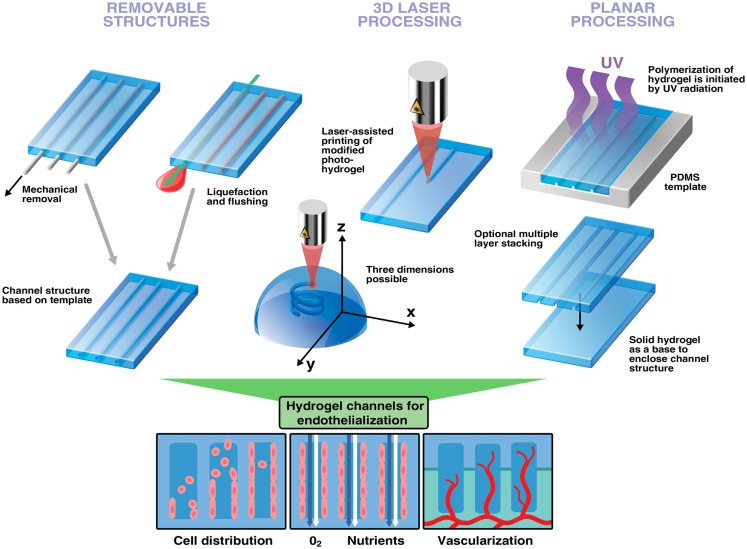
The use of cell-laden hydrogels to engineer soft tissue has been emerging within the past years. Despite, several newly developed and sophisticated techniques to encapsulate different cell types the importance of vascularization of the engineered constructs is often underestimated. As a result, cell death within a construct leads to impaired function and inclusion of the implant. Here, we discuss the fabrication of hollow channels within hydrogels as a promising strategy to facilitate vascularization. Furthermore, we present an overview on the feasible use of removable spacers, 3D laser-, and planar processing strategies to create channels within hydrogels. The implementation of these structures promotes control over cell distribution and increases oxygen transport and nutrient supply in vitro. However, many studies lack the use of endothelial cells in their approaches leaving out an important factor to enhance vessel ingrowth and anastomosis formation upon implantation. In addition, the adequate endothelial cell type needs to be considered to make these approaches bridge the gap to in vivo applications.
在过去的几年中,利用细胞负载水凝胶来工程软组织的方法已经出现。尽管已经开发出了几种新的、复杂的技术来封装不同类型的细胞,但工程化构建体的血管化的重要性往往被低估。因此,构建体内的细胞死亡会导致功能受损和植入物的包含。在这里,我们讨论了在水凝胶中制造空心通道作为促进血管生成的有前途的策略。此外,我们还概述了可移动间隔物、3D 激光和平面处理策略在水凝胶中制造通道的可行用途。这些结构的实施促进了对细胞分布的控制,并增加了体外的氧气运输和营养供应。然而,许多研究在其方法中缺乏内皮细胞的使用,从而忽略了一个重要的因素,即增强植入后血管生成和吻合形成。此外,需要考虑适当的内皮细胞类型,以使这些方法能够弥补与体内应用的差距。