Leibniz Institute for Age Research - Fritz Lipmann Institute (FLI), 07745 Jena, Germany.
Leibniz Institute for Age Research - Fritz Lipmann Institute (FLI), 07745 Jena, Germany; Faculty of Biology and Pharmacy, Friedrich Schiller University of Jena, 07745 Jena, Germany.
Genomics Proteomics Bioinformatics. 2014 Dec;12(6):255-65. doi: 10.1016/j.gpb.2014.10.004. Epub 2014 Nov 29.
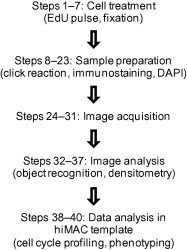
Cell cycle progression is coordinated with metabolism, signaling and other complex cellular functions. The investigation of cellular processes in a cell cycle stage-dependent manner is often the subject of modern molecular and cell biological research. Cell cycle synchronization and immunostaining of cell cycle markers facilitate such analysis, but are limited in use due to unphysiological experimental stress, cell type dependence and often low flexibility. Here, we describe high-content microscopy-assisted cell cycle phenotyping (hiMAC), which integrates high-resolution cell cycle profiling of asynchronous cell populations with immunofluorescence microscopy. hiMAC is compatible with cell types from any species and allows for statistically powerful, unbiased, simultaneous analysis of protein interactions, modifications and subcellular localization at all cell cycle stages within a single sample. For illustration, we provide a hiMAC analysis pipeline tailored to study DNA damage response and genomic instability using a 3-4-day protocol, which can be adjusted to any other cell cycle stage-dependent analysis.
细胞周期的进程与代谢、信号转导和其他复杂的细胞功能相协调。在依赖于细胞周期阶段的方式下研究细胞过程是现代分子和细胞生物学研究的主题。细胞周期同步化和细胞周期标志物的免疫染色有助于这种分析,但由于非生理的实验压力、细胞类型依赖性和通常较低的灵活性而受到限制。在这里,我们描述了高通量显微镜辅助的细胞周期表型分析(hiMAC),它将异步细胞群体的高分辨率细胞周期分析与免疫荧光显微镜相结合。hiMAC 与任何物种的细胞类型兼容,并允许在单个样本中对所有细胞周期阶段的蛋白质相互作用、修饰和亚细胞定位进行统计上强大、无偏、同时的分析。为了说明这一点,我们提供了一个 hiMAC 分析管道,针对使用 3-4 天方案研究 DNA 损伤反应和基因组不稳定性,该方案可以调整到任何其他依赖于细胞周期阶段的分析。