
肿瘤缺氧标志物匹莫硝唑反映了一种与侵袭性前列腺癌相关的转录程序。
The tumour hypoxia marker pimonidazole reflects a transcriptional programme associated with aggressive prostate cancer.
作者信息
Ragnum H B, Vlatkovic L, Lie A K, Axcrona K, Julin C H, Frikstad K M, Hole K H, Seierstad T, Lyng H
机构信息
Department of Radiation Biology, Norwegian Radium Hospital, Oslo University Hospital, Pb 4950, Nydalen, Oslo 0424, Norway.
Department of Pathology, Norwegian Radium Hospital, Oslo University Hospital, Oslo, Norway.
出版信息
Br J Cancer. 2015 Jan 20;112(2):382-90. doi: 10.1038/bjc.2014.604. Epub 2014 Dec 2.
BACKGROUND
The hypoxia marker pimonidazole is a candidate biomarker of cancer aggressiveness. We investigated the transcriptional programme associated with pimonidazole staining in prostate cancer.
METHODS
Index tumour biopsies were taken by image guidance from an investigation cohort of 52 patients, where 43 patients received pimonidazole before prostatectomy. Biopsy location within the index tumour was verified for 46 (88%) patients, who were included for gene expression profiling and immunohistochemistry. Two independent cohorts of 59 and 281 patients were used for validation.
RESULTS
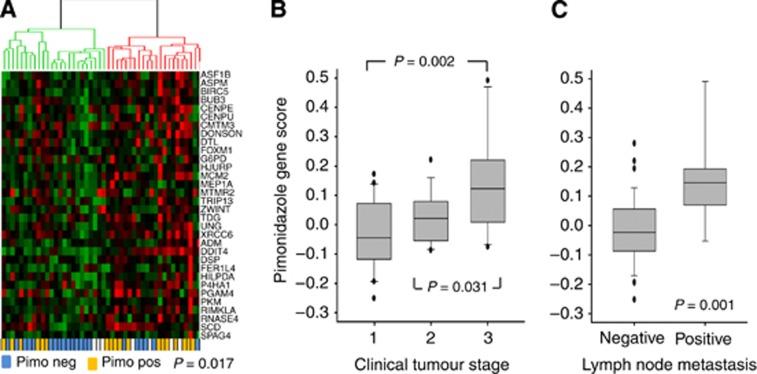
Expression of genes in proliferation, DNA repair and hypoxia response was a major part of the transcriptional programme associated with pimonidazole staining. A signature of 32 essential genes was constructed and showed positive correlation to Ki67 staining, confirming the increased proliferation in hypoxic tumours as suggested from the gene data. Positive correlations were also found to tumour stage and lymph node status, but not to blood prostate-specific antigen level, consistent with the findings for pimonidazole staining. The association with aggressiveness was confirmed in validation cohorts, where the signature correlated with Gleason score and had independent prognostic impact, respectively.
CONCLUSIONS
Pimonidazole staining reflects an aggressive hypoxic phenotype of prostate cancer characterised by upregulation of proliferation, DNA repair and hypoxia response genes.
背景
缺氧标志物匹莫硝唑是癌症侵袭性的候选生物标志物。我们研究了前列腺癌中与匹莫硝唑染色相关的转录程序。
方法
在影像引导下从52例患者的研究队列中获取索引肿瘤活检样本,其中43例患者在前列腺切除术前接受了匹莫硝唑治疗。对46例(88%)患者索引肿瘤内的活检位置进行了确认,这些患者被纳入基因表达谱分析和免疫组织化学研究。使用两个分别包含59例和281例患者的独立队列进行验证。
结果
增殖、DNA修复和缺氧反应相关基因的表达是与匹莫硝唑染色相关的转录程序的主要部分。构建了一个由32个关键基因组成的特征图谱,该图谱与Ki67染色呈正相关,证实了基因数据所提示的缺氧肿瘤中增殖增加的情况。还发现与肿瘤分期和淋巴结状态呈正相关,但与血液前列腺特异性抗原水平无关,这与匹莫硝唑染色的结果一致。在验证队列中证实了与侵袭性的关联,该特征图谱分别与 Gleason评分相关且具有独立的预后影响。
结论
匹莫硝唑染色反映了前列腺癌的一种侵袭性缺氧表型,其特征是增殖、DNA修复和缺氧反应基因上调。



 Zotero 插件