Rybakova Katja N, Tomaszewska Aleksandra, van Mourik Simon, Blom Joke, Westerhoff Hans V, Carlberg Carsten, Bruggeman Frank J
Molecular Cell Physiology, VU University Amsterdam, De Boelelaan 1087, NL-1081 HV Amsterdam, The Netherlands
School of Medicine, Institute of Biomedicine, University of Eastern Finland, FI-70211 Kuopio, Finland.
Nucleic Acids Res. 2015 Jan;43(1):153-61. doi: 10.1093/nar/gku1272. Epub 2014 Dec 3.
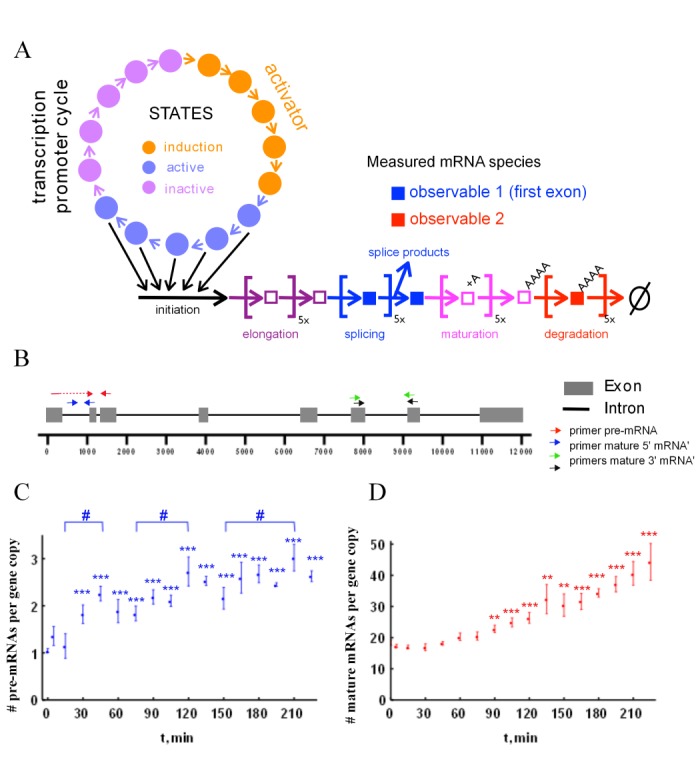
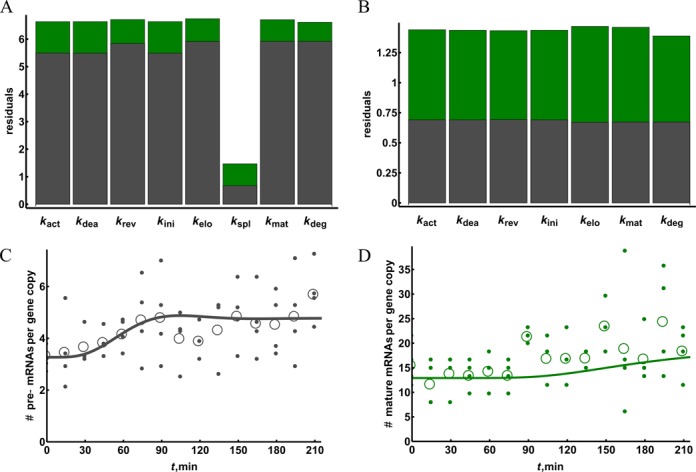
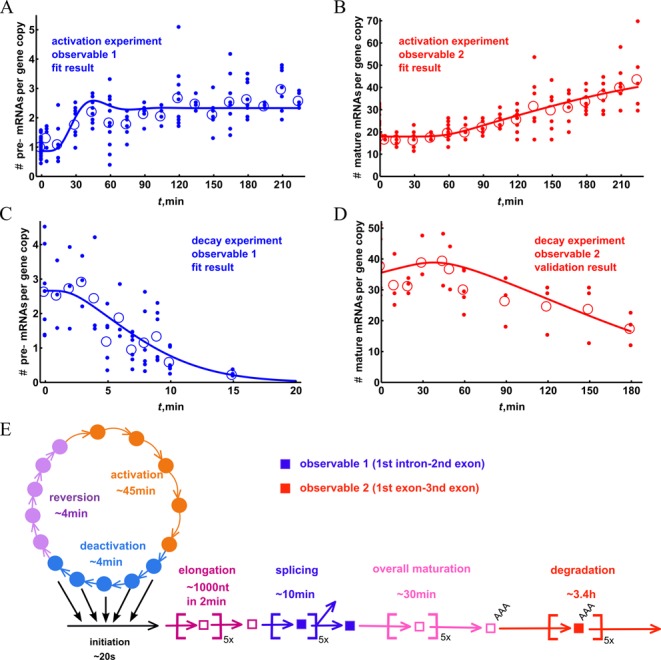
Changes in transcription factor levels, epigenetic status, splicing kinetics and mRNA degradation can each contribute to changes in the mRNA dynamics of a gene. We present a novel method to identify which of these processes is changed in cells in response to external signals or as a result of a diseased state. The method employs a mathematical model, for which the kinetics of gene regulation, splicing, elongation and mRNA degradation were estimated from experimental data of transcriptional dynamics. The time-dependent dynamics of several species of adipose differentiation-related protein (ADRP) mRNA were measured in response to ligand activation of the transcription factor peroxisome proliferator-activated receptor δ (PPARδ). We validated the method by monitoring the mRNA dynamics upon gene activation in the presence of a splicing inhibitor. Our mathematical model correctly identifies splicing as the inhibitor target, despite the noise in the data.
转录因子水平、表观遗传状态、剪接动力学和mRNA降解的变化都可能导致基因mRNA动态变化。我们提出了一种新方法,用于确定这些过程中哪些在细胞中因外部信号或疾病状态而发生了改变。该方法采用了一个数学模型,其基因调控、剪接、延伸和mRNA降解的动力学是根据转录动力学的实验数据估算得出的。我们测量了几种脂肪分化相关蛋白(ADRP)mRNA在转录因子过氧化物酶体增殖物激活受体δ(PPARδ)配体激活后的时间依赖性动态变化。我们通过监测存在剪接抑制剂时基因激活后的mRNA动态变化来验证该方法。尽管数据存在噪声,但我们的数学模型仍能正确识别剪接为抑制剂的作用靶点。