Solorzano Cesar D, Abbas Hamed K, Zablotowicz Robert M, Chang Perng-Kuang, Jones Walker A
Biological Control of Pests Research Unit, United States Department of Agriculture, Agricultural Research Service, Stoneville, MS 38776, USA.
Crop Production Systems Research Unit, United States Department of Agriculture, Agricultural Research Service, Stoneville, MS 38776, USA.
ScientificWorldJournal. 2014;2014:356059. doi: 10.1155/2014/356059. Epub 2014 Nov 12.
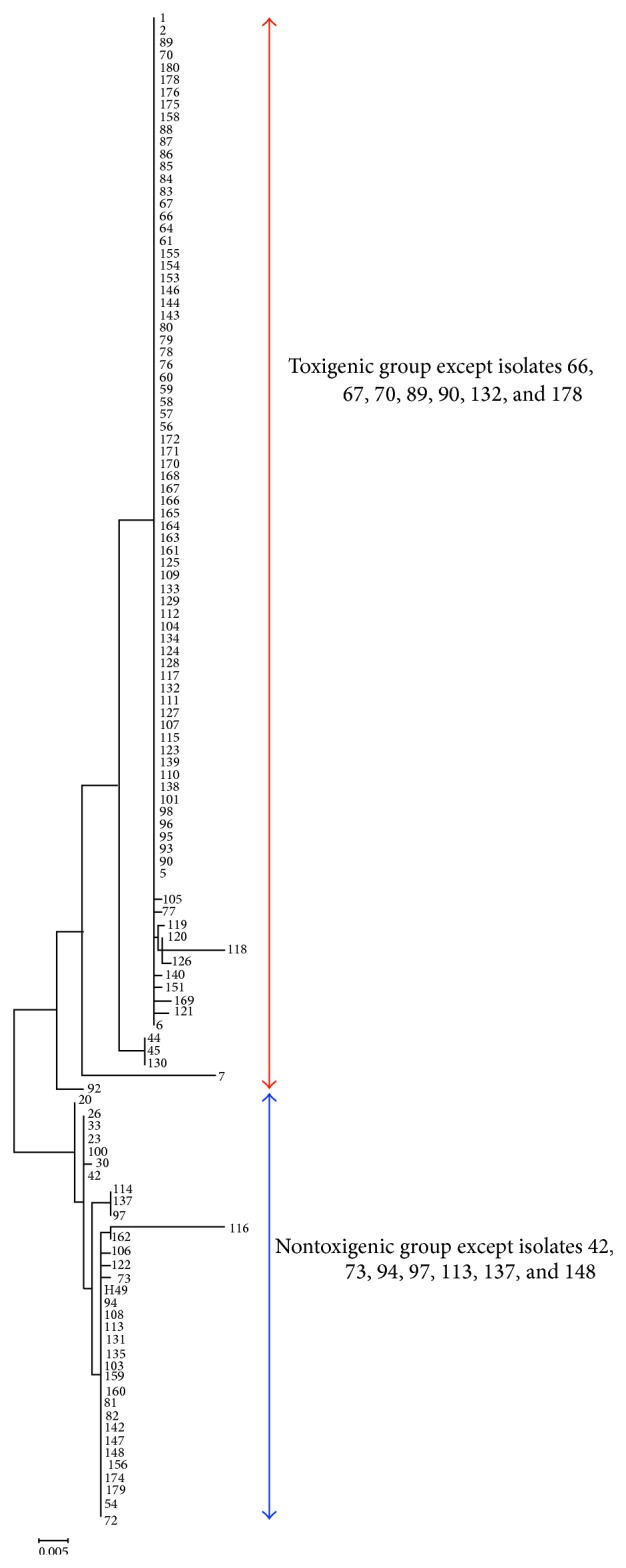
A nontoxigenic Aspergillus flavus strain, K49, is currently being tested as a biological control agent in corn fields in the Mississippi Delta. However, little is known about the overall genetic diversity of A. flavus from year to year in corn fields and specifically in Mississippi. Our objective was to assess the genetic variability of A. flavus isolates from different seasons, inoculum sources, and years, from a no-till corn field. Of the 175 A. flavus isolates examined, 74 and 97 had the typical norB-cypA type I (1.5 kb) and type II (1.0 kb) deletion patterns, respectively. Variability in the sequence of the omtA gene of the majority of the field isolates (n = 118) was compared to strain K49. High levels of haplotypic diversity (24 omtA haplotypes; Hd = 0.61 ± 0.04) were found. Among the 24 haplotypes, two were predominant, H1 (n = 71), which consists of mostly toxigenic isolates, and H49 (n = 18), which consists of mostly atoxigenic isolates including K49. Toxigenic isolates were prevalent (60%) in this natural population. Nonetheless, about 15% of the population likely shared the same ancestral origin with K49. This study provides valuable information on the diversity of A. flavus. This knowledge can be further used to develop additional biological control strains.
一种非产毒黄曲霉菌株K49目前正在密西西比三角洲的玉米田中作为生物防治剂进行测试。然而,对于玉米田中逐年的黄曲霉总体遗传多样性,尤其是密西西比州的情况,人们了解甚少。我们的目标是评估来自免耕玉米田不同季节、接种源和年份的黄曲霉分离株的遗传变异性。在检测的175株黄曲霉分离株中,分别有74株和97株具有典型的norB - cypA I型(1.5 kb)和II型(1.0 kb)缺失模式。将大多数田间分离株(n = 118)的omtA基因序列变异性与K49菌株进行了比较。发现单倍型多样性水平较高(24种omtA单倍型;Hd = 0.61±0.04)。在这24种单倍型中,两种占主导地位,H1(n = 71),主要由产毒分离株组成,H49(n = 18),主要由包括K49在内的非产毒分离株组成。产毒分离株在这个自然群体中很普遍(60%)。尽管如此,约15%的群体可能与K49有相同的祖先起源。本研究提供了关于黄曲霉多样性的有价值信息。这些知识可进一步用于开发更多的生物防治菌株。