Rahim Said, Minas Tsion, Hong Sung-Hyeok, Justvig Sarah, Çelik Haydar, Kont Yasemin Saygideger, Han Jenny, Kallarakal Abraham T, Kong Yali, Rudek Michelle A, Brown Milton L, Kallakury Bhaskar, Toretsky Jeffrey A, Üren Aykut
Lombardi Comprehensive Cancer Center, Georgetown University Medical Center, Washington, DC, United States of America.
The Sidney Kimmel Comprehensive Cancer Center, Johns Hopkins University, Baltimore, MD, United States of America.
PLoS One. 2014 Dec 5;9(12):e114260. doi: 10.1371/journal.pone.0114260. eCollection 2014.
The erythroblastosis virus E26 transforming sequences (ETS) family of transcription factors consists of a highly conserved group of genes that play important roles in cellular proliferation, differentiation, migration and invasion. Chromosomal translocations fusing ETS factors to promoters of androgen responsive genes have been found in prostate cancers, including the most clinically aggressive forms. ERG and ETV1 are the most commonly translocated ETS proteins. Over-expression of these proteins in prostate cancer cells results in a more invasive phenotype. Inhibition of ETS activity by small molecule inhibitors may provide a novel method for the treatment of prostate cancer.
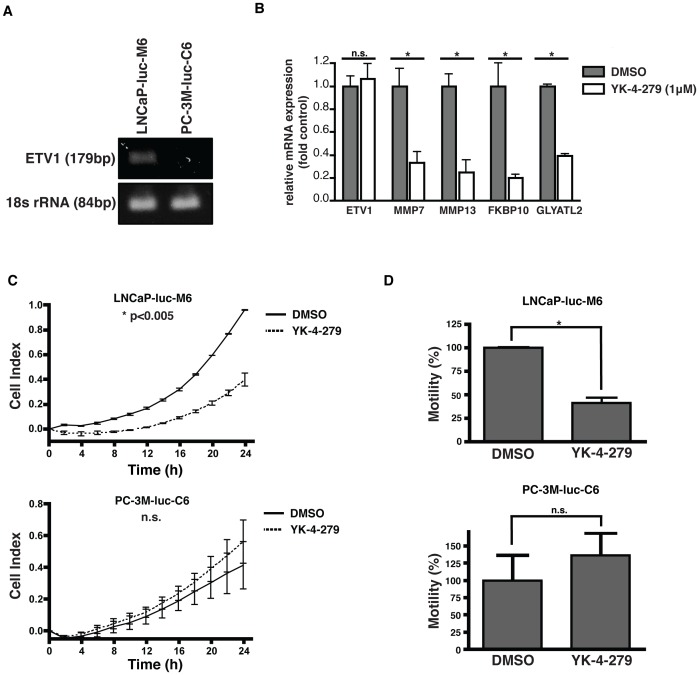
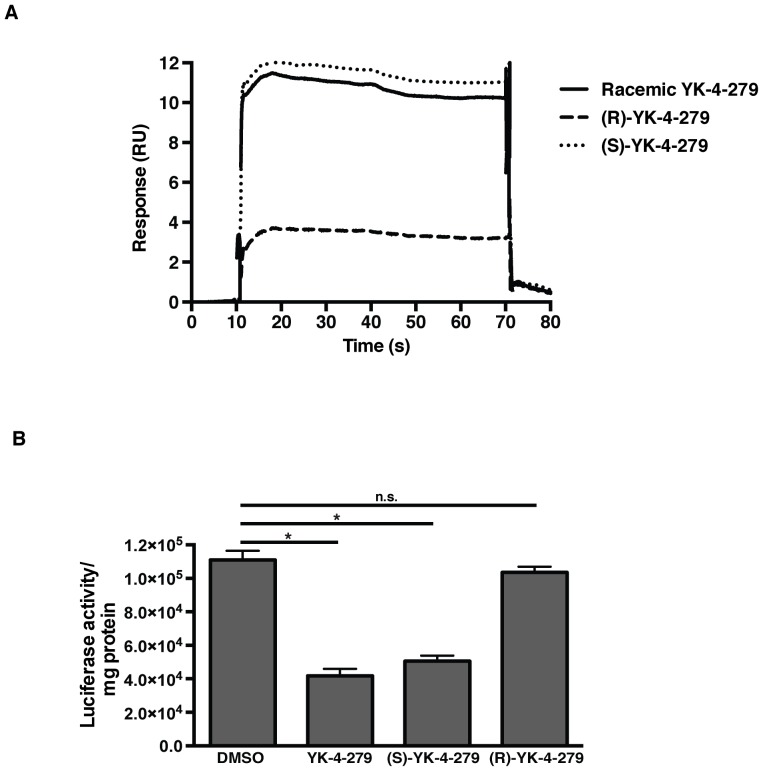
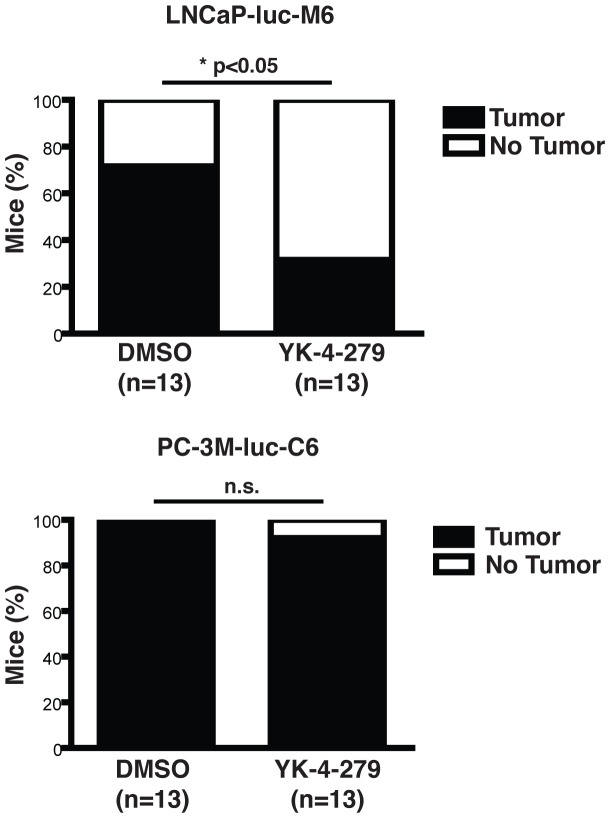
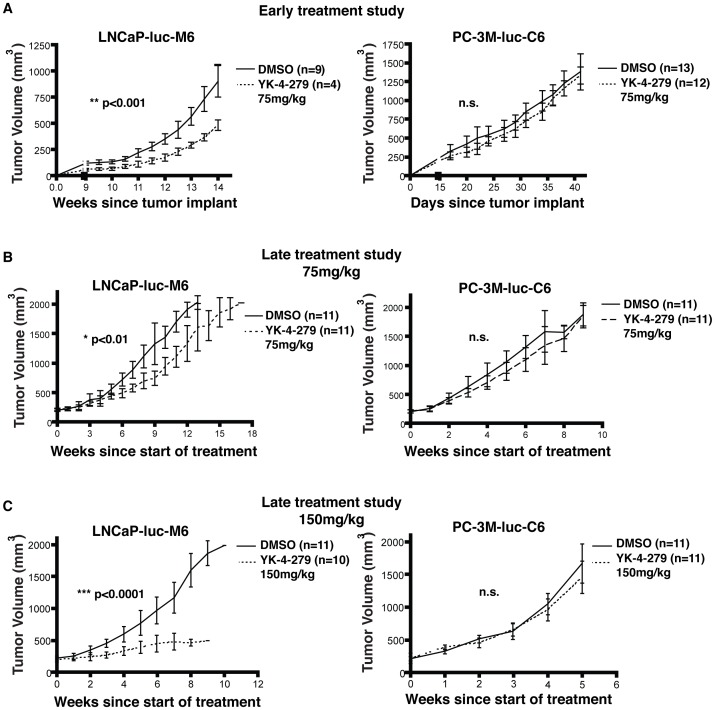
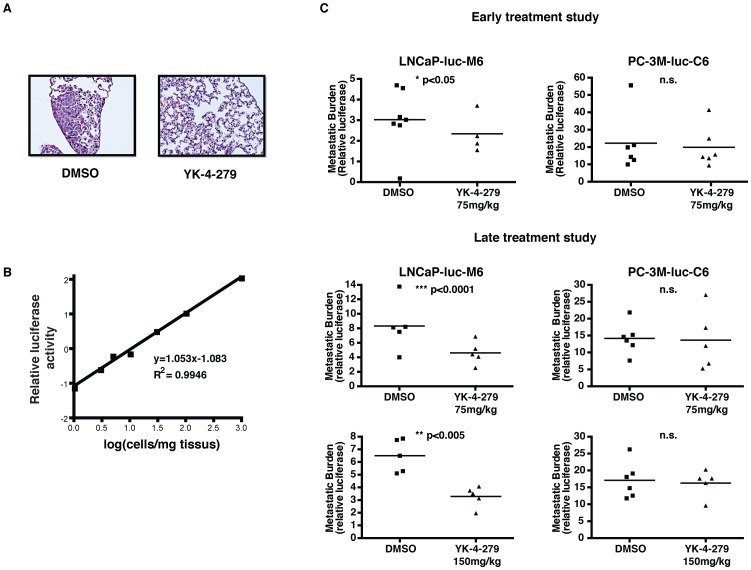
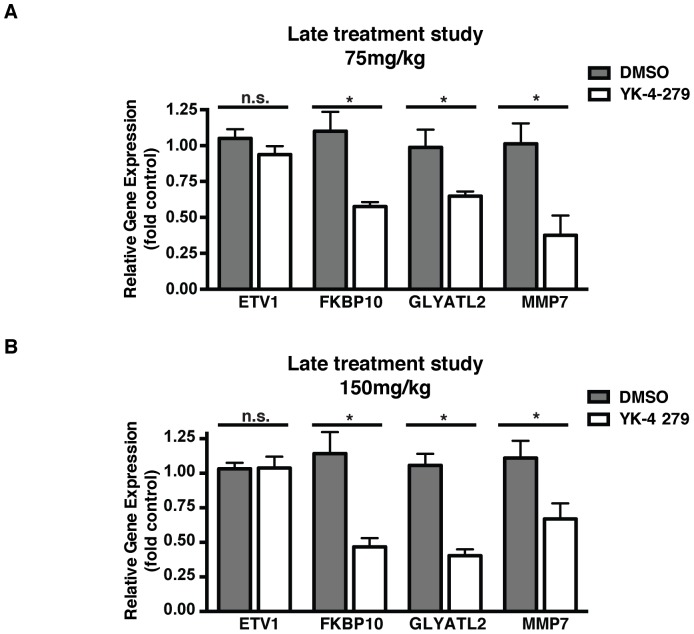
We recently demonstrated that the small molecule YK-4-279 inhibits biological activity of ETV1 in fusion-positive prostate cancer cells leading to decreased motility and invasion in-vitro. Here, we present data from an in-vivo mouse xenograft model. SCID-beige mice were subcutaneously implanted with fusion-positive LNCaP-luc-M6 and fusion-negative PC-3M-luc-C6 tumors. Animals were treated with YK-4-279, and its effects on primary tumor growth and lung metastasis were evaluated. YK-4-279 treatment resulted in decreased growth of the primary tumor only in LNCaP-luc-M6 cohort. When primary tumors were grown to comparable sizes, YK-4-279 inhibited tumor metastasis to the lungs. Expression of ETV1 target genes MMP7, FKBP10 and GLYATL2 were reduced in YK-4-279 treated animals. ETS fusion-negative PC-3M-luc-C6 xenografts were unresponsive to the compound. Furthermore, YK-4-279 is a chiral molecule that exists as a racemic mixture of R and S enantiomers. We established that (S)-YK-4-279 is the active enantiomer in prostate cancer cells.
Our results demonstrate that YK-4-279 is a potent inhibitor of ETV1 and inhibits both the primary tumor growth and metastasis of fusion positive prostate cancer xenografts. Therefore, YK-4-279 or similar compounds may be evaluated as a potential therapeutic tool for treatment of human prostate cancer at different stages.
成红细胞增多症病毒E26转化序列(ETS)转录因子家族由一组高度保守的基因组成,这些基因在细胞增殖、分化、迁移和侵袭中发挥重要作用。在前列腺癌中,包括临床上侵袭性最强的类型,已发现将ETS因子与雄激素反应基因的启动子融合的染色体易位。ERG和ETV1是最常发生易位的ETS蛋白。这些蛋白在前列腺癌细胞中的过表达导致更具侵袭性的表型。小分子抑制剂对ETS活性的抑制可能为前列腺癌的治疗提供一种新方法。
我们最近证明,小分子YK-4-279抑制融合阳性前列腺癌细胞中ETV1的生物学活性,导致体外运动性和侵袭性降低。在此,我们展示了来自体内小鼠异种移植模型的数据。将SCID-米色小鼠皮下植入融合阳性的LNCaP-luc-M6肿瘤和融合阴性的PC-3M-luc-C6肿瘤。用YK-4-279处理动物,并评估其对原发性肿瘤生长和肺转移的影响。YK-4-279处理仅在LNCaP-luc-M6组中导致原发性肿瘤生长减少。当原发性肿瘤生长到可比大小时,YK-4-279抑制肿瘤向肺部转移。在接受YK-4-279处理的动物中,ETV1靶基因MMP7、FKBP10和GLYATL2的表达降低。ETS融合阴性的PC-3M-luc-C6异种移植对该化合物无反应。此外,YK-4-279是一种手性分子,以R和S对映体的外消旋混合物形式存在。我们确定(S)-YK-4-279是前列腺癌细胞中的活性对映体。
我们的结果表明,YK-4-279是ETV1的有效抑制剂,可抑制融合阳性前列腺癌异种移植的原发性肿瘤生长和转移。因此,YK-4-279或类似化合物可作为治疗不同阶段人类前列腺癌的潜在治疗工具进行评估。