Hageman Patricia A, Pullen Carol H, Hertzog Melody, Boeckner Linda S
Physical Therapy Education, School of Allied Health Professions, College of Medicine, University of Nebraska Medical Center, Omaha, Nebraska, 68198-4420, USA.
College of Nursing, University of Nebraska Medical Center, Omaha, NE, 68198-5330, USA.
Int J Behav Nutr Phys Act. 2014 Dec 6;11:148. doi: 10.1186/s12966-014-0148-2.
Lifestyle modification is recommended for management of prehypertension, yet finding effective interventions to reach rural women is a public health challenge. This community-based clinical trial compared the effectiveness of standard advice to two multi-component theory-based tailored interventions, using web-based or print-mailed delivery, in reducing blood pressure among rural women, ages 40-69, with prehypertension.
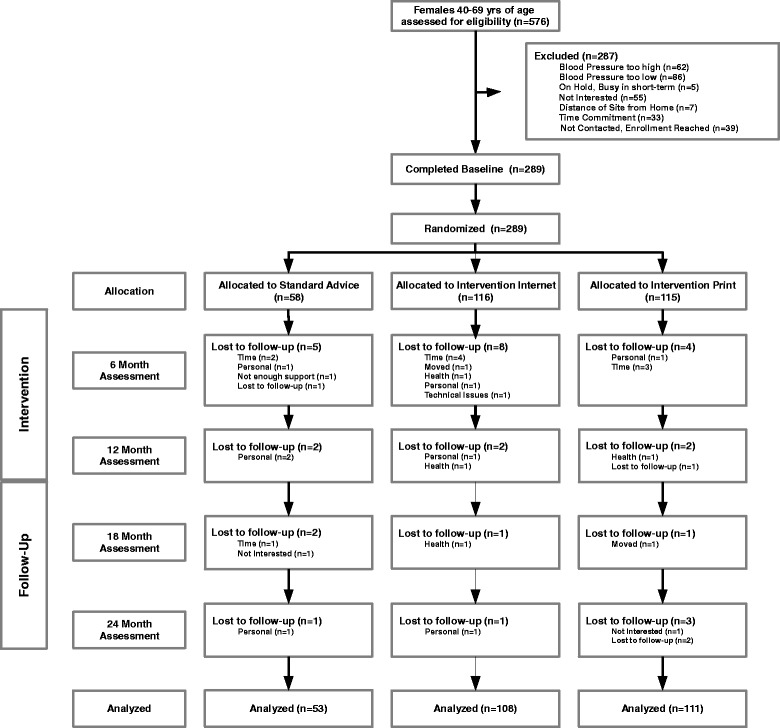
289 women with prehypertension enrolled in the Wellness for Women: DASHing towards Health trial, a 12-month intervention with 12-month follow-up. Women were randomly assigned to groups using a 1:2:2 ratio, comparing standard advice (30-minute counseling session) to two interventions (two 2-hour counseling sessions, 5 phone goal-setting sessions, strength-training video, and 16 tailored newsletters, web-based or print-mailed). Linear mixed model methods were used to test planned pairwise comparisons of marginal mean change in blood pressure, healthy eating and activity, adjusted for age and baseline level. General estimating equations were used to examine the proportion of women achieving normotensive status and meeting health outcome criteria for eating and activity.
Mean blood pressure reduction ranged from 3.8 (SD = 9.8) mm Hg to 8.1 (SD = 10.4) mm Hg. The 24-month estimated marginal proportions of women achieving normotensive status were 47% for web-based, and 39% for both print-mailed and standard advice groups, with no group differences (p = .11 and p = .09, respectively). Web-based and print-mailed groups improved more than standard advice group for waist circumference (p = .017 and p = .016, respectively); % daily calories from fat (p = .018 and p = .030) and saturated fat (p = .049 and p = .013); daily servings of fruit and vegetables (p = .008 and p < .005); and low fat dairy (p < .001 and p = .002). Greater improvements were observed in web-based versus standard advice groups in systolic blood pressure (p = .048) and estimated VO2max (p = .037). Dropout rates were 6% by 6-months, 11.4% by 24 months, with no differences across groups.
Rural women with prehypertension receiving distance-delivery theory-based lifestyle modifications can achieve a reduction of blood pressure and attainment of normotensive status.
ClinicalTrials.gov NCT00580528.
生活方式的改变被推荐用于管理高血压前期,然而找到有效的干预措施来覆盖农村女性是一项公共卫生挑战。这项基于社区的临床试验比较了标准建议与两种基于多成分理论的量身定制干预措施(通过网络或邮寄印刷品的方式提供)在降低40 - 69岁患有高血压前期的农村女性血压方面的效果。
289名患有高血压前期的女性参与了“女性健康:迈向健康的DASH饮食法”试验,这是一项为期12个月的干预试验,并进行了12个月的随访。女性被按照1:2:2的比例随机分组,将标准建议(30分钟咨询课程)与两种干预措施(两次2小时咨询课程、5次电话目标设定课程、力量训练视频以及16份量身定制的时事通讯,通过网络或邮寄印刷品的方式提供)进行比较。使用线性混合模型方法来测试计划中的血压、健康饮食和活动的边际均值变化的成对比较,并根据年龄和基线水平进行调整。使用广义估计方程来检查达到正常血压状态以及满足饮食和活动健康结果标准的女性比例。
平均血压降低范围为3.8(标准差 = 9.8)毫米汞柱至8.1(标准差 = 10.4)毫米汞柱。在24个月时,达到正常血压状态的女性的估计边际比例在基于网络的组中为47%,在邮寄印刷品组和标准建议组中均为39%,组间无差异(分别为p = 0.11和p = 0.09)。基于网络的组和邮寄印刷品组在腰围方面的改善超过标准建议组(分别为p = 0.017和p = 0.016);来自脂肪的每日卡路里百分比(p = 0.018和p = 0.030)以及饱和脂肪(p = 0.049和p = 0.013);每日水果和蔬菜的摄入量(p = 0.008和p < 0.005);以及低脂乳制品摄入量(p < 0.001和p = 0.002)。在收缩压(p = 0.048)和估计的最大摄氧量(p = 0.037)方面,基于网络的组与标准建议组相比有更大的改善。6个月时的退出率为6%,24个月时为11.4%,各组之间无差异。
患有高血压前期的农村女性接受基于远程交付理论的生活方式改变可以实现血压降低并达到正常血压状态。
ClinicalTrials.gov NCT00580528。