Babbucci Massimiliano, Basso Andrea, Scupola Antonio, Patarnello Tomaso, Negrisolo Enrico
Department of Comparative Biomedicine and Food Science (BCA), University of Padova, Agripolis, Legnaro (PD), Italy.
Department of Comparative Biomedicine and Food Science (BCA), University of Padova, Agripolis, Legnaro (PD), Italy Department of Agronomy, Food, Natural Resources, Animal and Environment (DAFNE), University of Padova, Agripolis, Legnaro (PD), Italy Department of Comparative Biomedicine and Food Science (BCA), University of Padova, Agripolis, Legnaro (PD), Italy.
Genome Biol Evol. 2014 Dec 4;6(12):3326-43. doi: 10.1093/gbe/evu265.
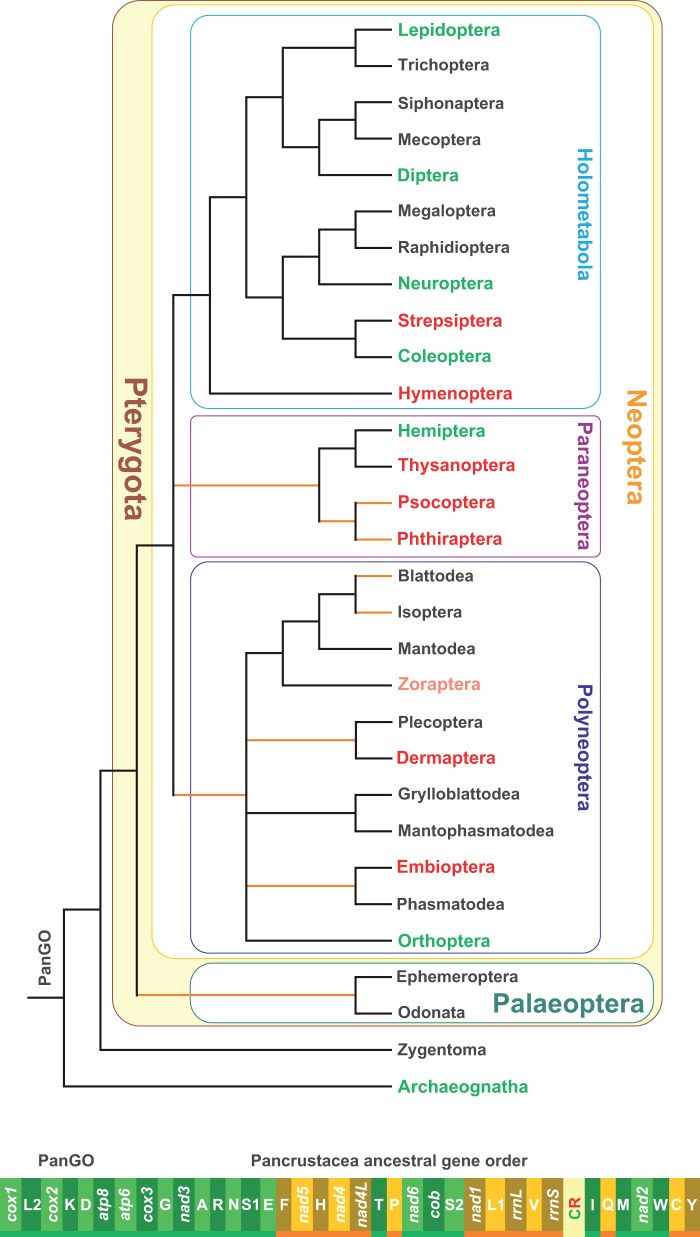
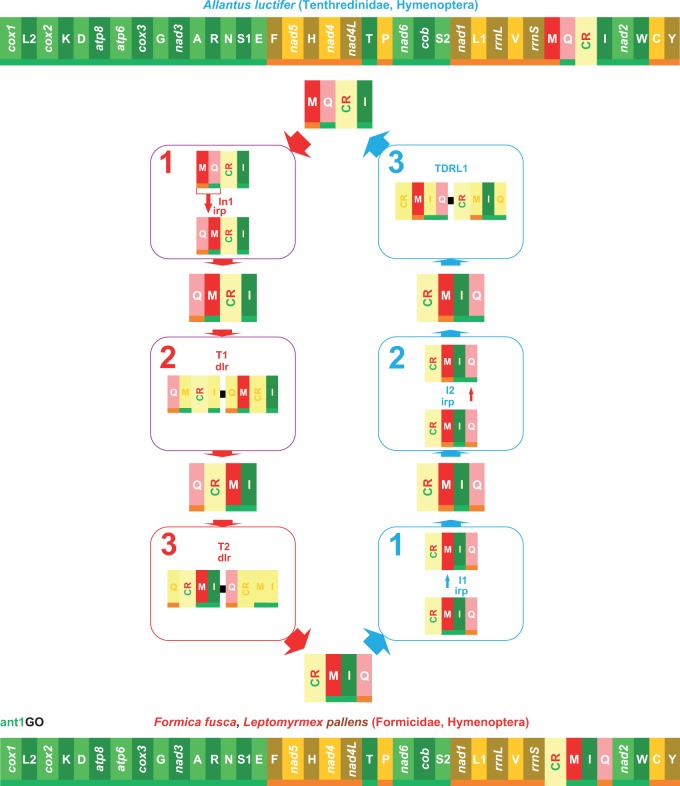
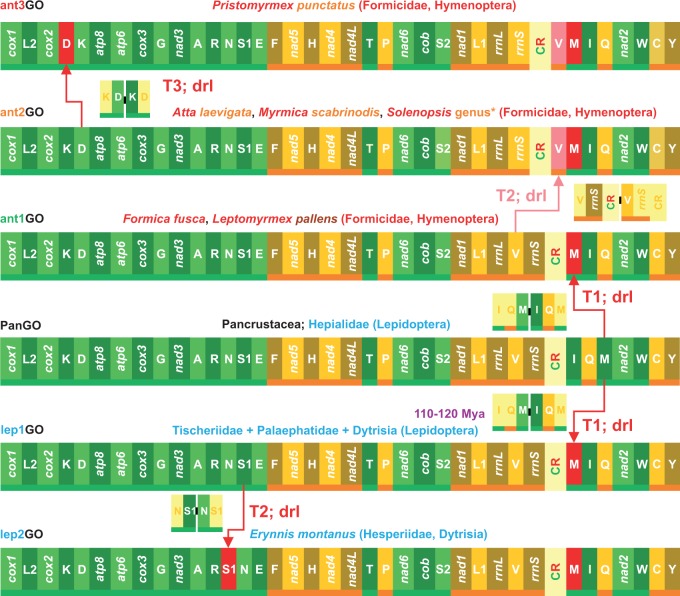
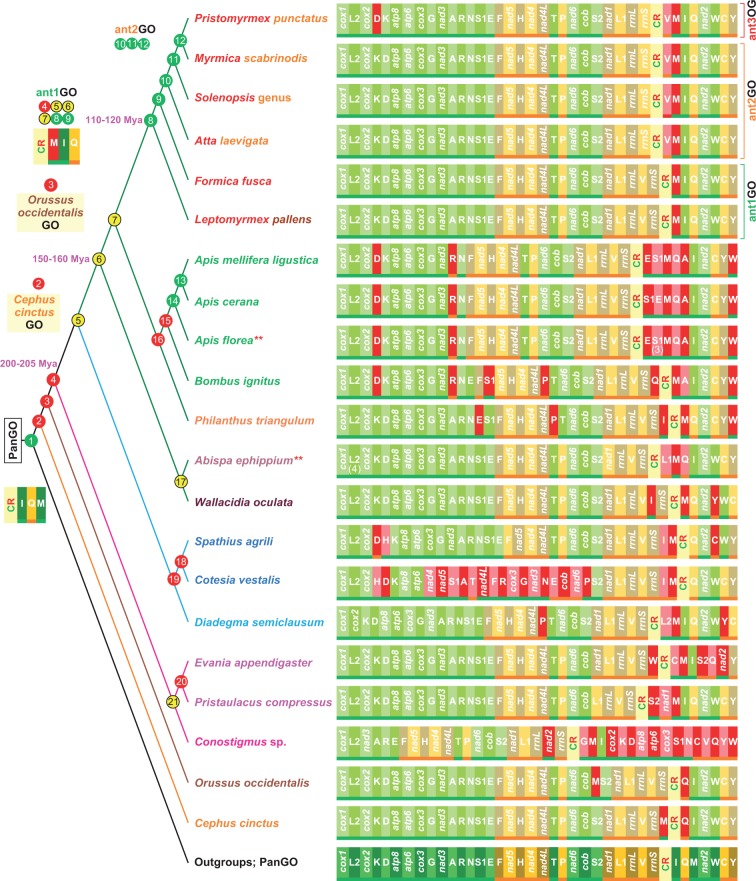
Insect mitochondrial genomes (mtDNA) are usually double helical and circular molecules containing 37 genes that are encoded on both strands. The arrangement of the genes is not constant for all species, and produces distinct gene orders (GOs) that have proven to be diagnostic in defining clades at different taxonomic levels. In general, it is believed that distinct taxa have a very low chance of sharing identically arranged GOs. However, examples of identical, homoplastic local rearrangements occurring in distinct taxa do exist. In this study, we sequenced the complete mtDNAs of the ants Formica fusca and Myrmica scabrinodis (Formicidae, Hymenoptera) and compared their GOs with those of other Insecta. The GO of F. fusca was found to be identical to the GO of Dytrisia (the largest clade of Lepidoptera). This finding is the first documented case of an identical GO shared by distinct groups of Insecta, and it is the oldest known event of GO convergent evolution in animals. Both Hymenoptera and Lepidoptera acquired this GO early in their evolution. Using a phylogenetic approach combined with new bioinformatic tools, the chronological order of the evolutionary events that produced the diversity of the hymenopteran GOs was determined. Additionally, new local homoplastic rearrangements shared by distinct groups of insects were identified. Our study showed that local and global homoplasies affecting the insect GOs are more widespread than previously thought. Homoplastic GOs can still be useful for characterizing the various clades, provided that they are appropriately considered in a phylogenetic and taxonomic context.
昆虫线粒体基因组(mtDNA)通常是双螺旋环状分子,包含37个基因,分布于两条链上。基因排列在所有物种中并非恒定不变,会产生不同的基因顺序(GOs),这些基因顺序已被证明在定义不同分类水平的进化枝时具有诊断价值。一般认为,不同的分类群共享相同排列的基因顺序的可能性非常低。然而,在不同分类群中确实存在相同的、同塑性局部重排的例子。在本研究中,我们对褐蚁(Formica fusca)和皱结蚁(Myrmica scabrinodis)(蚁科,膜翅目)的完整线粒体DNA进行了测序,并将它们的基因顺序与其他昆虫纲的进行了比较。发现褐蚁的基因顺序与夜蛾亚目(鳞翅目中最大的进化枝)的基因顺序相同。这一发现是首次记录的不同昆虫类群共享相同基因顺序的案例,也是动物界已知最古老的基因顺序趋同进化事件。膜翅目和鳞翅目在其进化早期就获得了这种基因顺序。结合新的生物信息学工具,采用系统发育方法确定了产生膜翅目基因顺序多样性的进化事件的时间顺序。此外,还鉴定出了不同昆虫类群共享的新的局部同塑性重排。我们的研究表明,影响昆虫基因顺序的局部和全局同塑性比以前认为的更为普遍。同塑性基因顺序在系统发育和分类学背景下得到适当考虑时,仍可用于表征不同的进化枝。