James Allison, Wang Yubo, Raje Himanshu, Rosby Raphyel, DiMario Patrick
a Department of Biological Sciences; Louisiana State University; Baton Rouge, LA USA.
Nucleus. 2014 Sep-Oct;5(5):402-26. doi: 10.4161/nucl.32235.
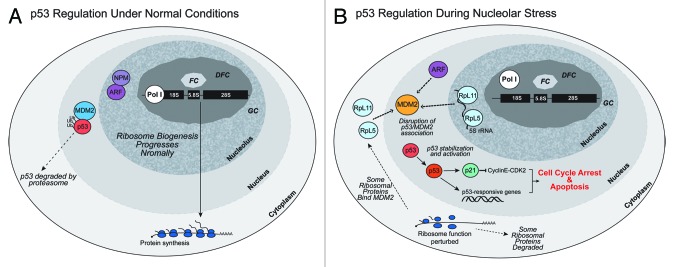
A veritable explosion of primary research papers within the past 10 years focuses on nucleolar and ribosomal stress, and for good reason: with ribosome biosynthesis consuming ~80% of a cell's energy, nearly all metabolic and signaling pathways lead ultimately to or from the nucleolus. We begin by describing p53 activation upon nucleolar stress resulting in cell cycle arrest or apoptosis. The significance of this mechanism cannot be understated, as oncologists are now inducing nucleolar stress strategically in cancer cells as a potential anti-cancer therapy. We also summarize the human ribosomopathies, syndromes in which ribosome biogenesis or function are impaired leading to birth defects or bone narrow failures; the perplexing problem in the ribosomopathies is why only certain cells are affected despite the fact that the causative mutation is systemic. We then describe p53-independent nucleolar stress, first in yeast which lacks p53, and then in other model metazoans that lack MDM2, the critical E3 ubiquitin ligase that normally inactivates p53. Do these presumably ancient p53-independent nucleolar stress pathways remain latent in human cells? If they still exist, can we use them to target >50% of known human cancers that lack functional p53?
在过去10年里,关于核仁及核糖体应激的原创研究论文数量激增,这绝非偶然:核糖体生物合成消耗了细胞约80%的能量,几乎所有代谢和信号通路最终都通向核仁或从核仁发出。我们首先描述核仁应激时p53的激活,这会导致细胞周期停滞或凋亡。这一机制的重要性再怎么强调也不为过,因为肿瘤学家如今正战略性地在癌细胞中诱导核仁应激,将其作为一种潜在的抗癌疗法。我们还总结了人类核糖体病,即核糖体生物合成或功能受损导致出生缺陷或骨髓衰竭的综合征;核糖体病中令人困惑的问题是,尽管致病突变是全身性的,但为何只有某些细胞受到影响。然后我们描述不依赖p53的核仁应激,首先是在缺乏p53的酵母中,接着是在缺乏MDM2的其他后生动物模型中,MDM2是一种关键的E3泛素连接酶,通常会使p53失活。这些大概古老的不依赖p53的核仁应激途径在人类细胞中是否仍然潜伏着?如果它们仍然存在,我们能否利用它们来靶向超过50%的已知缺乏功能性p53的人类癌症?