De Vos Lieschen, Steenkamp Emma T, Martin Simon H, Santana Quentin C, Fourie Gerda, van der Merwe Nicolaas A, Wingfield Michael J, Wingfield Brenda D
Department of Genetics, Forestry and Agricultural Biotechnology Institute (FABI), University of Pretoria, Private Bag X20, Pretoria, South Africa.
Department of Microbiology and Plant Pathology, Forestry and Agricultural Biotechnology Institute (FABI), University of Pretoria, Private Bag X20, Pretoria, South Africa.
PLoS One. 2014 Dec 8;9(12):e114682. doi: 10.1371/journal.pone.0114682. eCollection 2014.
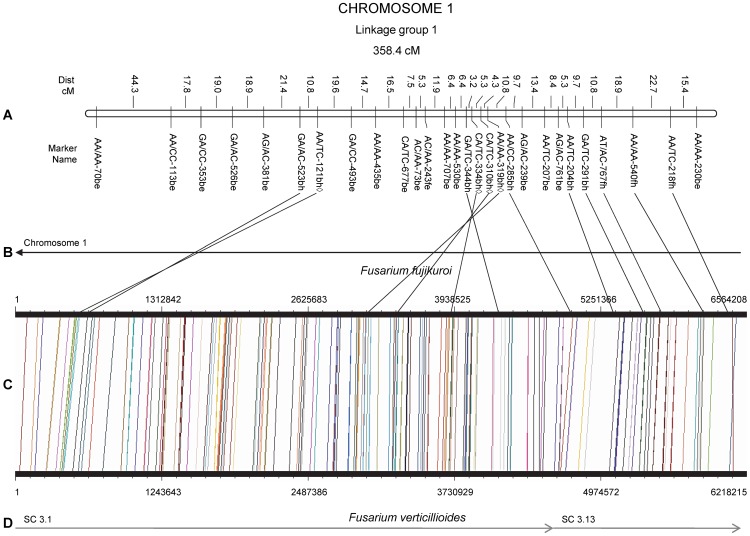
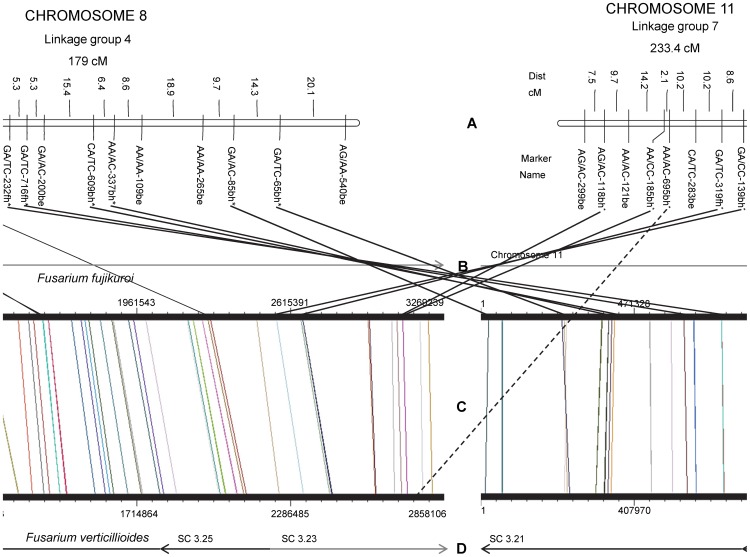
The Gibberella fujikuroi complex includes many Fusarium species that cause significant losses in yield and quality of agricultural and forestry crops. Due to their economic importance, whole-genome sequence information has rapidly become available for species including Fusarium circinatum, Fusarium fujikuroi and Fusarium verticillioides, each of which represent one of the three main clades known in this complex. However, no previous studies have explored the genomic commonalities and differences among these fungi. In this study, a previously completed genetic linkage map for an interspecific cross between Fusarium temperatum and F. circinatum, together with genomic sequence data, was utilized to consider the level of synteny between the three Fusarium genomes. Regions that are homologous amongst the Fusarium genomes examined were identified using in silico and pyrosequenced amplified fragment length polymorphism (AFLP) fragment analyses. Homology was determined using BLAST analysis of the sequences, with 777 homologous regions aligned to F. fujikuroi and F. verticillioides. This also made it possible to assign the linkage groups from the interspecific cross to their corresponding chromosomes in F. verticillioides and F. fujikuroi, as well as to assign two previously unmapped supercontigs of F. verticillioides to probable chromosomal locations. We further found evidence of a reciprocal translocation between the distal ends of chromosome 8 and 11, which apparently originated before the divergence of F. circinatum and F. temperatum. Overall, a remarkable level of macrosynteny was observed among the three Fusarium genomes, when comparing AFLP fragments. This study not only demonstrates how in silico AFLPs can aid in the integration of a genetic linkage map to the physical genome, but it also highlights the benefits of using this tool to study genomic synteny and architecture.
藤仓赤霉菌复合体包含许多镰刀菌物种,这些物种会给农林作物的产量和品质造成重大损失。由于其经济重要性,包括轮枝镰刀菌、藤仓赤霉菌和串珠镰刀菌在内的物种的全基因组序列信息已迅速可得,它们各自代表了该复合体中已知的三个主要进化枝之一。然而,此前尚无研究探讨这些真菌之间的基因组共性与差异。在本研究中,利用之前完成的温带镰刀菌和轮枝镰刀菌种间杂交的遗传连锁图谱以及基因组序列数据,来考量这三种镰刀菌基因组之间的共线性水平。使用电子分析和焦磷酸测序扩增片段长度多态性(AFLP)片段分析,确定了所检测的镰刀菌基因组之间的同源区域。通过对序列进行BLAST分析确定同源性,共鉴定出777个与藤仓赤霉菌和轮枝镰刀菌同源的区域。这也使得将种间杂交的连锁群对应到轮枝镰刀菌和藤仓赤霉菌相应的染色体上成为可能,同时还能将轮枝镰刀菌两个之前未定位的超级重叠群定位到可能的染色体位置。我们还发现了8号和11号染色体远端之间相互易位的证据,这种易位显然发生在轮枝镰刀菌和温带镰刀菌分化之前。总体而言,比较AFLP片段时,在这三种镰刀菌基因组中观察到了显著水平的宏观共线性。本研究不仅展示了电子AFLP如何有助于将遗传连锁图谱与物理基因组整合,还突出了使用该工具研究基因组共线性和结构的益处。