Lee Eun Young, Kaneko Shuji, Jutabha Promsuk, Zhang Xilin, Seino Susumu, Jomori Takahito, Anzai Naohiko, Miki Takashi
Department of Medical PhysiologyGraduate School of Medicine, Chiba University, 1-8-1 Inohana, Chuo-ku, Chiba 260-8670, JapanDepartment of Molecular PharmacologyGraduate School of Pharmaceutical Sciences, Kyoto University, Kyoto, JapanDepartment of Pharmacology and ToxicologyDokkyo Medical University School of Medicine, Tochigi 321-0293, JapanDivision of Molecular and Metabolic MedicineKobe University Graduate School of Medicine, 7-5-1, Kusunoki-cho, Chuo-ku, Kobe 650-0017, JapanDrug Development CenterSanwa Kagaku Kenkyusho Co., Ltd, 35 Higashisotobori-cho, Higashi-ku, Nagoya 461-8631, Japan.
Department of Medical PhysiologyGraduate School of Medicine, Chiba University, 1-8-1 Inohana, Chuo-ku, Chiba 260-8670, JapanDepartment of Molecular PharmacologyGraduate School of Pharmaceutical Sciences, Kyoto University, Kyoto, JapanDepartment of Pharmacology and ToxicologyDokkyo Medical University School of Medicine, Tochigi 321-0293, JapanDivision of Molecular and Metabolic MedicineKobe University Graduate School of Medicine, 7-5-1, Kusunoki-cho, Chuo-ku, Kobe 650-0017, JapanDrug Development CenterSanwa Kagaku Kenkyusho Co., Ltd, 35 Higashisotobori-cho, Higashi-ku, Nagoya 461-8631, Japan
J Endocrinol. 2015 Mar;224(3):205-14. doi: 10.1530/JOE-14-0555. Epub 2014 Dec 8.
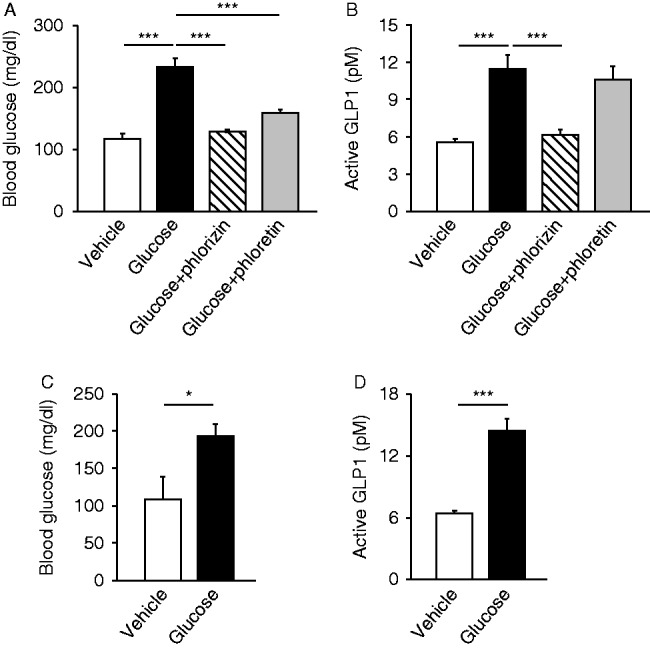
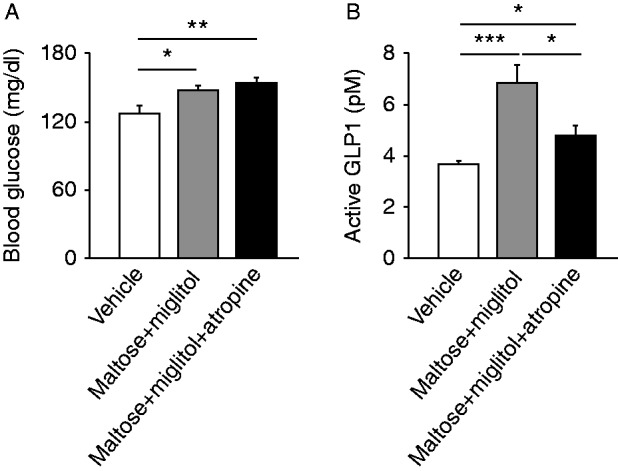
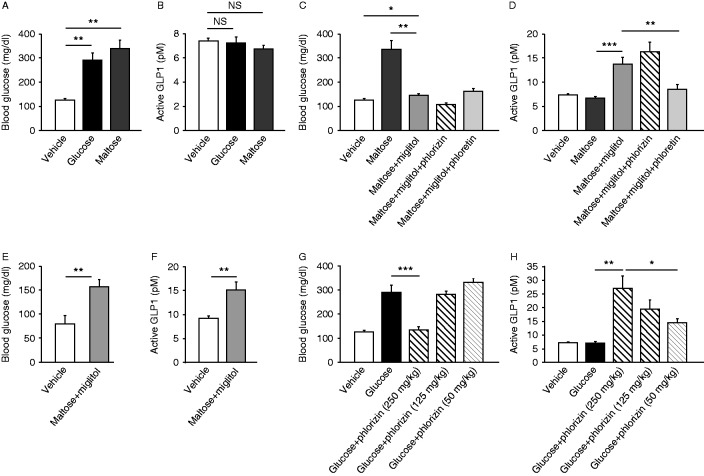
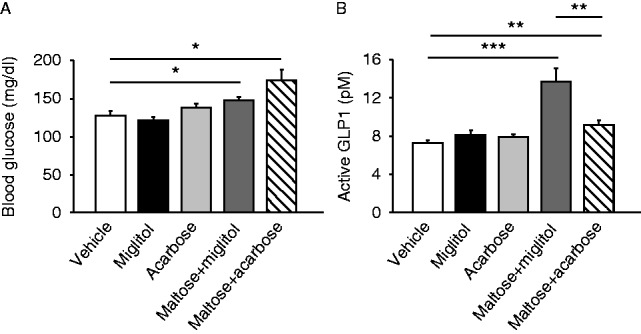
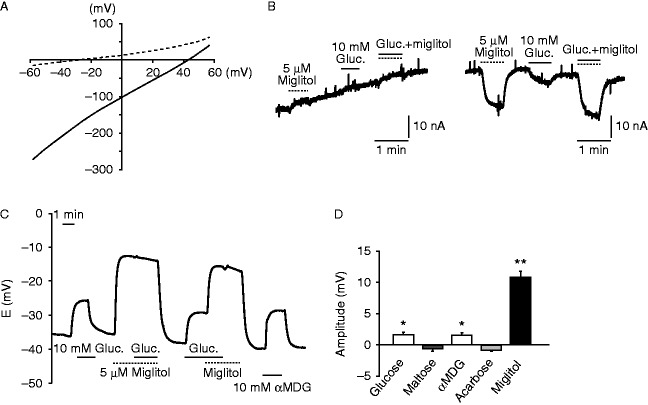
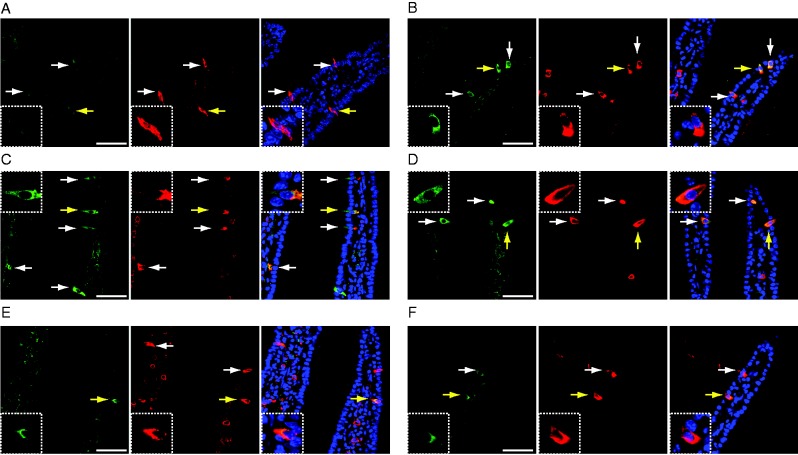
Oral ingestion of carbohydrate triggers glucagon-like peptide 1 (GLP1) secretion, but the molecular mechanism remains elusive. By measuring GLP1 concentrations in murine portal vein, we found that the ATP-sensitive K(+) (KATP) channel is not essential for glucose-induced GLP1 secretion from enteroendocrine L cells, while the sodium-glucose co-transporter 1 (SGLT1) is required, at least in the early phase (5 min) of secretion. By contrast, co-administration of the α-glucosidase inhibitor (α-GI) miglitol plus maltose evoked late-phase secretion in a glucose transporter 2-dependent manner. We found that GLP1 secretion induced by miglitol plus maltose was significantly higher than that by another α-GI, acarbose, plus maltose, despite the fact that acarbose inhibits maltase more potently than miglitol. As miglitol activates SGLT3, we compared the effects of miglitol on GLP1 secretion with those of acarbose, which failed to depolarize the Xenopus laevis oocytes expressing human SGLT3. Oral administration of miglitol activated duodenal enterochromaffin (EC) cells as assessed by immunostaining of phosphorylated calcium-calmodulin kinase 2 (phospho-CaMK2). In contrast, acarbose activated much fewer enteroendocrine cells, having only modest phospho-CaMK2 immunoreactivity. Single administration of miglitol triggered no GLP1 secretion, and GLP1 secretion by miglitol plus maltose was significantly attenuated by atropine pretreatment, suggesting regulation via vagal nerve. Thus, while α-GIs generally delay carbohydrate absorption and potentiate GLP1 secretion, miglitol also activates duodenal EC cells, possibly via SGLT3, and potentiates GLP1 secretion through the parasympathetic nervous system.
口服碳水化合物会触发胰高血糖素样肽1(GLP1)的分泌,但其分子机制仍不清楚。通过测量小鼠门静脉中的GLP1浓度,我们发现ATP敏感性钾(KATP)通道对于葡萄糖诱导的肠内分泌L细胞分泌GLP1并非必需,而钠-葡萄糖协同转运蛋白1(SGLT1)是必需的,至少在分泌的早期阶段(5分钟)是如此。相比之下,α-葡萄糖苷酶抑制剂(α-GI)米格列醇与麦芽糖共同给药以葡萄糖转运蛋白2依赖性方式诱发晚期分泌。我们发现,尽管阿卡波糖比米格列醇更有效地抑制麦芽糖酶,但米格列醇加麦芽糖诱导的GLP1分泌明显高于另一种α-GI阿卡波糖加麦芽糖诱导的分泌。由于米格列醇激活SGLT3,我们比较了米格列醇与阿卡波糖对GLP1分泌的影响,阿卡波糖未能使表达人SGLT3的非洲爪蟾卵母细胞去极化。通过磷酸化钙-钙调蛋白激酶2(磷酸化CaMK2)的免疫染色评估,口服米格列醇可激活十二指肠肠嗜铬(EC)细胞。相比之下,阿卡波糖激活的肠内分泌细胞要少得多,只有适度的磷酸化CaMK2免疫反应性。单次给予米格列醇不会触发GLP1分泌,米格列醇加麦芽糖诱导的GLP1分泌在阿托品预处理后明显减弱,提示通过迷走神经进行调节。因此,虽然α-GIs通常会延迟碳水化合物吸收并增强GLP1分泌,但米格列醇还可能通过SGLT3激活十二指肠EC细胞,并通过副交感神经系统增强GLP1分泌。