Fujiwara Yuki, Eguchi Shunsuke, Murayama Hiroki, Takahashi Yuri, Toda Mitsutoshi, Imai Kota, Tsuda Kinsuke
Medical Division, Cardio-Metabolic Medical Franchise Department Novartis Pharma K.K Tokyo Japan.
Faculty of Human Sciences Tezukayama Gakuin University Osaka Japan.
Endocrinol Diabetes Metab. 2019 May 16;2(3):e00068. doi: 10.1002/edm2.68. eCollection 2019 Jul.
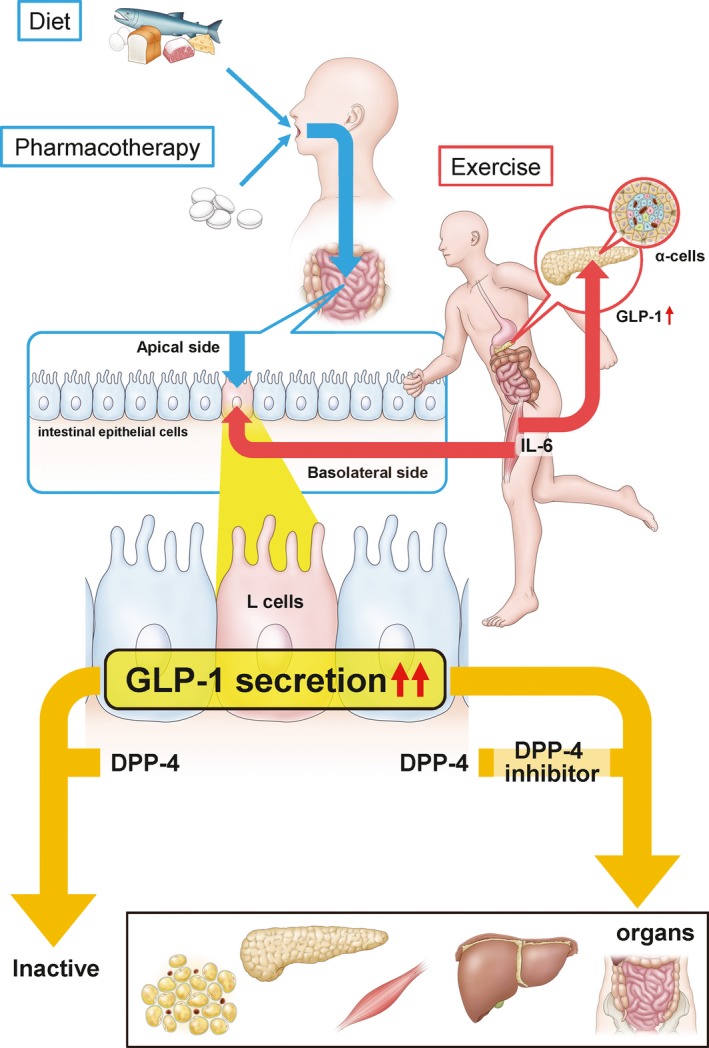
The rapid rise in the prevalence of type 2 diabetes mellitus (T2DM) poses a huge healthcare burden across the world. Although there are several antihyperglycaemic agents (AHAs) available including addition of new drug classes to the treatment algorithm, more than 50% of patients with T2DM do not achieve glycaemic targets, suggesting an urgent need for treatment strategies focusing on prevention and progression of T2DM and its long-term complications. Lifestyle changes including implementation of healthy diet and physical activity are cornerstones for the management of T2DM. The positive effects of diet and exercise on incretin hormones such as glucagon-like peptide-1 (GLP-1) have been reported. We hypothesize an IDEP concept (Interaction between Diet/Exercise and Pharmacotherapy) aimed at modifying the diet and lifestyle, along with pharmacotherapy to enhance the GLP-1 levels, would result in good glycaemic control in patients with T2DM. Consuming protein-rich food, avoiding saturated fatty acids and making small changes in eating habits such as eating slowly with longer mastication time can have a positive impact on the GLP-1 secretion and insulin levels. Further the type of physical activity (aerobic/resistance training), intensity of exercise, duration, time and frequency of exercise have shown to improve GLP-1 levels. Apart from AHAs, a few antihypertensive drugs and lipid-lowering drugs have also shown to increase endogenous GLP-1 levels, however, due to quick degradation of GLP-1 by dipeptidyl peptidase-4 (DPP-4) enzyme, treatment with DPP-4 inhibitors would protect GLP-1 from degradation and prolong its activity. Thus, IDEP concept can be a promising treatment strategy, which positively influences the GLP-1 levels and provide additive benefits in terms of improving metabolic parameters in patients with T2DM and slowing the progression of T2DM and its associated complications.
2型糖尿病(T2DM)患病率的迅速上升给全球带来了巨大的医疗负担。尽管有多种抗高血糖药物(AHA)可供使用,包括在治疗方案中增加新的药物类别,但超过50%的T2DM患者未达到血糖目标,这表明迫切需要制定侧重于预防和延缓T2DM及其长期并发症进展的治疗策略。包括实施健康饮食和体育活动在内的生活方式改变是T2DM管理的基石。饮食和运动对诸如胰高血糖素样肽-1(GLP-1)等肠促胰岛素激素的积极作用已有报道。我们提出了一个IDEP概念(饮食/运动与药物治疗之间的相互作用),旨在改变饮食和生活方式,并结合药物治疗以提高GLP-1水平,从而使T2DM患者实现良好的血糖控制。食用富含蛋白质的食物、避免饱和脂肪酸以及在饮食习惯上做出一些小改变,如细嚼慢咽,都可能对GLP-1分泌和胰岛素水平产生积极影响。此外,体育活动的类型(有氧运动/抗阻训练)、运动强度、持续时间、时间点和频率均已表明可提高GLP-1水平。除了AHA外,一些抗高血压药物和降脂药物也已显示可增加内源性GLP-1水平,然而,由于GLP-1会被二肽基肽酶-4(DPP-4)酶迅速降解,使用DPP-4抑制剂进行治疗可保护GLP-1不被降解并延长其活性。因此,IDEP概念可能是一种有前景的治疗策略,它能对GLP-1水平产生积极影响,并在改善T2DM患者的代谢参数、延缓T2DM及其相关并发症的进展方面带来额外益处。