Yang Li-Yuan, Machado Carlos A, Dang Xiao-Dong, Peng Yan-Qiong, Yang Da-Rong, Zhang Da-Yong, Liao Wan-Jin
State Key Laboratory of Earth Surface Processes and Resource Ecology and MOE Key Laboratory for Biodiversity Science and Ecological Engineering, College of Life Sciences, Beijing Normal University, Beijing, 100875, China.
Evolution. 2015 Feb;69(2):294-304. doi: 10.1111/evo.12584. Epub 2015 Jan 19.
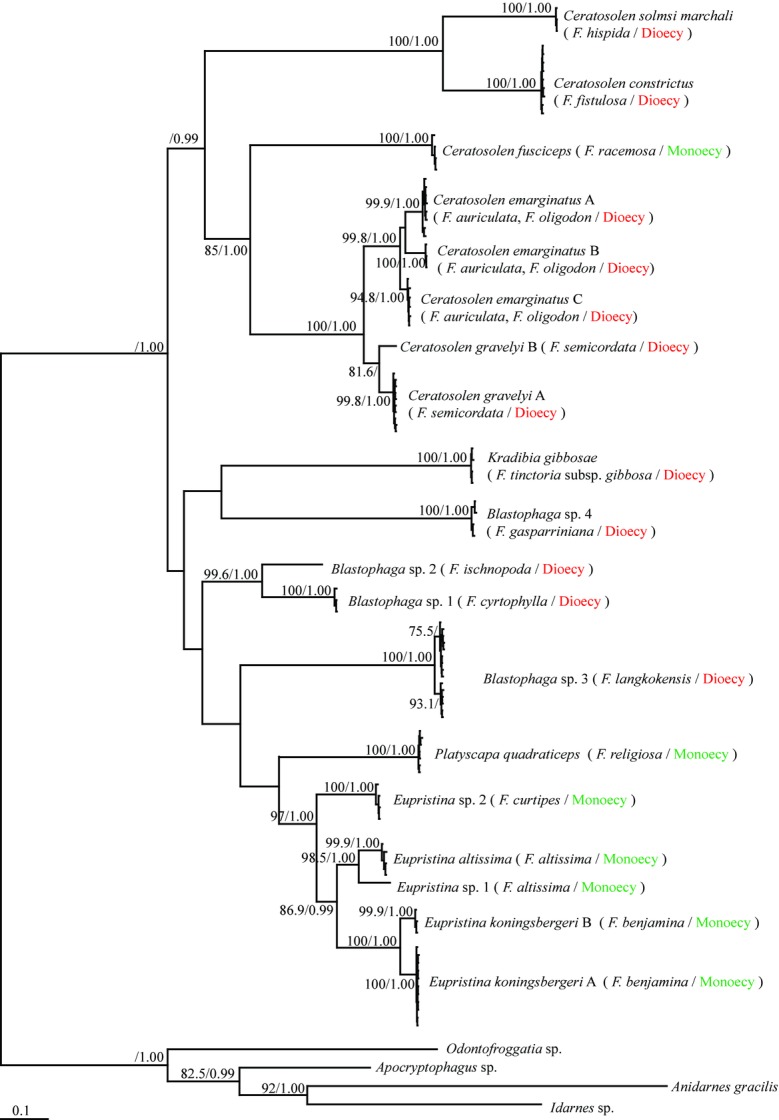
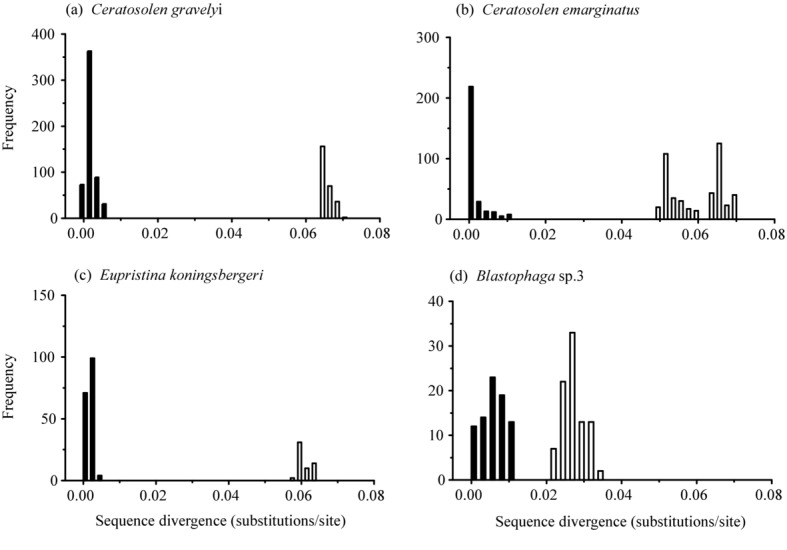
Differences in breeding system are associated with correlated ecological and morphological changes in plants. In Ficus, dioecy and monoecy are strongly associated with different suites of traits (tree height, population density, fruiting frequency, pollinator dispersal ecology). Although approximately 30% of fig species are pollinated by multiple species of fig-pollinating wasps, it has been suggested that copollinators are rare in dioecious figs. Here, we test whether there is a connection between the fig breeding system and copollinator incidence and diversification by conducting a meta-analysis of molecular data from pollinators of 119 fig species that includes new data from 15 Asian fig species. We find that the incidence of copollinators is not significantly different between monoecious and dioecious Ficus. Surprisingly, while all copollinators in dioecious figs are sister taxa, only 32.1% in monoecious figs are sister taxa. We present hypotheses to explain those patterns and discuss their consequences on the evolution of this mutualism.
繁殖系统的差异与植物相关的生态和形态变化有关。在榕属植物中,雌雄异株和雌雄同株与不同的性状组合(树高、种群密度、结果频率、传粉者扩散生态学)密切相关。尽管约30%的榕属物种由多种榕小蜂传粉,但有人认为在雌雄异株的榕属植物中共同传粉者很罕见。在此,我们通过对119种榕属植物传粉者的分子数据进行荟萃分析(包括来自15种亚洲榕属植物的新数据),来检验榕属植物的繁殖系统与共同传粉者发生率及多样化之间是否存在关联。我们发现,雌雄同株和雌雄异株的榕属植物中共同传粉者的发生率没有显著差异。令人惊讶的是,虽然雌雄异株榕属植物中的所有共同传粉者都是姐妹类群,但雌雄同株榕属植物中只有32.1%是姐妹类群。我们提出假设来解释这些模式,并讨论它们对这种共生关系进化的影响。