Barasona Jose A, Latham M Cecilia, Acevedo Pelayo, Armenteros Jose A, Latham A David M, Gortazar Christian, Carro Francisco, Soriguer Ramon C, Vicente Joaquin
SaBio (Health and Biotechnology), IREC, National Wildlife Research Institute (CSIC-UCLM-JCCM), Ciudad Real, Spain.
Vet Res. 2014 Dec 12;45(1):122. doi: 10.1186/s13567-014-0122-7.
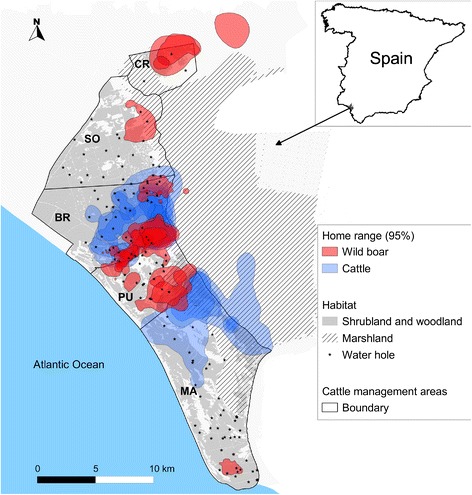
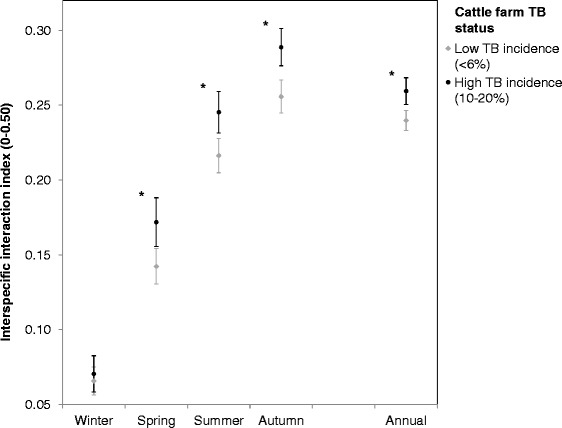
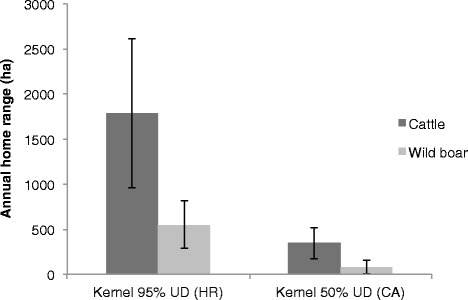
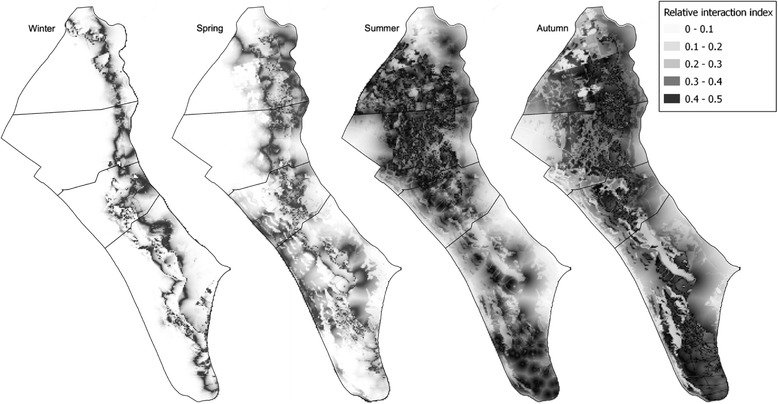
Controlling infectious diseases at the wildlife/livestock interface is often difficult because the ecological processes driving transmission between wildlife reservoirs and sympatric livestock populations are poorly understood. Thus, assessing how animals use their environment and how this affects interspecific interactions is an important factor in determining the local risk for disease transmission and maintenance. We used data from concurrently monitored GPS-collared domestic cattle and wild boar (Sus scrofa) to assess spatiotemporal interactions and associated implications for bovine tuberculosis (TB) transmission in a complex ecological and epidemiological system, Doñana National Park (DNP, South Spain). We found that fine-scale spatial overlap of cattle and wild boar was seasonally high in some habitats. In general, spatial interactions between the two species were highest in the marsh-shrub ecotone and at permanent water sources, whereas shrub-woodlands and seasonal grass-marshlands were areas with lower predicted relative interactions. Wild boar and cattle generally used different resources during winter and spring in DNP. Conversely, limited differences in resource selection during summer and autumn, when food and water availability were limiting, resulted in negligible spatial segregation and thus probably high encounter rates. The spatial gradient in potential overlap between the two species across DNP corresponded well with the spatial variation in the observed incidence of TB in cattle and prevalence of TB in wild boar. We suggest that the marsh-shrub ecotone and permanent water sources act as important points of TB transmission in our system, particularly during summer and autumn. Targeted management actions are suggested to reduce potential interactions between cattle and wild boar in order to prevent disease transmission and design effective control strategies.
在野生动物与家畜的交界处控制传染病往往很困难,因为驱动野生动物宿主与同域家畜种群之间传播的生态过程尚不清楚。因此,评估动物如何利用其环境以及这如何影响种间相互作用,是确定疾病传播和维持的局部风险的一个重要因素。我们利用同时监测的佩戴GPS项圈的家牛和野猪(野猪)的数据,在一个复杂的生态和流行病学系统——多尼亚纳国家公园(西班牙南部)中,评估时空相互作用以及对牛结核病(TB)传播的相关影响。我们发现,在某些栖息地,牛和野猪的精细尺度空间重叠在季节上较高。一般来说,这两个物种之间的空间相互作用在沼泽-灌木交错带和永久性水源处最高,而灌木林地和季节性草沼地是预测相对相互作用较低的区域。在多尼亚纳国家公园,野猪和牛在冬季和春季通常利用不同的资源。相反,在夏季和秋季,当食物和水的供应受到限制时,资源选择的差异有限,导致空间隔离可以忽略不计,因此相遇率可能很高。整个多尼亚纳国家公园这两个物种之间潜在重叠的空间梯度与牛群中观察到的结核病发病率和野猪中结核病患病率的空间变化非常吻合。我们认为,沼泽-灌木交错带和永久性水源是我们系统中结核病传播的重要点,特别是在夏季和秋季。建议采取有针对性的管理行动,以减少牛和野猪之间的潜在相互作用,从而预防疾病传播并设计有效的控制策略。