Li Haifu, Wozniak Agnieszka, Sciot Raf, Cornillie Jasmien, Wellens Jasmien, Van Looy Thomas, Vanleeuw Ulla, Stas Marguerite, Hompes Daphne, Debiec-Rychter Maria, Schöffski Patrick
Laboratory of Experimental Oncology, Department of Oncology, KU Leuven and Department of General Medical Oncology, University Hospitals Leuven, Leuven Cancer Institute, Leuven, Belgium.
Department of Pathology, KU Leuven and University Hospitals Leuven, Leuven, Belgium.
Transl Oncol. 2014 Dec;7(6):665-71. doi: 10.1016/j.tranon.2014.09.007.
The rarity of dedifferentiated liposarcoma (DDLPS) and the lack of experimental DDLPS models limit the development of novel therapeutic strategies. Pazopanib (PAZ) is a tyrosine kinase inhibitor that is approved for the treatment of non-adipocytic advanced soft tissue sarcoma. The activity of this agent has not yet been properly explored in preclinical liposarcoma models nor in a randomized phase Ш clinical trial in this entity. The aim of the present study was to investigate whether PAZ had antitumor activity in DDLPS models in vivo.
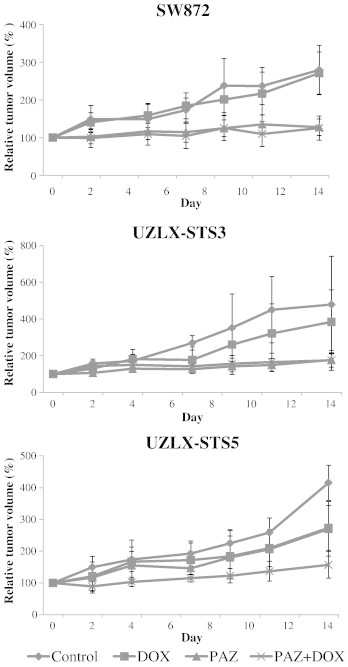
We established two patient-derived DDLPS xenograft models (UZLX-STS3 and UZLX-STS5) through implantation of tumor material from sarcoma patients in athymic nude NMRI mice. An animal model of the SW872 liposarcoma cell line was also used. To investigate the efficacy of PAZ in vivo, mice bearing tumors were treated for 2 weeks with sterile water, doxorubicin (1.2 mg/kg, intraperitoneally, twice per week), PAZ [40 mg/kg, orally (p.o.), twice per day], or PAZ plus doxorubicin (same schedules as for single treatments).
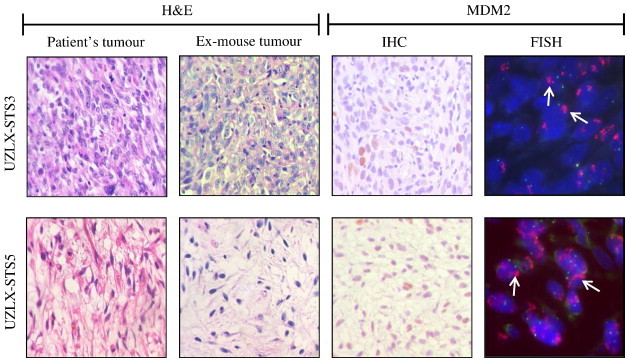
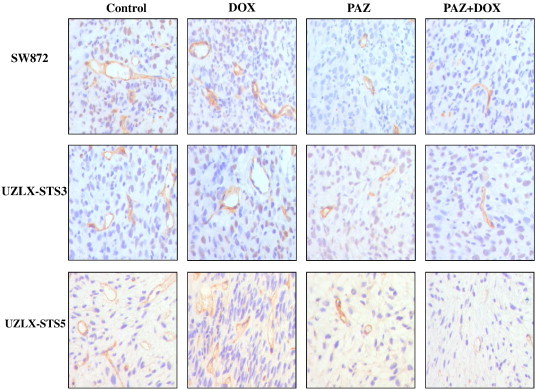
Patient-derived xenografts retained the histologic and molecular features of DDLPS. PAZ significantly delayed tumor growth by decreasing proliferation and inhibited angiogenesis in all models tested. Combining the angiogenesis inhibitor with an anthracycline did not show superior efficacy.
These results suggest that PAZ has potential antitumor activity in DDLPS primarily through antiangiogenic effects and therefore should be explored in clinical trials.
去分化脂肪肉瘤(DDLPS)较为罕见,且缺乏实验性DDLPS模型,这限制了新型治疗策略的开发。帕唑帕尼(PAZ)是一种酪氨酸激酶抑制剂,已被批准用于治疗非脂肪细胞性晚期软组织肉瘤。该药物在临床前脂肪肉瘤模型或该实体的随机III期临床试验中的活性尚未得到充分研究。本研究的目的是调查PAZ在体内DDLPS模型中是否具有抗肿瘤活性。
我们通过将肉瘤患者的肿瘤材料植入无胸腺裸NMRI小鼠体内,建立了两种患者来源的DDLPS异种移植模型(UZLX-STS3和UZLX-STS5)。还使用了SW872脂肪肉瘤细胞系的动物模型。为了研究PAZ在体内的疗效,对荷瘤小鼠用无菌水、阿霉素(1.2mg/kg,腹腔注射,每周两次)、PAZ[40mg/kg,口服(p.o.),每天两次]或PAZ加阿霉素(与单次治疗相同的给药方案)治疗2周。
患者来源的异种移植瘤保留了DDLPS的组织学和分子特征。在所有测试模型中,PAZ通过减少增殖显著延迟了肿瘤生长并抑制了血管生成。将血管生成抑制剂与蒽环类药物联合使用并未显示出更好的疗效。
这些结果表明,PAZ在DDLPS中主要通过抗血管生成作用具有潜在的抗肿瘤活性,因此应在临床试验中进行探索。