Warburton-Pitt Simon R F, Silva Malan, Nguyen Ken C Q, Hall David H, Barr Maureen M
Department of Genetics, Rutgers, The State University of New Jersey, Piscataway, New Jersey, United States of America.
Center for C. elegans Anatomy, Albert Einstein College of Medicine, Bronx, New York, New York, United States of America.
PLoS Genet. 2014 Dec 11;10(12):e1004866. doi: 10.1371/journal.pgen.1004866. eCollection 2014 Dec.
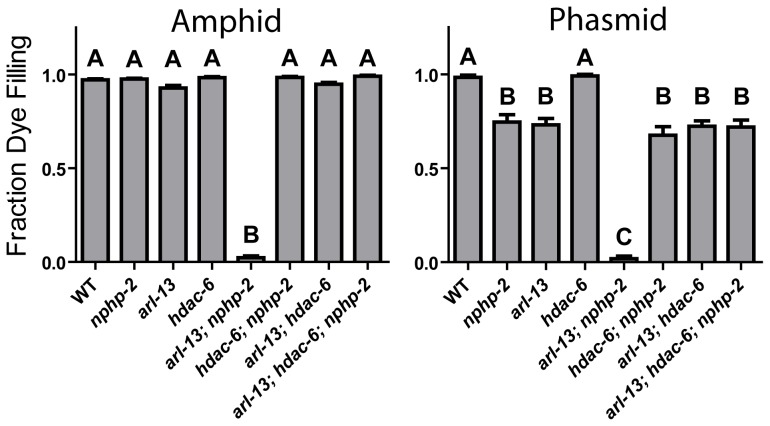
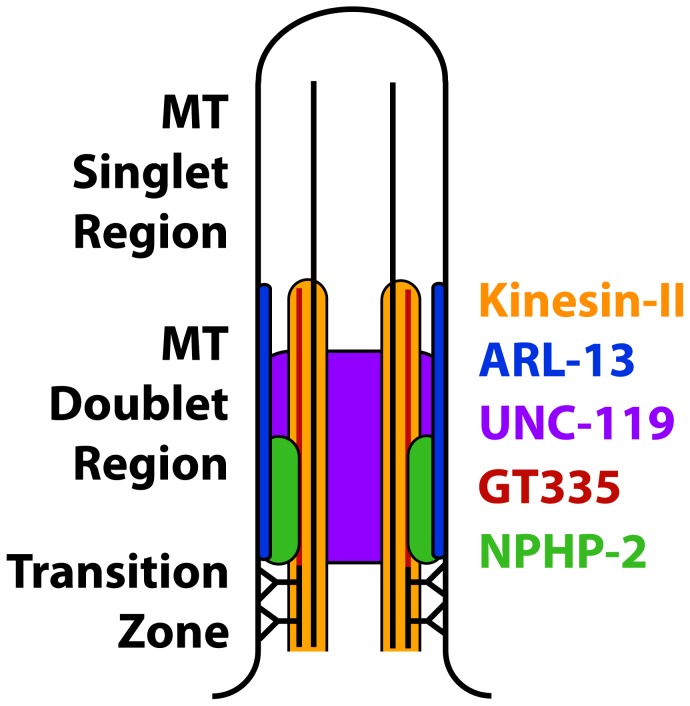
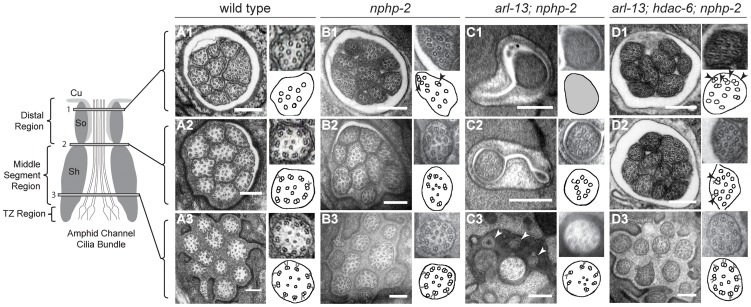
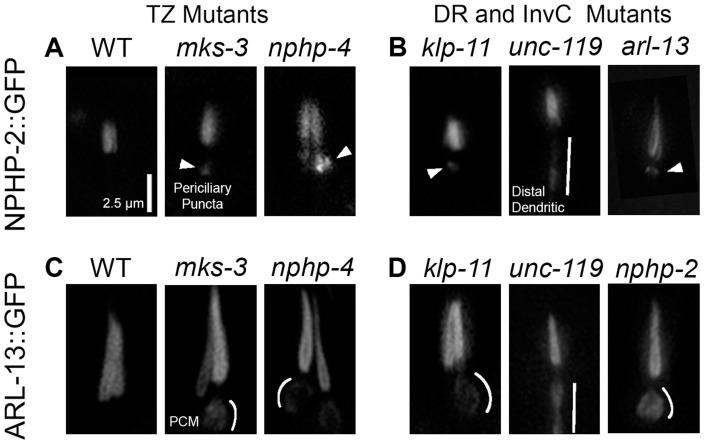
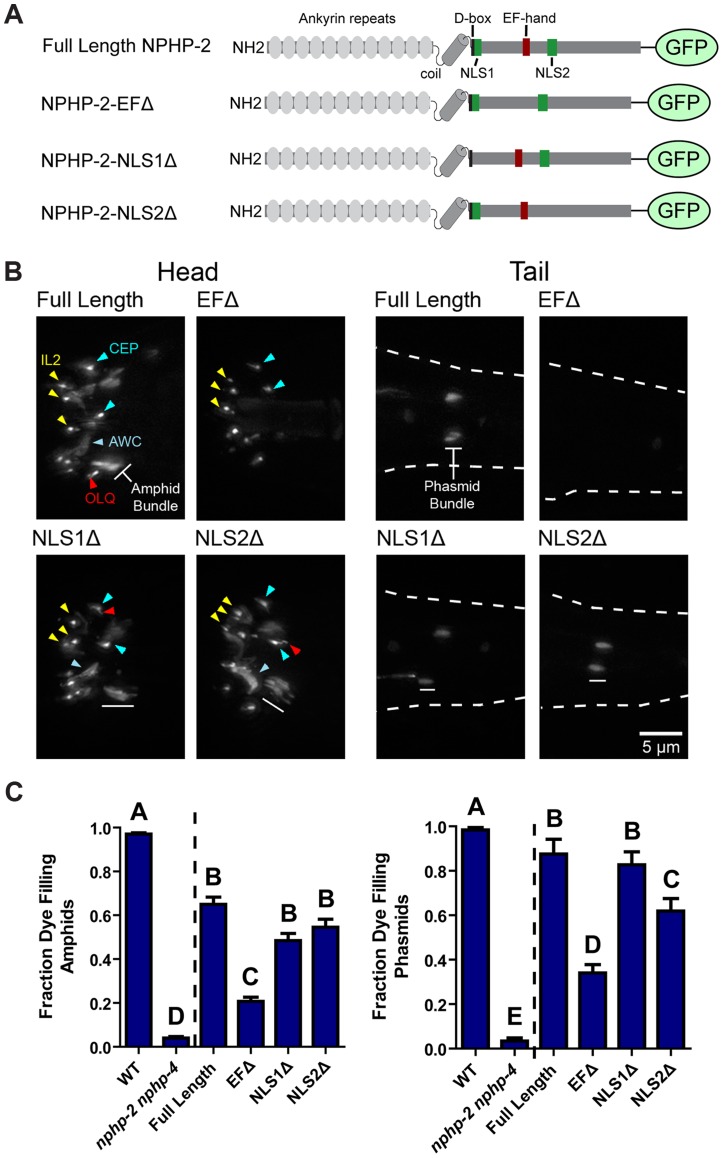
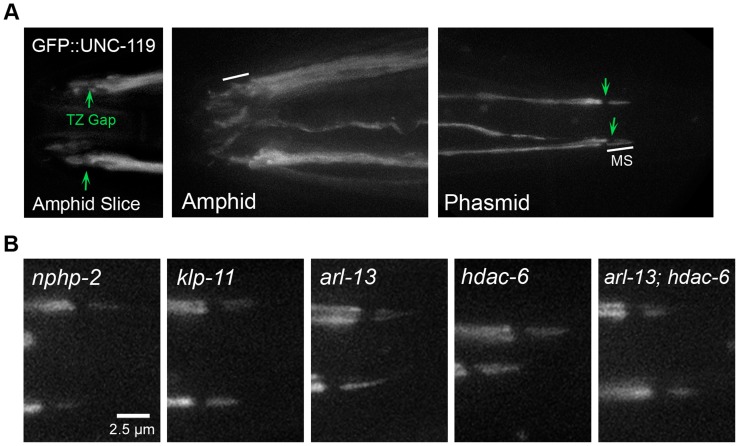
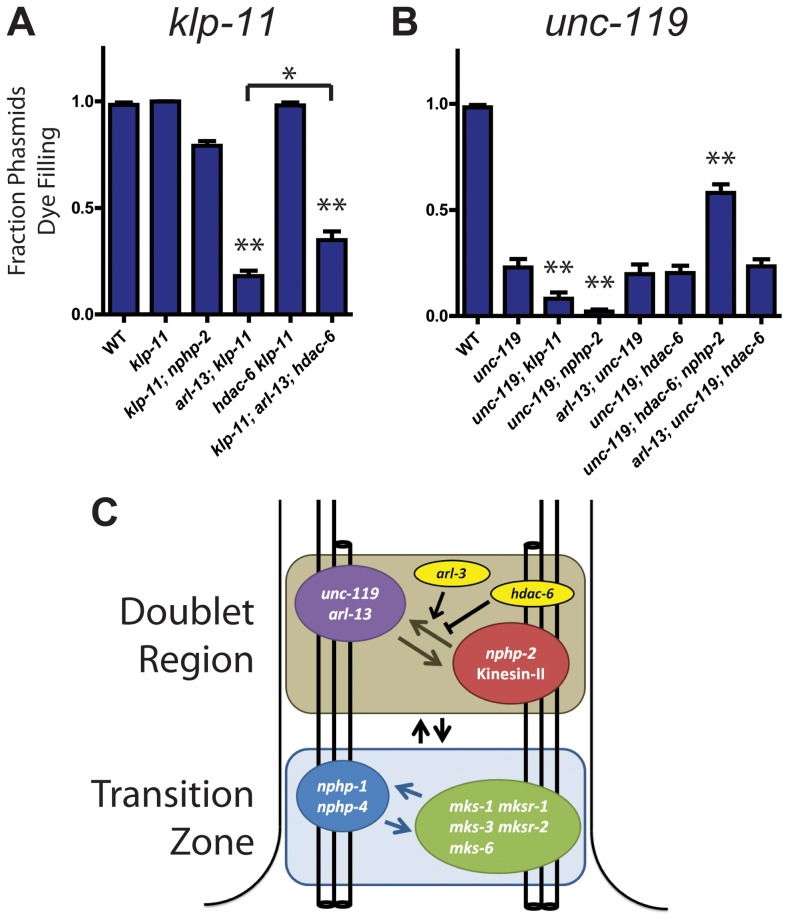
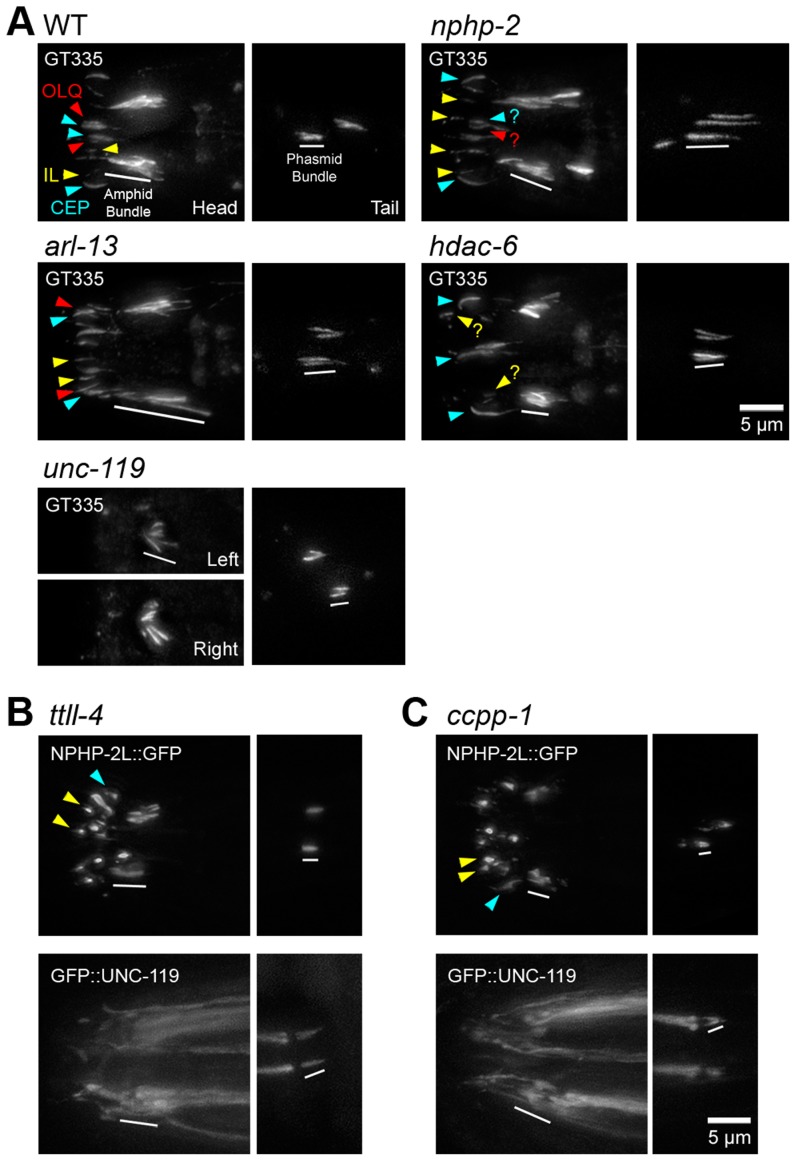
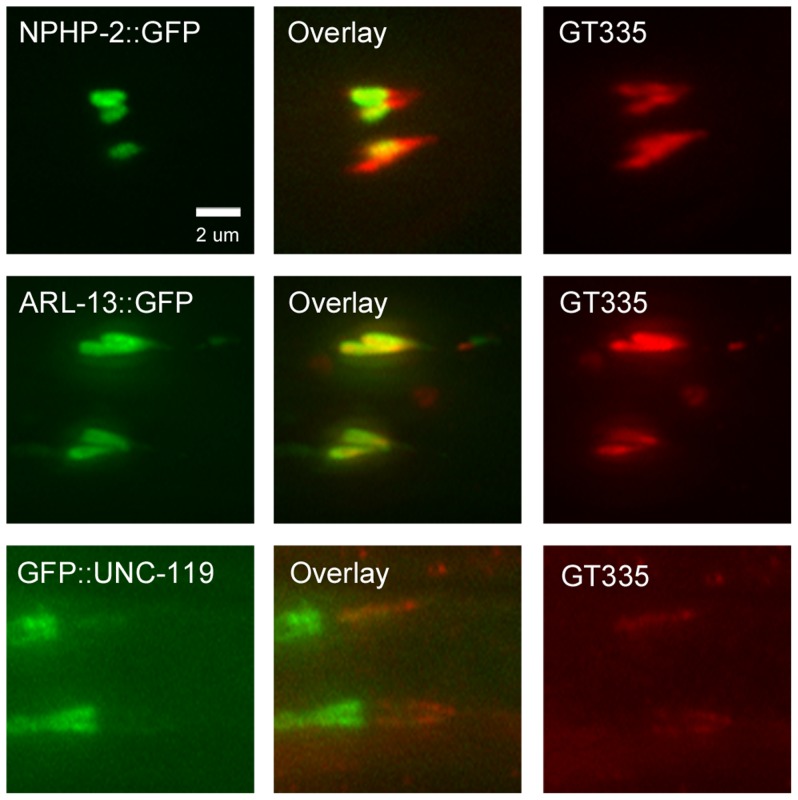
Cilia are microtubule-based cellular organelles that mediate signal transduction. Cilia are organized into several structurally and functionally distinct compartments: the basal body, the transition zone (TZ), and the cilia shaft. In vertebrates, the cystoprotein Inversin localizes to a portion of the cilia shaft adjacent to the TZ, a region termed the "Inversin compartment" (InvC). The mechanisms that establish and maintain the InvC are unknown. In the roundworm C. elegans, the cilia shafts of amphid channel and phasmid sensory cilia are subdivided into two regions defined by different microtubule ultrastructure: a proximal doublet-based region adjacent to the TZ, and a distal singlet-based region. It has been suggested that C. elegans cilia also possess an InvC, similarly to mammalian primary cilia. Here we explored the biogenesis, structure, and composition of the C. elegans ciliary doublet region and InvC. We show that the InvC is conserved and distinct from the doublet region. nphp-2 (the C. elegans Inversin homolog) and the doublet region genes arl-13, klp-11, and unc-119 are redundantly required for ciliogenesis. InvC and doublet region genes can be sorted into two modules-nphp-2+klp-11 and arl-13+unc-119-which are both antagonized by the hdac-6 deacetylase. The genes of this network modulate the sizes of the NPHP-2 InvC and ARL-13 doublet region. Glutamylation, a tubulin post-translational modification, is not required for ciliary targeting of InvC and doublet region components; rather, glutamylation is modulated by nphp-2, arl-13, and unc-119. The ciliary targeting and restricted localization of NPHP-2, ARL-13, and UNC-119 does not require TZ-, doublet region, and InvC-associated genes. NPHP-2 does require its calcium binding EF hand domain for targeting to the InvC. We conclude that the C. elegans InvC is distinct from the doublet region, and that components in these two regions interact to regulate ciliogenesis via cilia placement, ciliary microtubule ultrastructure, and protein localization.
纤毛是基于微管的细胞器,介导信号转导。纤毛被组织成几个结构和功能上不同的区室:基体、过渡区(TZ)和纤毛轴。在脊椎动物中,囊肿蛋白Inversin定位于纤毛轴上与TZ相邻的一部分,该区域称为“Inversin区室”(InvC)。建立和维持InvC的机制尚不清楚。在蛔虫秀丽隐杆线虫中,两性离子通道和咽侧体感觉纤毛的纤毛轴被细分为由不同微管超微结构定义的两个区域:与TZ相邻的近端双联体区域和远端单联体区域。有人提出,秀丽隐杆线虫的纤毛也拥有一个InvC,类似于哺乳动物的初级纤毛。在这里,我们探索了秀丽隐杆线虫纤毛双联体区域和InvC的生物发生、结构和组成。我们表明,InvC是保守的,并且与双联体区域不同。nphp-2(秀丽隐杆线虫Inversin同源物)以及双联体区域基因arl-13、klp-11和unc-119对于纤毛发生是冗余必需的。InvC和双联体区域基因可以分为两个模块——nphp-2+klp-11和arl-13+unc-119——这两个模块都受到hdac-6脱乙酰酶的拮抗作用。该网络的基因调节NPHP-2 InvC和ARL-13双联体区域的大小。谷氨酰胺化是一种微管蛋白翻译后修饰,对于InvC和双联体区域成分的纤毛靶向不是必需的;相反,谷氨酰胺化受到nphp-2 arl-13和unc-119的调节。NPHP-2、ARL-13和UNC-119的纤毛靶向和受限定位不需要与TZ、双联体区域和InvC相关的基因。NPHP-2确实需要其钙结合EF手结构域来靶向InvC。我们得出结论,秀丽隐杆线虫的InvC与双联体区域不同,并且这两个区域中的成分相互作用,通过纤毛定位、纤毛微管超微结构和蛋白质定位来调节纤毛发生。