Rehman Andrea M, Woodd Susannah, PrayGod George, Chisenga Molly, Siame Joshua, Koethe John R, Heimburger Douglas C, Kelly Paul, Friis Henrik, Filteau Suzanne
*Faculty of Epidemiology and Population Health, London School of Hygiene & Tropical Medicine, London, United Kingdom; †Mwanza Research Centre, National Institute for Medical Research, Mwanza, Tanzania; ‡University Teaching Hospital, Lusaka, Zambia; §Vanderbilt University School of Medicine, Nashville, TN; ‖Department of Gastroenterology, Queen Mary University of London, London, United Kingdom; and ¶Department of Nutrition, Exercise and Sports, University of Copenhagen, Copenhagen, Denmark.
J Acquir Immune Defic Syndr. 2015 Apr 1;68(4):405-12. doi: 10.1097/QAI.0000000000000483.
The evidence base for effects of nutritional interventions for malnourished HIV-infected patients starting antiretroviral therapy (ART) is limited and inconclusive.
We hypothesized that both vitamin and mineral deficiencies and poor appetite limit weight gain in malnourished patients starting ART and that vitamin and mineral supplementation would improve appetite and permit nutritional recovery.
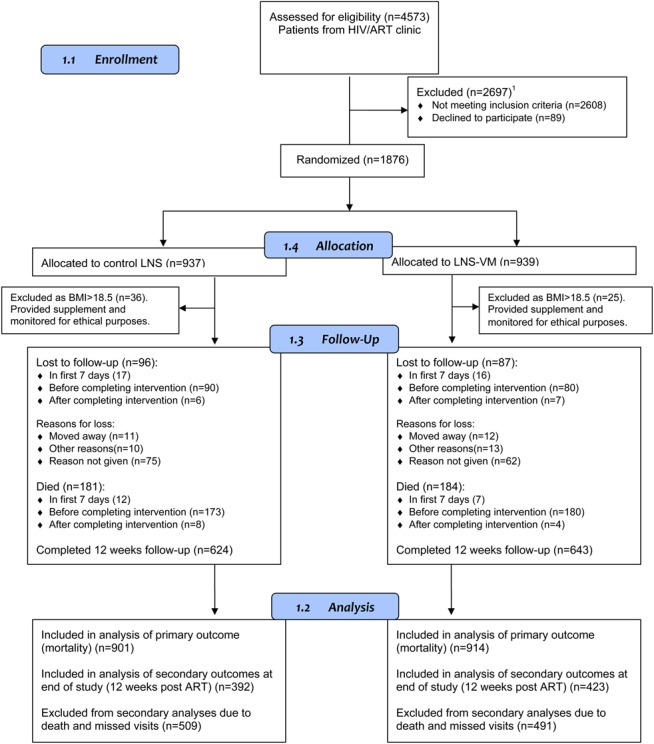
The randomized controlled Nutritional Support for Africans Starting Antiretroviral Therapy trial was conducted in Mwanza, Tanzania, and Lusaka, Zambia. ART-naive adults referred for ART and with body mass index <18.5 kg/m received lipid-based nutritional supplements either without (LNS) or with added vitamins and minerals (LNS-VM), beginning before ART initiation. Participants were given 30 g/d LNS from recruitment until 2 weeks after starting ART and 250 g/d from weeks 2 to 6 of ART.
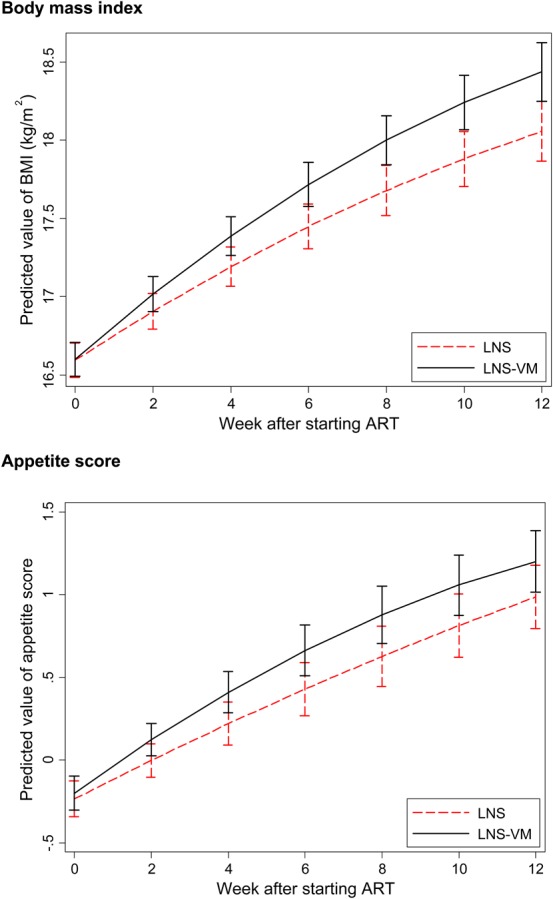
Of 1815 patients recruited, 365 (20%) died during the study and 813 (45%) provided data at 12 weeks. Controlling for baseline values, anthropometric measures were consistently higher at 12-week ART in the LNS-VM than in the LNS group but statistically significant only for calf and mid-upper arm circumferences and triceps skinfold. Appetite did not differ between groups. Using piecewise mixed-effects quadratic models including all patients and time points, the main effects of LNS-VM were seen after starting ART and were significant for weight, body mass index, and mid-upper arm circumference.
Provision of high levels of vitamins and minerals to patients referred for ART, delivered with substantial macronutrients, increased nutritional recovery but did not seem to act through treatment group differences in appetite.
对于开始抗逆转录病毒治疗(ART)的营养不良的HIV感染患者,营养干预效果的证据基础有限且尚无定论。
我们假设维生素和矿物质缺乏以及食欲不佳会限制开始接受ART治疗的营养不良患者的体重增加,并且补充维生素和矿物质会改善食欲并促进营养恢复。
“非洲人开始抗逆转录病毒治疗的营养支持”随机对照试验在坦桑尼亚的姆万扎和赞比亚的卢萨卡进行。未接受过ART治疗、因ART治疗前来就诊且体重指数<18.5kg/m²的成年人,在开始ART治疗前,接受不含维生素和矿物质(LNS)或添加了维生素和矿物质(LNS-VM)的基于脂质的营养补充剂。参与者从招募开始至开始ART治疗后2周每天服用30g LNS,在ART治疗的第2至6周每天服用250g。
在招募的1815名患者中,365名(20%)在研究期间死亡,813名(45%)在12周时提供了数据。在控制基线值后,LNS-VM组在ART治疗12周时的人体测量指标始终高于LNS组,但仅小腿和上臂中部周长以及三头肌皮褶厚度在统计学上有显著差异。两组之间的食欲没有差异。使用包括所有患者和时间点的分段混合效应二次模型,LNS-VM的主要作用在开始ART治疗后显现,对体重、体重指数和上臂中部周长有显著影响。
为因ART治疗前来就诊的患者提供高水平的维生素和矿物质,并搭配大量的宏量营养素,可促进营养恢复,但似乎并非通过治疗组之间的食欲差异起作用。