Chitale Vishwas Sudhir, Behera Mukund Dev, Roy Partha Sarthi
Centre for Oceans, Rivers, Atmosphere and Land Sciences, Indian Institute of Technology Kharagpur, West Bengal, India; Geospatial Solutions, International Centre for Integrated Mountain Development (ICIMOD), Kathmandu, Nepal.
Centre for Oceans, Rivers, Atmosphere and Land Sciences, Indian Institute of Technology Kharagpur, West Bengal, India.
PLoS One. 2014 Dec 12;9(12):e115264. doi: 10.1371/journal.pone.0115264. eCollection 2014.
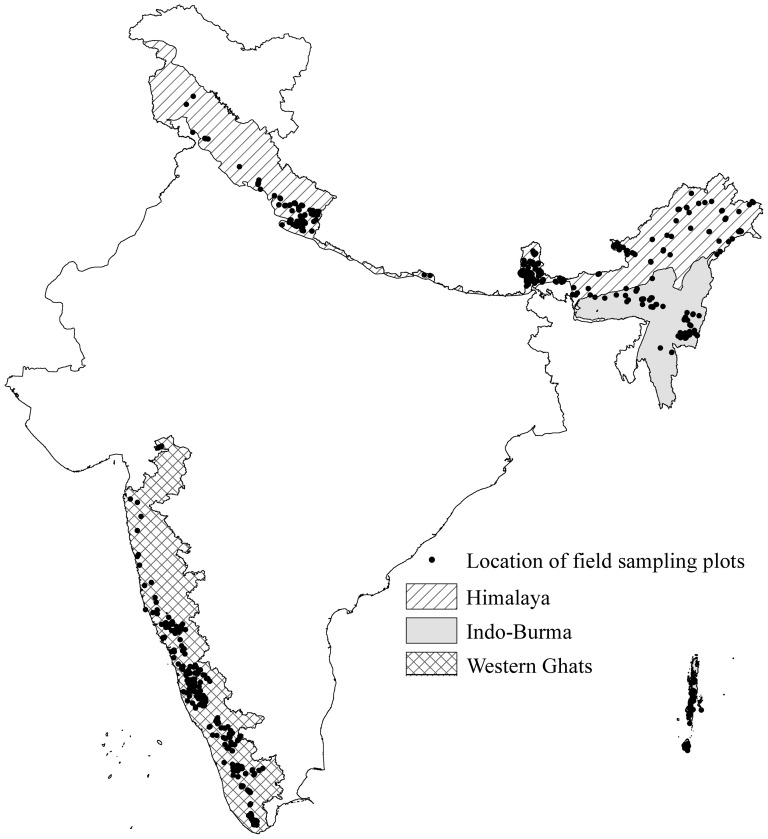
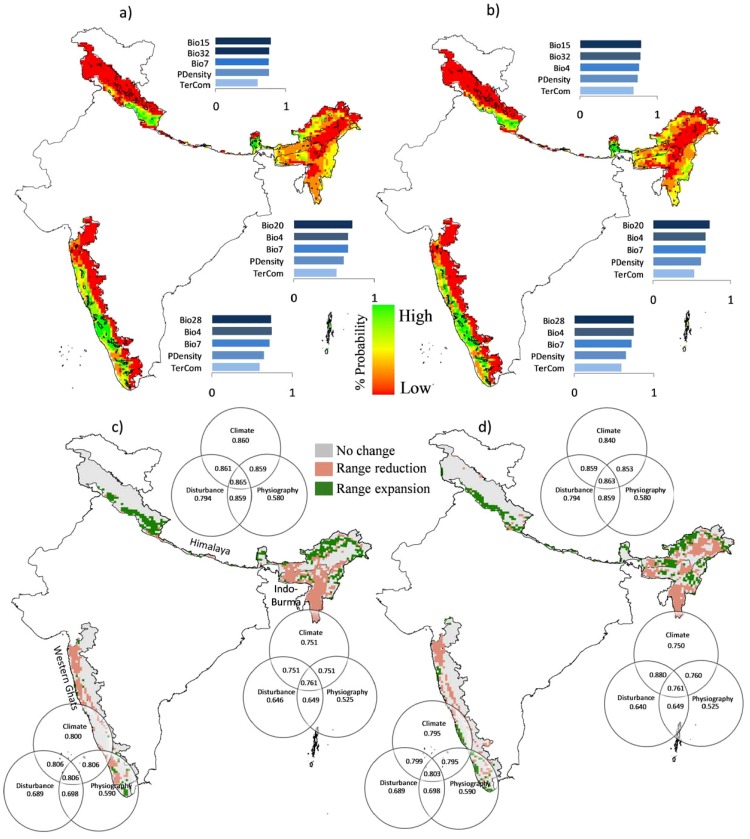
India is one of the 12 mega biodiversity countries of the world, which represents 11% of world's flora in about 2.4% of global land mass. Approximately 28% of the total Indian flora and 33% of angiosperms occurring in India are endemic. Higher human population density in biodiversity hotspots in India puts undue pressure on these sensitive eco-regions. In the present study, we predict the future distribution of 637 endemic plant species from three biodiversity hotspots in India; Himalaya, Western Ghats, Indo-Burma, based on A1B scenario for year 2050 and 2080. We develop individual variable based models as well as mixed models in MaxEnt by combining ten least co-related bioclimatic variables, two disturbance variables and one physiography variable as predictor variables. The projected changes suggest that the endemic flora will be adversely impacted, even under such a moderate climate scenario. The future distribution is predicted to shift in northern and north-eastern direction in Himalaya and Indo-Burma, while in southern and south-western direction in Western Ghats, due to cooler climatic conditions in these regions. In the future distribution of endemic plants, we observe a significant shift and reduction in the distribution range compared to the present distribution. The model predicts a 23.99% range reduction and a 7.70% range expansion in future distribution by 2050, while a 41.34% range reduction and a 24.10% range expansion by 2080. Integration of disturbance and physiography variables along with bioclimatic variables in the models improved the prediction accuracy. Mixed models provide most accurate results for most of the combinations of climatic and non-climatic variables as compared to individual variable based models. We conclude that a) regions with cooler climates and higher moisture availability could serve as refugia for endemic plants in future climatic conditions; b) mixed models provide more accurate results, compared to single variable based models.
印度是世界上12个生物多样性大国之一,在约占全球陆地面积2.4%的土地上,拥有世界11%的植物区系。印度本土植物总数的约28%以及印度境内33%的被子植物为特有种。印度生物多样性热点地区较高的人口密度给这些敏感的生态区域带来了过大压力。在本研究中,我们基于2050年和2080年的A1B情景,预测了印度三个生物多样性热点地区(喜马拉雅地区、西高止山脉、印度-缅甸)637种特有植物物种的未来分布情况。我们通过将十个相关性最小的生物气候变量、两个干扰变量和一个地形变量作为预测变量,在最大熵模型(MaxEnt)中开发了基于单个变量的模型以及混合模型。预测变化表明,即使在这种温和的气候情景下,特有植物区系也将受到不利影响。由于这些地区气候变冷,预计喜马拉雅地区和印度-缅甸的未来分布将向北方和东北方向转移,而西高止山脉的未来分布将向南方和西南方向转移。在特有植物的未来分布中,与当前分布相比,我们观察到分布范围有显著的转移和缩小。该模型预测,到2050年未来分布范围将缩小23.99%,扩大7.70%,而到2080年范围将缩小41.34%,扩大24.10%。在模型中整合干扰变量、地形变量以及生物气候变量提高了预测准确性。与基于单个变量的模型相比,混合模型在大多数气候和非气候变量组合下提供了最准确的结果。我们得出以下结论:a)气候较凉爽且水分供应较高的地区在未来气候条件下可作为特有植物的避难所;b)与基于单一变量的模型相比,混合模型提供了更准确的结果。