Gordian Edna, Li Jiannong, Pevzner Yuri, Mediavilla-Varela Melanie, Luddy Kimberly, Ohaegbulam Kim, Daniel Kenyon G, Haura Eric B, Muñoz-Antonia Teresita
Molecular Oncology Program, H. Lee Moffitt Cancer Center & Research Institute, Tampa, Florida 33612, United States of America.
Department of Thoracic Oncology, H. Lee Moffitt Cancer Center & Research Institute, Tampa, Florida 33612, United States of America.
PLoS One. 2014 Dec 11;9(12):e114131. doi: 10.1371/journal.pone.0114131. eCollection 2014.
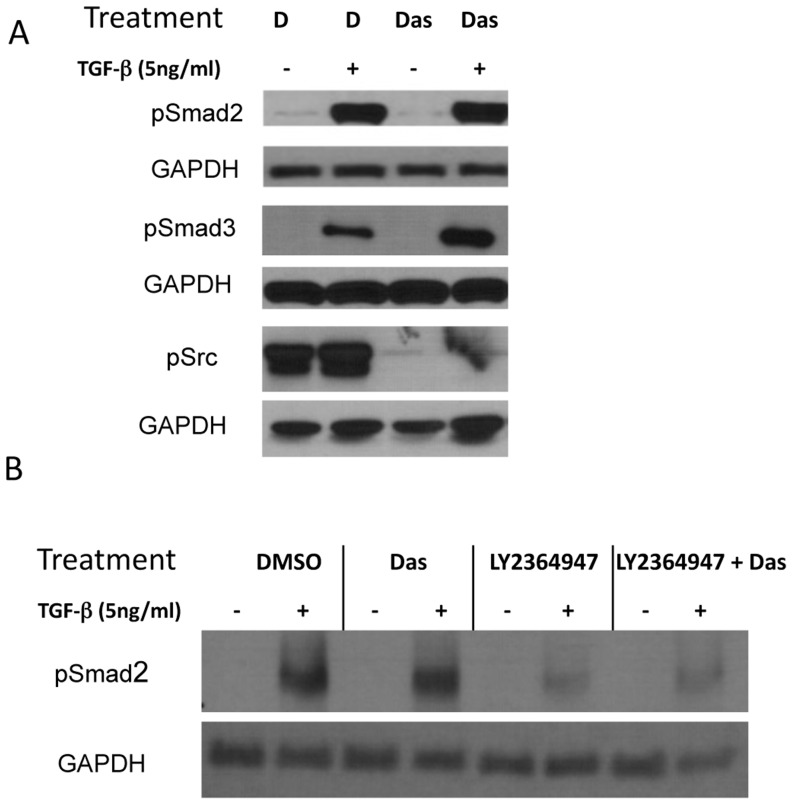
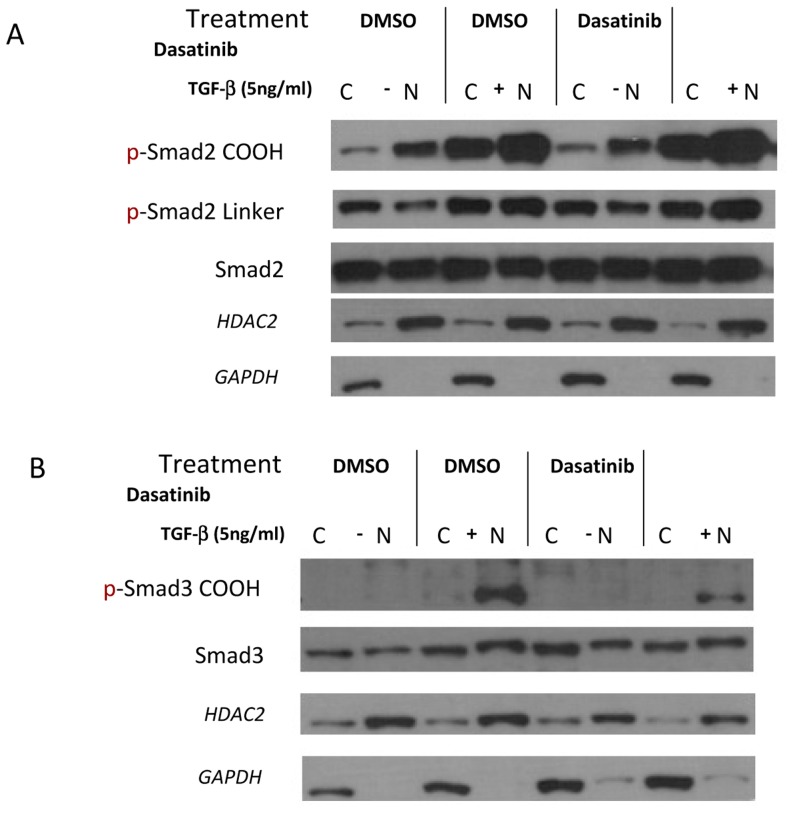
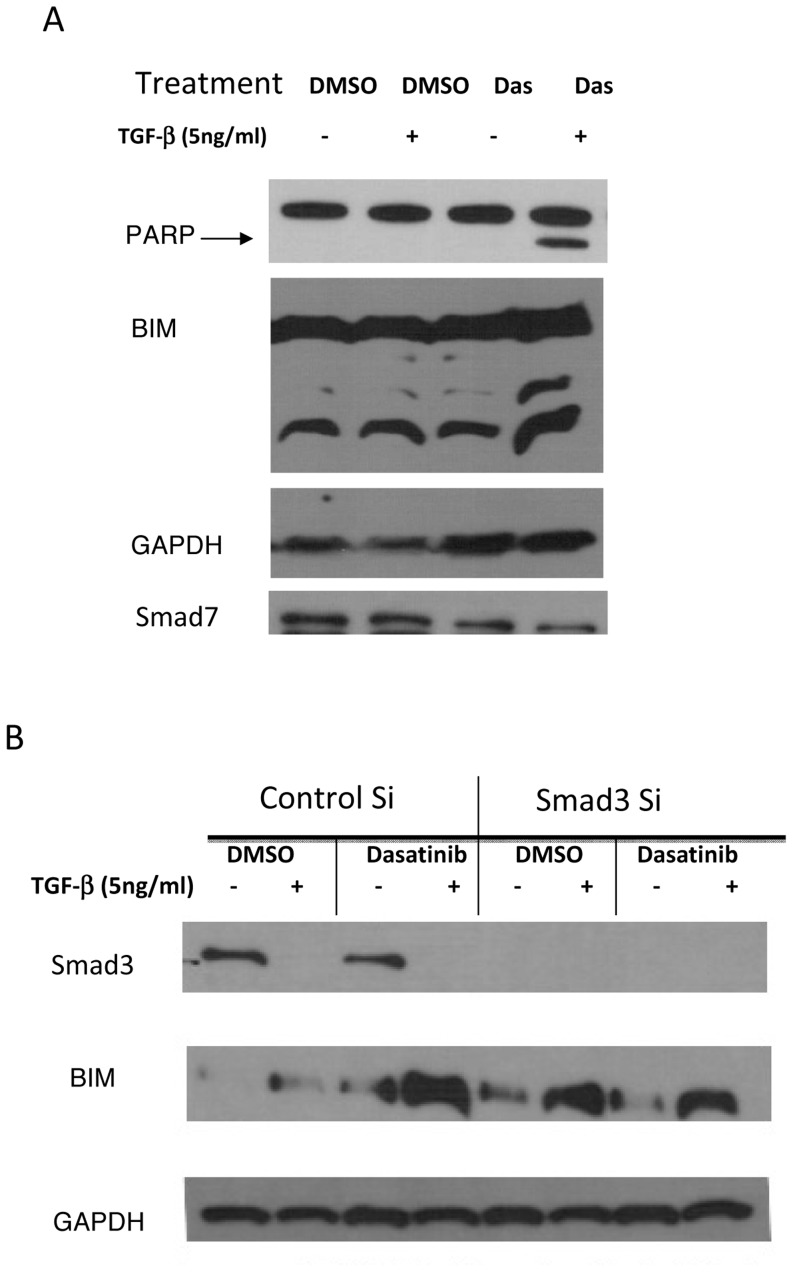
Lung cancer is the second most common cancer and the leading cause of cancer-related deaths. Despite recent advances in the development of targeted therapies, patients with advanced disease remain incurable, mostly because metastatic non-small cell lung carcinomas (NSCLC) eventually become resistant to tyrosine kinase inhibitors (TKIs). Kinase inhibitors have the potential for target promiscuity because the kinase super family is the largest family of druggable genes that binds to a common substrate (ATP). As a result, TKIs often developed for a specific purpose have been found to act on other targets. Drug affinity chromatography has been used to show that dasatinib interacts with the TGFβ type I receptor (TβR-I), a serine-threonine kinase. To determine the potential biological relevance of this association, we studied the combined effects of dasatinib and TGFβ on lung cancer cell lines. We found that dasatinib treatment alone had very little effect; however, when NSCLC cell lines were treated with a combination of TGFβ and dasatinib, apoptosis was induced. Combined TGFβ-1 + dasatinib treatment had no effect on the activity of Smad2 or other non-canonical TGFβ intracellular mediators. Interestingly, combined TGFβ and dasatinib treatment resulted in a transient increase in p-Smad3 (seen after 3 hours). In addition, when NSCLC cells were treated with this combination, the pro-apoptotic protein BIM was up-regulated. Knockdown of the expression of Smad3 using Smad3 siRNA also resulted in a decrease in BIM protein, suggesting that TGFβ-1 + dasatinib-induced apoptosis is mediated by Smad3 regulation of BIM. Dasatinib is only effective in killing EGFR mutant cells, which is shown in only 10% of NSCLCs. Therefore, the observation that wild-type EGFR lung cancers can be manipulated to render them sensitive to killing by dasatinib could have important implications for devising innovative and potentially more efficacious treatment strategies for this disease.
肺癌是第二大常见癌症,也是癌症相关死亡的主要原因。尽管靶向治疗的发展取得了最新进展,但晚期疾病患者仍然无法治愈,主要是因为转移性非小细胞肺癌(NSCLC)最终会对酪氨酸激酶抑制剂(TKIs)产生耐药性。激酶抑制剂具有靶点混杂的可能性,因为激酶超家族是与共同底物(ATP)结合的最大的可药物化基因家族。因此,经常为特定目的开发的TKIs已被发现作用于其他靶点。药物亲和色谱法已被用于表明达沙替尼与转化生长因子β I型受体(TβR-I)相互作用,TβR-I是一种丝氨酸 - 苏氨酸激酶。为了确定这种关联的潜在生物学相关性,我们研究了达沙替尼和转化生长因子β对肺癌细胞系的联合作用。我们发现单独使用达沙替尼治疗效果甚微;然而,当NSCLC细胞系用转化生长因子β和达沙替尼联合治疗时,会诱导细胞凋亡。转化生长因子β-1 +达沙替尼联合治疗对Smad2或其他非经典转化生长因子β细胞内介质的活性没有影响。有趣的是,转化生长因子β和达沙替尼联合治疗导致p-Smad3短暂增加(在3小时后可见)。此外,当用这种组合治疗NSCLC细胞时,促凋亡蛋白BIM上调。使用Smad3 siRNA敲低Smad3的表达也导致BIM蛋白减少,表明转化生长因子β-1 +达沙替尼诱导的细胞凋亡是由Smad3对BIM的调节介导的。达沙替尼仅对EGFR突变细胞有效,而EGFR突变仅在10%的NSCLC中出现。因此,野生型EGFR肺癌可被操控使其对达沙替尼杀伤敏感这一观察结果可能对设计针对该疾病的创新且可能更有效的治疗策略具有重要意义。