Jiang Yanmei, Zhang Changfu, Chen Kai, Chen Zhe, Sun Zhigang, Zhang Zhuqing, Ding Dongbing, Ren Shuangyi, Zuo Yunfei
Department of Clinical Biochemistry, College of Laboratory Diagnostic Medicine, Dalian Medical University, Dalian, 116044, China; Department of Clinical Laboratory, the First Affiliated Hospital of Dalian Medical University, Dalian, 116011, China.
Department of Clinical Biochemistry, College of Laboratory Diagnostic Medicine, Dalian Medical University, Dalian, 116044, China; Department of Neurosurgery, the First Affiliated Hospital of Dalian Medical University, Dalian, 116011, China.
PLoS One. 2014 Dec 12;9(12):e114748. doi: 10.1371/journal.pone.0114748. eCollection 2014.
Colon cancer has always been diagnosed at a late stage, which is associated with poor prognosis. The currently used serum tumor markers CEA and CA19-9 display low sensitivity and specificity and may not have diagnostic value in early stage colon cancer. Thus, there is an urgent need to identify novel serum biomarkers for use in the early detection of colon cancer.
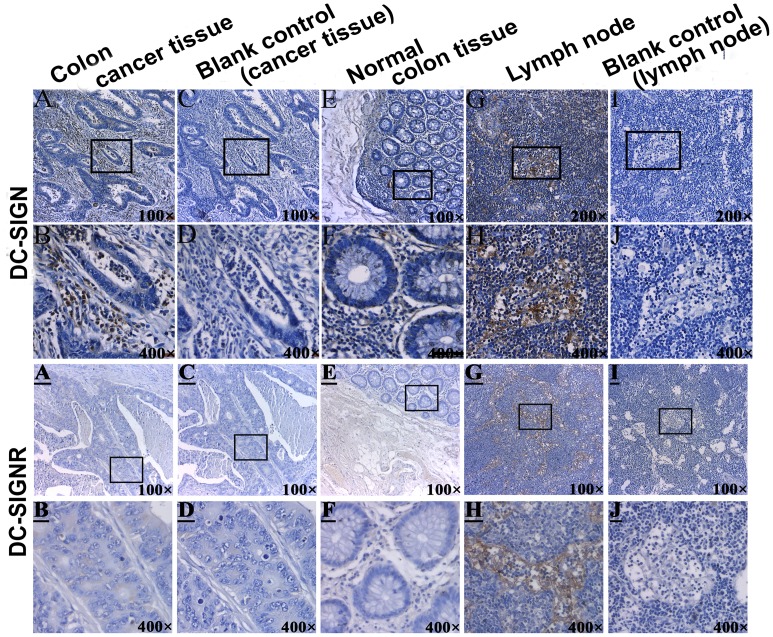
In this study, the expression of DC-SIGN and DC-SIGNR in serum was detected by enzyme-linked immunosorbent assay (ELISA). DC-SIGN and DC-SIGNR expression was detected in cancer tissues by immunohistochemistry (IHC).
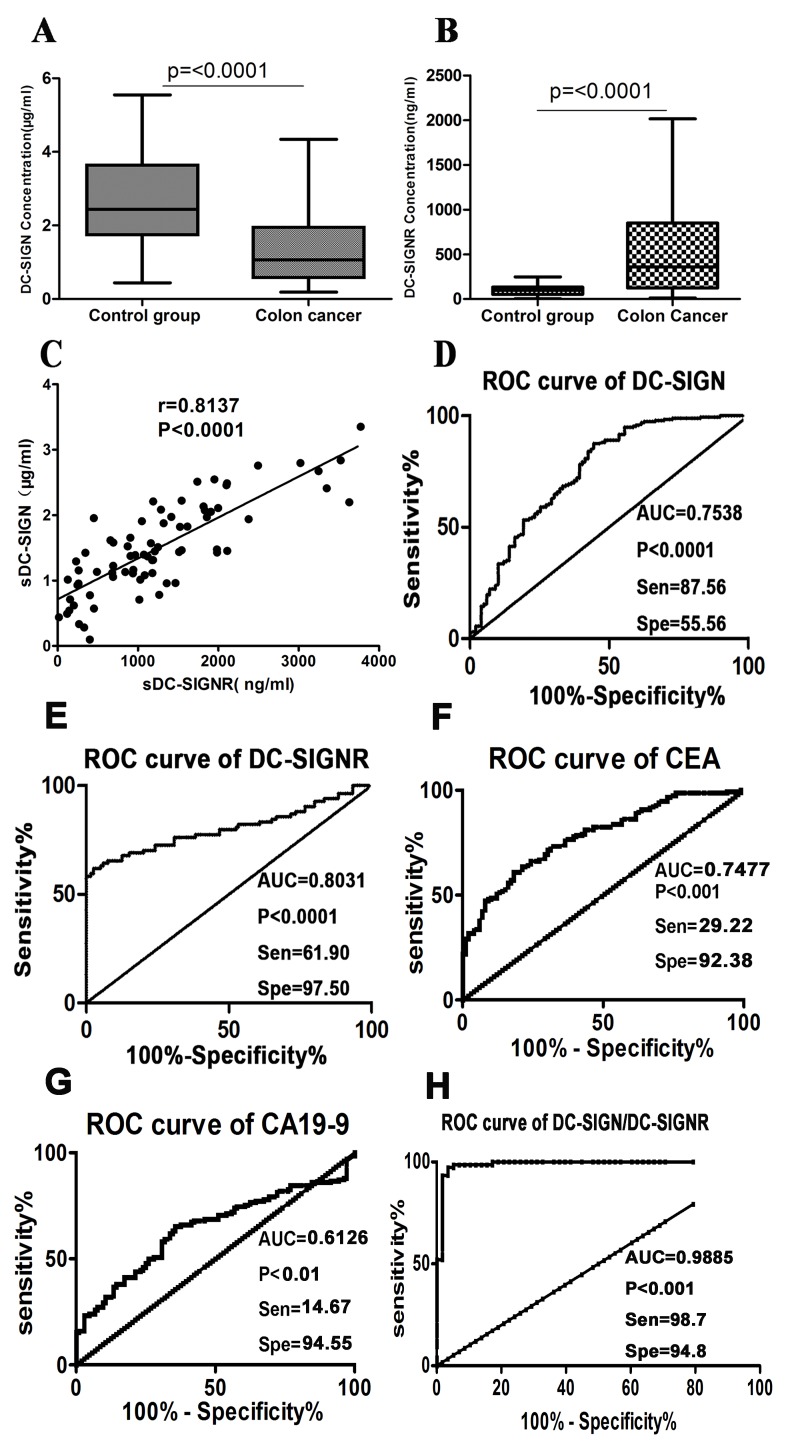
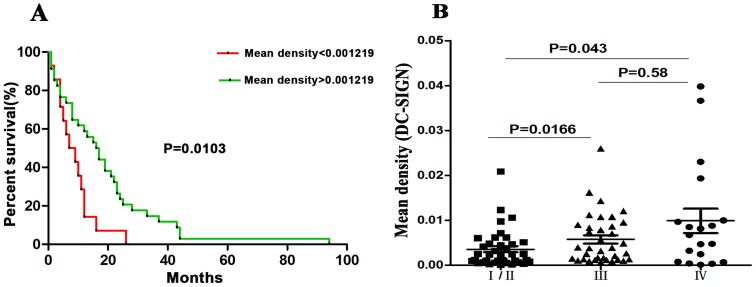
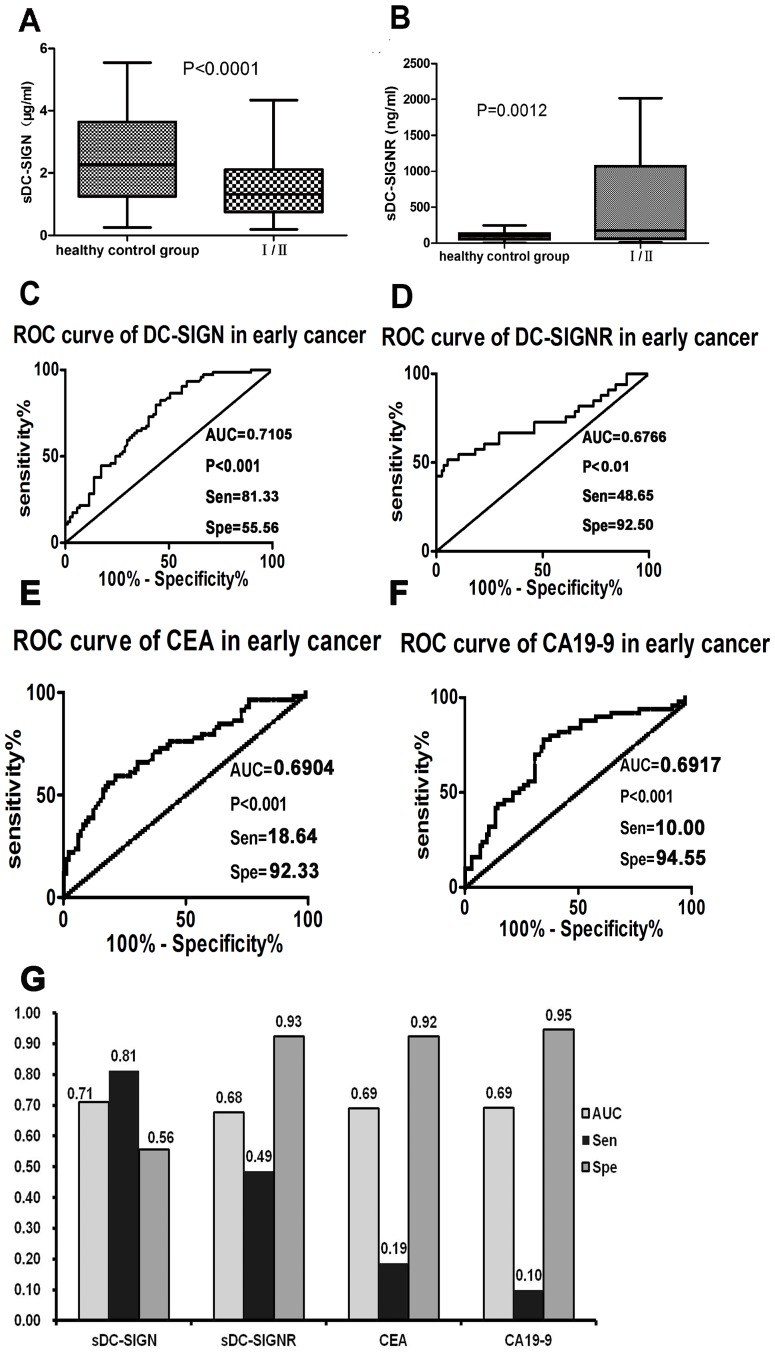
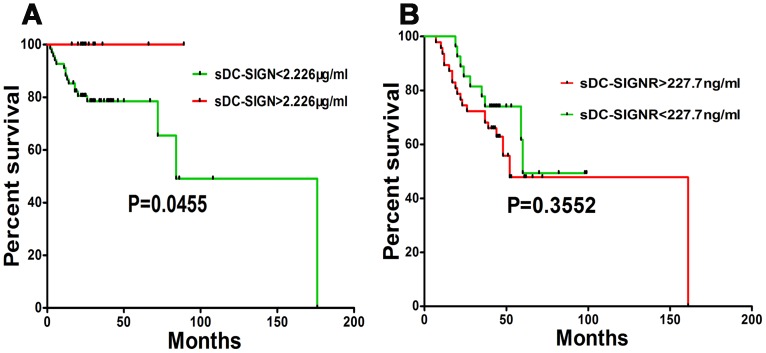
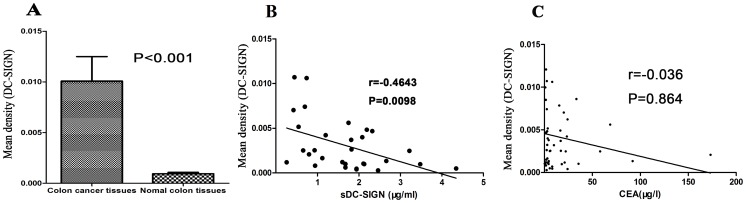
The level of sDC-SIGN was lower in patients than in the healthy controls, while the level of sDC-SIGNR in patients was higher than in the healthy controls. Both sDC-SIGN and sDC-SIGNR had diagnostic significances for cancer patients, and the combined diagnosis of these two markers was higher than both of them alone. Furthermore, there were significant differences between both sDC-SIGN and sDC-SIGNR in stage I/II patients and the healthy controls. Moreover, high sDC-SIGN level was accompanied with the long survival time. Additionally, DC-SIGNR was negative in the cancer foci and matched normal colon tissues but was weakly positive between the cancer foci. DC-SIGN staining was faint in matched normal colon tissues, strong in the tumor stroma and the invasive margin of colon cancer tissues, and negatively correlated with the sDC-SIGN level in serum from the same patient. Interestingly, the percent survival of patients with a DC-SIGN mean density of>0.001219 (the upper 95% confidence interval of matched normal colon tissues) was higher than for all other patients.
DC-SIGN and DC-SIGNR are blood-based molecular markers that can potentially be used for the diagnosis of early stage patients. Moreover, expression of DC-SIGN in serum and cancer tissues may affect the survival time for colon cancer patients.
结肠癌一直被诊断为晚期,这与预后不良相关。目前使用的血清肿瘤标志物癌胚抗原(CEA)和糖类抗原19-9(CA19-9)显示出低敏感性和特异性,可能对早期结肠癌没有诊断价值。因此,迫切需要鉴定用于早期检测结肠癌的新型血清生物标志物。
在本研究中,通过酶联免疫吸附测定(ELISA)检测血清中树突状细胞特异性细胞间黏附分子3结合非整合素(DC-SIGN)和DC-SIGN相关蛋白(DC-SIGNR)的表达。通过免疫组织化学(IHC)检测癌组织中DC-SIGN和DC-SIGNR的表达。
患者血清中可溶性DC-SIGN(sDC-SIGN)水平低于健康对照,而患者血清中sDC-SIGNR水平高于健康对照。sDC-SIGN和sDC-SIGNR对癌症患者均具有诊断意义,这两种标志物的联合诊断高于单独使用它们中的任何一种。此外,I/II期患者与健康对照之间的sDC-SIGN和sDC-SIGNR均存在显著差异。此外,sDC-SIGN水平高与生存时间长相关。另外,DC-SIGNR在癌灶和匹配的正常结肠组织中呈阴性,但在癌灶之间呈弱阳性。DC-SIGN在匹配的正常结肠组织中染色微弱,在肿瘤基质和结肠癌组织的浸润边缘中染色强烈,并且与同一患者血清中的sDC-SIGN水平呈负相关。有趣的是,DC-SIGN平均密度>0.001219(匹配的正常结肠组织的上95%置信区间)的患者的生存率高于所有其他患者。
DC-SIGN和DC-SIGNR是基于血液的分子标志物,有可能用于早期患者的诊断。此外,血清和癌组织中DC-SIGN的表达可能影响结肠癌患者的生存时间。