Vogt Miriam A, Inta Dragos, Luoni Alessia, Elkin Hasan, Pfeiffer Natascha, Riva Marco A, Gass Peter
Department of Psychiatry and Psychotherapy, RG Animal Models in Psychiatry, Central Institute of Mental Health, Medical Faculty Mannheim / Heidelberg University Mannheim, Germany.
Department of Pharmacological and Biomolecular Sciences University of Milan, Milan, Italy.
Front Behav Neurosci. 2014 Nov 27;8:407. doi: 10.3389/fnbeh.2014.00407. eCollection 2014.
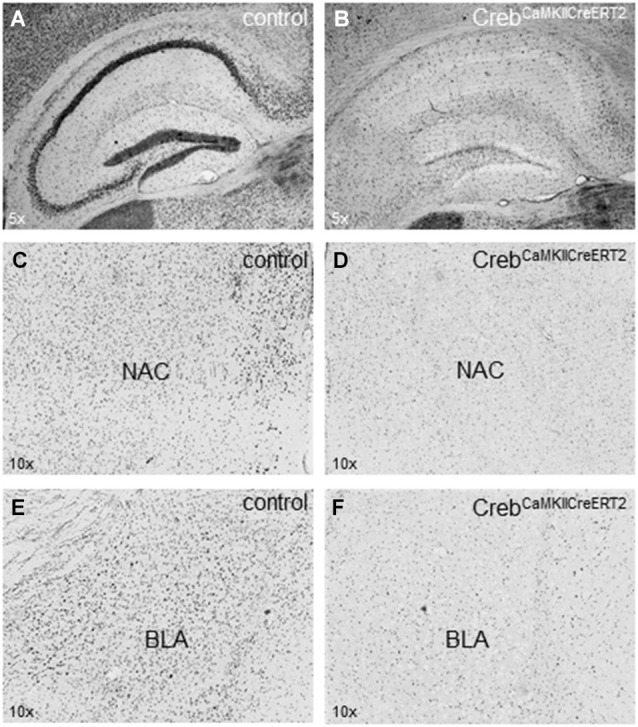
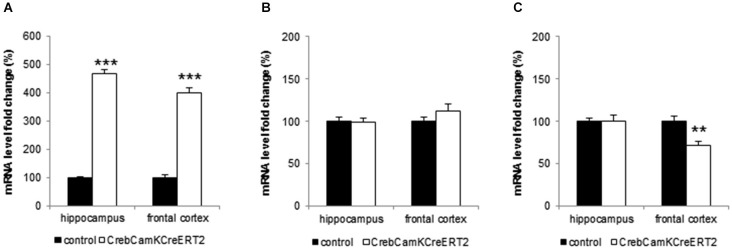
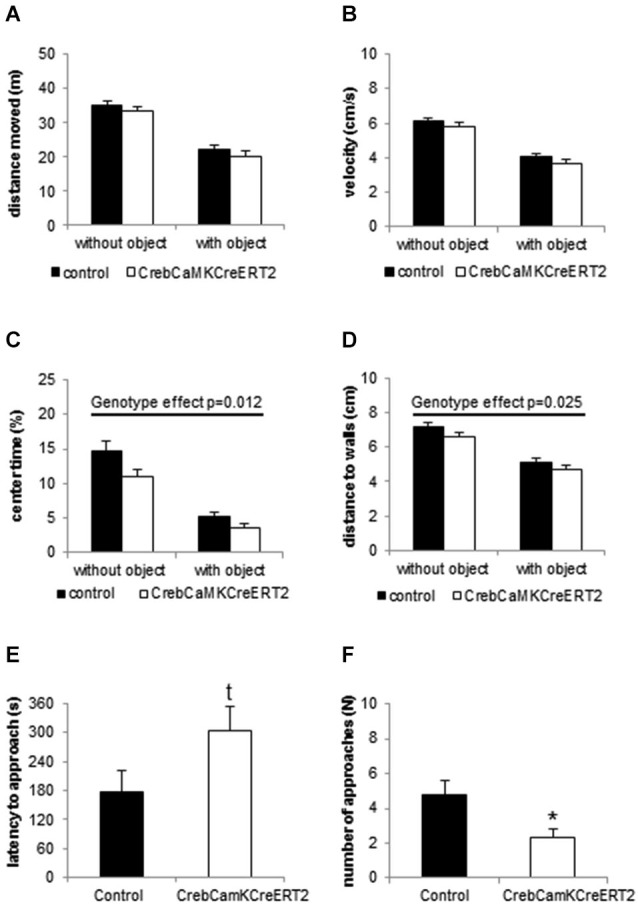
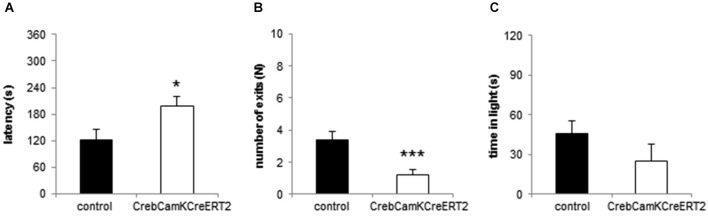
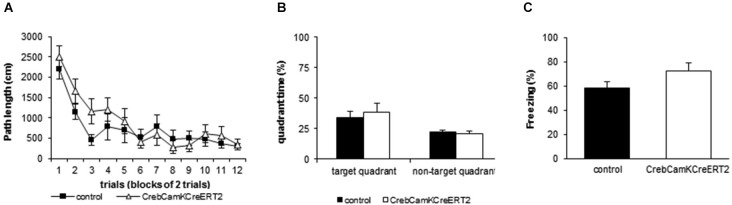
The cyclic AMP (cAMP)-response element binding protein (CREB) is an activity-dependent transcription factor playing a role in synaptic plasticity, learning and memory, and emotional behavior. However, the impact of Creb ablation on rodent behavior is vague as e.g., memory performance of different Creb mutant mice depends on the specific type of mutation per se but additionally on the background and learning protocol differences. Here we present the first targeted ablation of CREB induced during adulthood selectively in principal forebrain neurons in a pure background strain of C57BL/6 mice. All hippocampal principal neurons exhibited lack of CREB expression. Mutant mice showed a severe anxiety phenotype in the openfield and novel object exploration test as well as in the Dark-Light Box Test, but unaltered hippocampus-dependent long-term memory in the Morris water maze and in context dependent fear conditioning. On the molecular level, CREB ablation led to CREM up regulation in the hippocampus and frontal cortex which may at least in part compensate for the loss of CREB. BDNF, a postulated CREB target gene, was down regulated in the frontal lobe but not in the hippocampus; neurogenesis remained unaltered. Our data indicate that in the adult mouse forebrain the late onset of CREB ablation can, in case of memory functionality, be compensated for and is not essential for memory consolidation and retrieval during adulthood. In contrast, the presence of CREB protein during adulthood seems to be pivotal for the regulation of emotional behavior.
环磷酸腺苷(cAMP)反应元件结合蛋白(CREB)是一种依赖活性的转录因子,在突触可塑性、学习和记忆以及情绪行为中发挥作用。然而,Creb基因敲除对啮齿动物行为的影响尚不明确,例如,不同Creb突变小鼠的记忆表现不仅取决于突变的具体类型,还取决于背景和学习方案的差异。在此,我们首次在成年期对C57BL/6小鼠的纯背景品系中选择性地在前脑主要神经元中诱导CREB的靶向敲除。所有海马主要神经元均表现出CREB表达缺失。突变小鼠在旷场试验、新物体探索试验以及明暗箱试验中表现出严重的焦虑表型,但在莫里斯水迷宫试验和情境依赖性恐惧条件反射中,其海马依赖性长期记忆未改变。在分子水平上,CREB敲除导致海马和额叶皮质中CREM上调,这可能至少部分补偿了CREB的缺失。脑源性神经营养因子(BDNF)是一种假定的CREB靶基因,在额叶中下调,但在海马中未下调;神经发生保持不变。我们的数据表明,在成年小鼠前脑中,CREB敲除的晚期发生在记忆功能方面可以得到补偿,并且对成年期的记忆巩固和提取并非必不可少。相比之下,成年期CREB蛋白的存在似乎对情绪行为的调节至关重要。