Cho Insook, Slight Sarah P, Nanji Karen C, Seger Diane L, Maniam Nivethietha, Dykes Patricia C, Bates David W
The Center for Patient Safety Research and Practice, Division of General Internal Medicine, Brigham and Women's Hospital, Boston, MA, USA.
BMC Nephrol. 2014 Dec 15;15:200. doi: 10.1186/1471-2369-15-200.
Although most outpatients are relatively healthy, many have chronic renal insufficiency, and high override rates for suggestions on renal dosing have been observed. To better understand the override of renal dosing alerts in an outpatient setting, we conducted a study to evaluate which patients were more frequently prescribed contraindicated medications, to assess providers' responses to suggestions, and to examine the drugs involved and the reasons for overrides.
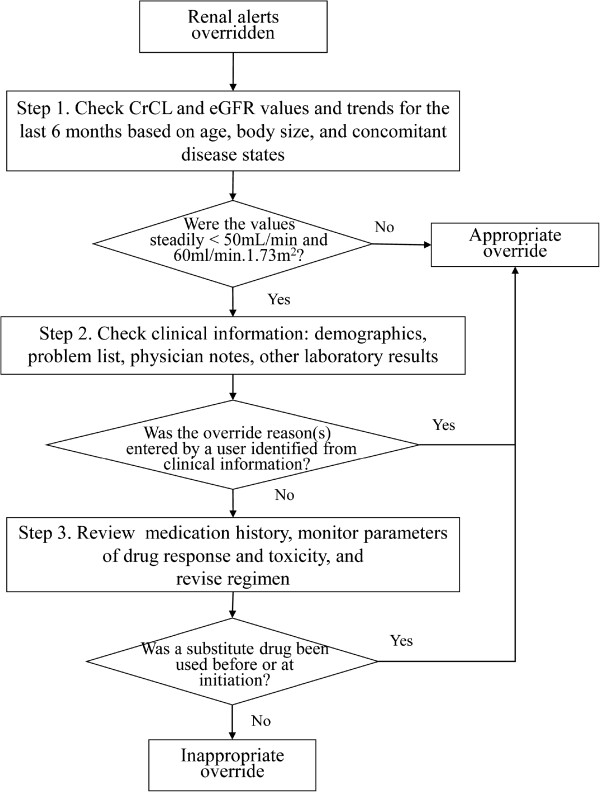
We obtained data on renal alert overrides and the coded reasons for overrides cited by providers at the time of prescription from outpatient clinics and ambulatory hospital-based practices at a large academic health care center over a period of 3 years, from January 2009 to December 2011. For detailed chart review, a group of 6 trained clinicians developed the appropriateness criteria with excellent inter-rater reliability (κ=0.93). We stratified providers by override frequency and then drew samples from the high- and low-frequency groups. We measured the rate of total overrides, rate of appropriate overrides, medications overridden, and the reason(s) for override.
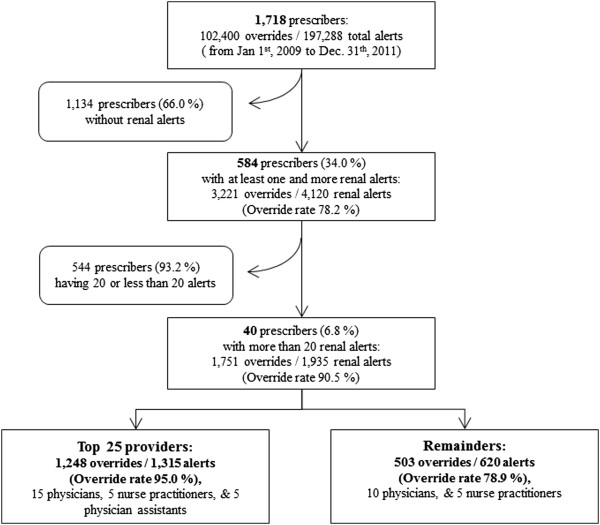
A total of 4120 renal alerts were triggered by 584 prescribers in the study period, among which 78.2% (3,221) were overridden. Almost half of the alerts were triggered by 40 providers and one-third was triggered by high-frequency overriders. The appropriateness rates were fairly similar, at 28.4% and 31.6% for high- and low-frequency overriders, respectively. Metformin, glyburide, hydrochlorothiazide, and nitrofurantoin were the most common drugs overridden. Physicians' appropriateness rates were higher than the rates for nurse practitioners (32.9% vs. 22.1%). Physicians with low frequency override rates had higher levels of appropriateness for metformin than the high frequency overriders (P=0.005).
A small number of providers accounted for a large fraction of overrides, as was the case with a small number of drugs. These data suggest that a focused intervention targeting primarily these providers and medications has the potential to improve medication safety.
尽管大多数门诊患者相对健康,但许多人患有慢性肾功能不全,并且已观察到肾脏给药建议的高忽略率。为了更好地了解门诊环境中肾脏给药警报的忽略情况,我们开展了一项研究,以评估哪些患者更频繁地被开具禁忌药物,评估医疗服务提供者对建议的反应,并检查所涉及的药物及忽略的原因。
我们从2009年1月至2011年12月的3年时间里,从一家大型学术医疗中心的门诊诊所和门诊医院实践中获取了关于肾脏警报忽略情况以及医疗服务提供者在开处方时引用的忽略原因的编码数据。对于详细的病历审查,一组6名经过培训的临床医生制定了适用性标准,评分者间信度极佳(κ=0.93)。我们根据忽略频率对医疗服务提供者进行分层,然后从高频组和低频组中抽取样本。我们测量了总忽略率、适当忽略率、被忽略的药物以及忽略的原因。
在研究期间,584名开处方者共触发了4120次肾脏警报,其中78.2%(3221次)被忽略。几乎一半的警报由40名医疗服务提供者触发,三分之一由高频忽略者触发。适当率相当相似,高频忽略者和低频忽略者的适当率分别为28.4%和31.6%。二甲双胍、格列本脲、氢氯噻嗪和呋喃妥因是最常被忽略的药物。医生的适当率高于执业护士(32.9%对22.1%)。低频忽略率的医生在二甲双胍的适用性方面高于高频忽略者(P=0.005)。
少数医疗服务提供者导致了大部分的忽略情况,少数药物也是如此。这些数据表明,主要针对这些医疗服务提供者和药物的重点干预措施有可能提高用药安全性。