Division of General Internal Medicine, University of Washington, Box 354765, 4245 Roosevelt Way NE, Seattle, WA 98105, USA.
BMC Nephrol. 2014 Jun 7;15:86. doi: 10.1186/1471-2369-15-86.
Medication safety in patients with chronic kidney disease (CKD) is a growing concern. This is particularly relevant in older adults due to underlying CKD. Metformin use is contraindicated in patients with abnormal kidney function; however, many patients are potentially prescribed metformin inappropriately. We evaluated the prevalence of CKD among older adults prescribed metformin for type 2 diabetes mellitus using available equations to estimate kidney function and examined demographic characteristics of patients who were potentially inappropriately prescribed metformin.
We conducted a cross-sectional analysis of older adults aged ≥ 65 years prescribed metformin from March 2008-March 2009 at an urban tertiary-care facility in Seattle, Washington, USA. CKD was defined using National Kidney Foundation-Kidney Disease Outcomes Quality Initiative criteria. Creatinine clearance was calculated using the Cockcroft-Gault equation; estimated glomerular filtration rate was calculated using the abbreviated Modification of Diet in Renal Disease (MDRD) and CKD-Epidemiology (EPI) Collaboration equations. Regression analyses were used to determine the associations between demographic characteristics and prevalent CKD.
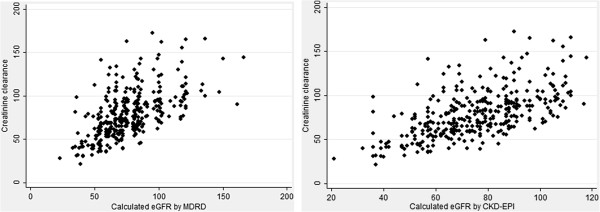
Among 356 subjects (median age 69 years, 52.5% female, 39.4% non-Hispanic black), prevalence of stage 3 or greater CKD calculated by any of the equations was 31.4%. The Cockcroft-Gault equation identified more subjects as having CKD (23.7%) than the abbreviated MDRD (21.1%) or CKD-EPI (21.7%) equations (P<0.001). Older age (OR=1.13, 95% CI 1.08-1.19) and female sex (OR=2.51, 95% CI 1.44-4.38) were associated with increased odds of potentially inappropriate metformin prescription due to CKD; non-Hispanic black race was associated with decreased odds of potentially inappropriate metformin prescription due to CKD (OR=0.41, 95% CI 0.23-0.71).
CKD is common in older adults prescribed metformin for type 2 diabetes, raising concern for potentially inappropriate medication use. No single equation to estimate kidney function may accurately identify CKD in this population. Medication safety deserves greater consideration among elderly patients due to the widespread prevalence of CKD.
慢性肾脏病(CKD)患者的用药安全是一个日益严重的问题。对于患有基础 CKD 的老年人来说,这一点尤其重要。由于肾功能异常,二甲双胍的使用被禁用;然而,许多患者可能被不适当地开了二甲双胍。我们使用现有的估算肾功能的方程评估了在西雅图的一家城市三级保健机构中被开二甲双胍治疗 2 型糖尿病的老年患者的 CKD 患病率,并检查了那些可能被不适当地开了二甲双胍的患者的人口统计学特征。
我们对 2008 年 3 月至 2009 年 3 月在美国华盛顿州西雅图市的一家市级三级保健机构中开二甲双胍的年龄≥65 岁的老年患者进行了一项横断面分析。根据国家肾脏基金会肾脏病预后质量倡议的标准定义 CKD。使用 Cockcroft-Gault 方程计算肌酐清除率;使用简化的肾脏病饮食改良试验(MDRD)和 CKD 流行病学合作(EPI)合作方程计算估算肾小球滤过率。回归分析用于确定人口统计学特征与普遍 CKD 之间的关联。
在 356 名患者中(中位年龄 69 岁,52.5%为女性,39.4%为非西班牙裔黑人),任何方程计算的 3 期或更严重 CKD 的患病率为 31.4%。Cockcroft-Gault 方程识别出患有 CKD 的患者(23.7%)多于简化的 MDRD(21.1%)或 CKD-EPI(21.7%)方程(P<0.001)。年龄较大(OR=1.13,95%CI 1.08-1.19)和女性(OR=2.51,95%CI 1.44-4.38)与由于 CKD 而导致潜在不适当的二甲双胍处方的可能性增加有关;非西班牙裔黑人种族与由于 CKD 而导致潜在不适当的二甲双胍处方的可能性降低有关(OR=0.41,95%CI 0.23-0.71)。
在为 2 型糖尿病开二甲双胍的老年患者中,CKD 很常见,这引起了对潜在不适当用药的担忧。没有单一的方程可以准确地识别该人群中的 CKD。由于 CKD 的广泛流行,老年患者的药物安全性应得到更多关注。