Gomes Cid André Fidelis de Paula, El Hage Yasmin, Amaral Ana Paula, Politti Fabiano, Biasotto-Gonzalez Daniela Aparecida
Postgraduate Program in Biophotonics Applied to Health Sciences, Universidade Nove de Julho (UNINOVE), Av. Dr. Adolfo Pinto,109, Água Branca, 05001-100 São Paulo, SP Brazil ; Department of Physical Therapy, Universidade Nove de Julho (UNINOVE), Av. Dr. Adolfo Pinto,109, Água Branca, 05001-100 São Paulo, SP Brazil.
Postgraduate Program in Rehabilitation Sciences, Universidade Nove de Julho (UNINOVE), Av. Dr. Adolfo Pinto,109, Água Branca, 05001-100 São Paulo, SP Brazil ; Department of Physical Therapy, Universidade Nove de Julho (UNINOVE), Av. Dr. Adolfo Pinto,109, Água Branca, 05001-100 São Paulo, SP Brazil.
Chiropr Man Therap. 2014 Dec 15;22(1):43. doi: 10.1186/s12998-014-0043-6. eCollection 2014.
Temporomandibular disorder (TDM) is the most common source of orofacial pain of a non-dental origin. Sleep bruxism is characterized by clenching and/or grinding the teeth during sleep and is involved in the perpetuation of TMD. The aim of the present study was to investigate the effects of massage therapy, conventional occlusal splint therapy and silicone occlusal splint therapy on electromyographic activity in the masseter and anterior temporal muscles and the intensity of signs and symptoms in individuals with severe TMD and sleep bruxism.
Sixty individuals with severe TMD and sleep bruxism were randomly distributed into four treatment groups: 1) massage group, 2) conventional occlusal splint group, 3) massage + conventional occlusal splint group and 4) silicone occlusal splint group. Block randomization was employed and sealed opaque envelopes were used to conceal the allocation. Groups 2, 3 and 4 wore an occlusal splint for four weeks. Groups 1 and 3 received three weekly massage sessions for four weeks. All groups were evaluated before and after treatment through electromyographic analysis of the masseter and anterior temporal muscles and the Fonseca Patient History Index. The Wilcoxon test was used to compare the effects of the different treatments and repeated-measures ANOVA was used to determine the intensity of TMD.
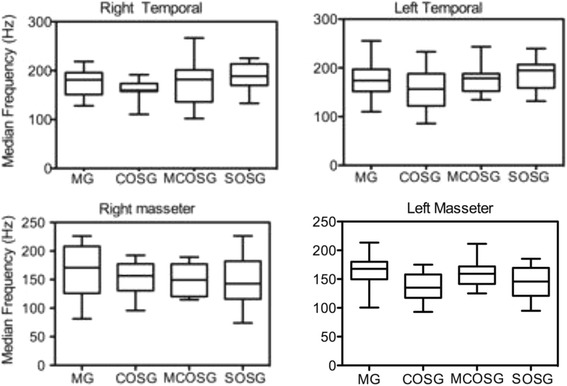
The inter-group analysis of variance revealed no statistically significant differences in median frequency among the groups prior to treatment. In the intra-group analysis, no statistically significant differences were found between pre-treatment and post-treatment evaluations in any of the groups. Group 3 demonstrated a greater improvement in the intensity of TMD in comparison to the other groups.
Massage therapy and the use of an occlusal splint had no significant influence on electromyographic activity of the masseter or anterior temporal muscles. However, the combination of therapies led to a reduction in the intensity of signs and symptoms among individuals with severe TMD and sleep bruxism.
This study is registered in August, 2014 in the ClinicalTrials.gov (NCT01874041).
颞下颌关节紊乱病(TDM)是口腔颌面部非牙源性疼痛最常见的病因。睡眠磨牙症的特征是在睡眠期间紧咬牙和/或磨牙,并且与颞下颌关节紊乱病的持续存在有关。本研究的目的是调查按摩疗法、传统咬合板疗法和硅胶咬合板疗法对重度颞下颌关节紊乱病和睡眠磨牙症患者咬肌和颞肌前份肌电图活动以及体征和症状强度的影响。
60例重度颞下颌关节紊乱病和睡眠磨牙症患者被随机分为四个治疗组:1)按摩组,2)传统咬合板组,3)按摩 + 传统咬合板组和4)硅胶咬合板组。采用区组随机化,并使用密封不透明信封隐藏分配情况。第2、3和4组佩戴咬合板四周。第1和3组接受为期四周、每周三次的按摩治疗。所有组在治疗前后均通过咬肌和颞肌前份的肌电图分析以及丰塞卡患者病史指数进行评估。采用威尔科克森检验比较不同治疗的效果,并采用重复测量方差分析确定颞下颌关节紊乱病的强度。
组间方差分析显示治疗前各组之间的中位频率无统计学显著差异。在组内分析中,任何组的治疗前和治疗后评估之间均未发现统计学显著差异。与其他组相比,第3组在颞下颌关节紊乱病强度方面有更大改善。
按摩疗法和使用咬合板对咬肌或颞肌前份的肌电图活动没有显著影响。然而,联合治疗可降低重度颞下颌关节紊乱病和睡眠磨牙症患者的体征和症状强度。
本研究于2014年8月在ClinicalTrials.gov(NCT01874041)注册。