Huang Xiao, Cao Mengru, Wang Li, Wu Shuhong, Liu Xiaoying, Li Hongyu, Zhang Hui, Wang Rui-Yu, Sun Xiaoping, Wei Caimiao, Baggerly Keith A, Roth Jack A, Wang Michael, Swisher Stephen G, Fang Bingliang
Department of Thoracic and Cardiovascular Surgery, The University of Texas MD Anderson Cancer Center, Houston, Texas, USA.
Department of Thoracic and Cardiovascular Surgery, The University of Texas MD Anderson Cancer Center, Houston, Texas, USA. The Fourth Department of Medicine Oncology, Harbin Medical University Cancer Hospital, Harbin, China.
Oncotarget. 2015 Jan 1;6(1):345-54. doi: 10.18632/oncotarget.2814.
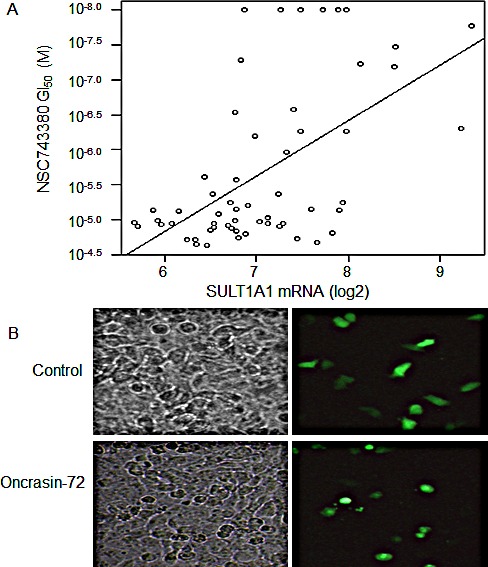
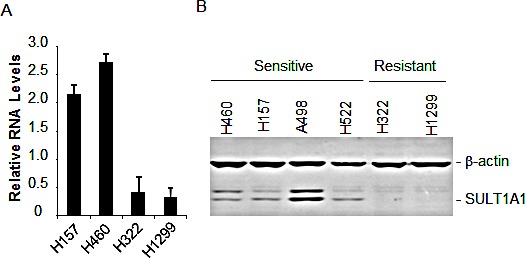
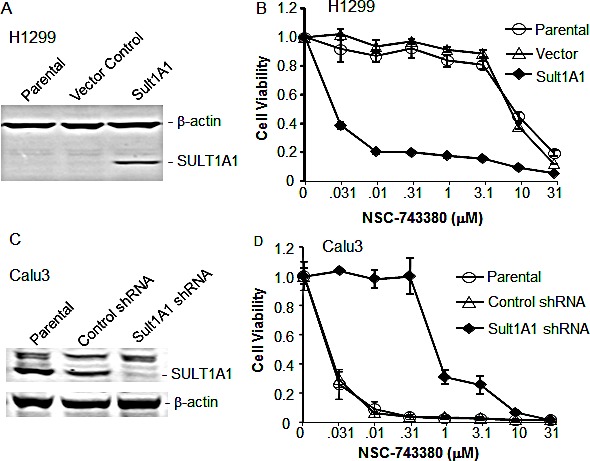
The small molecule anticancer agent NSC-743380 modulates functions of multiple cancer-related pathways and is highly active in a subset of cancer cell lines in the NCI-60 cell line panel. It also has promising in vivo anticancer activity. However, the mechanisms underlying NSC-743380's selective anticancer activity remain uncharacterized. To determine biomarkers that may be used to identify responders to this novel anticancer agent, we performed correlation analysis on NSC-743380's anticancer activity and the gene expression levels in NCI-60 cell lines and characterized the functions of the top associated genes in NSC-743380-mediated anticancer activity. We found sulfotransferase SULT1A1 is causally associated with NSC-743380's anticancer activity. SULT1A1 was expressed in NSC-743380-sensitive cell lines but was undetectable in resistant cancer cells. Ectopic expression of SULT1A1 in NSC743380 resistant cancer cells dramatically sensitized the resistant cells to NSC-743380. Knockdown of the SULT1A1 in the NSC-743380 sensitive cancer cell line rendered it resistance to NSC-743380. The SULT1A1 protein levels in cell lysates from 18 leukemia cell lines reliably predicted the susceptibility of the cell lines to NSC-743380. Thus, expression of SULT1A1 in cancer cells is required for NSC-743380's anticancer activity and can be used as a biomarker for identification of NSC-743380 responders.
小分子抗癌剂NSC - 743380可调节多种癌症相关信号通路的功能,并且在NCI - 60细胞系面板中的一部分癌细胞系中具有高活性。它在体内也具有良好的抗癌活性。然而,NSC - 743380选择性抗癌活性的潜在机制仍未明确。为了确定可用于识别对这种新型抗癌剂有反应者的生物标志物,我们对NSC - 743380的抗癌活性与NCI - 60细胞系中的基因表达水平进行了相关性分析,并对NSC - 743380介导的抗癌活性中最相关基因的功能进行了表征。我们发现磺基转移酶SULT1A1与NSC - 743380的抗癌活性存在因果关系。SULT1A1在对NSC - 743380敏感的细胞系中表达,但在耐药癌细胞中未检测到。在对NSC743380耐药的癌细胞中异位表达SULT1A1可使耐药细胞对NSC - 743380显著敏感。在对NSC - 743380敏感的癌细胞系中敲低SULT1A1可使其对NSC - 743380产生耐药性。来自18个白血病细胞系的细胞裂解物中的SULT1A1蛋白水平可靠地预测了细胞系对NSC - 743380的敏感性。因此,癌细胞中SULT1A1的表达是NSC - 743380抗癌活性所必需的,并且可作为识别NSC - 743380反应者的生物标志物。