University of California, Davis.
J Cogn Neurosci. 2015 Jun;27(6):1180-93. doi: 10.1162/jocn_a_00771. Epub 2014 Dec 16.
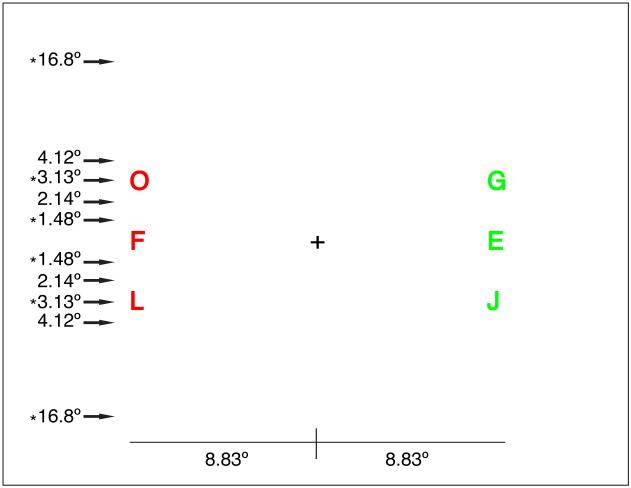
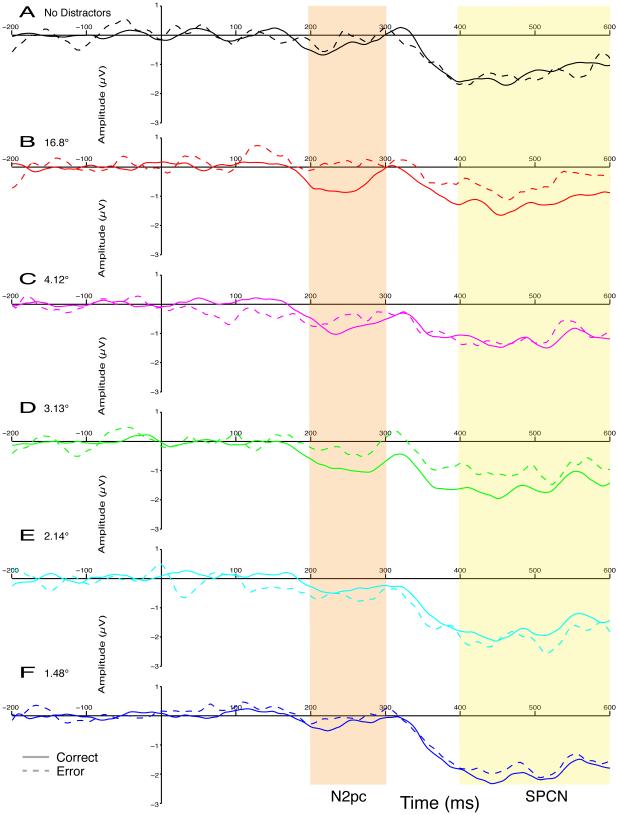
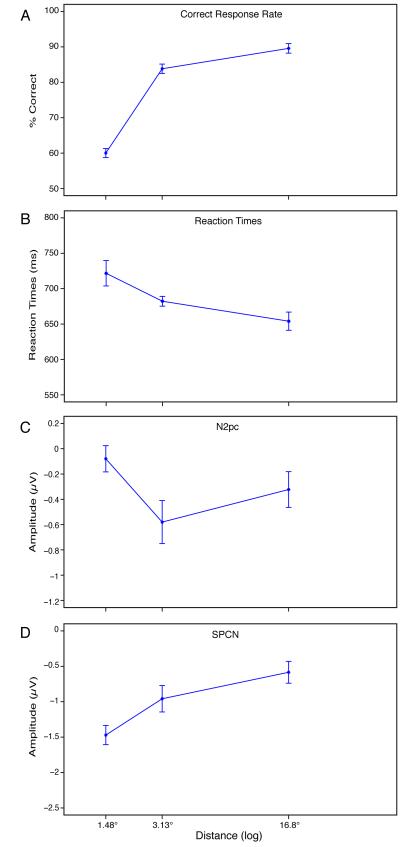
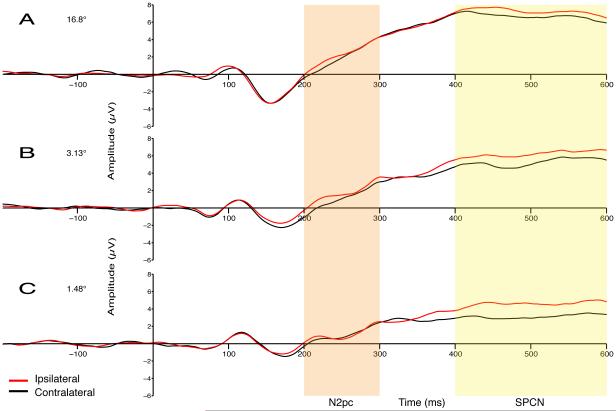
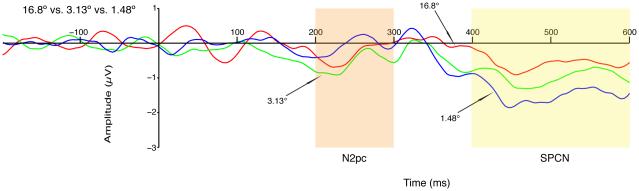
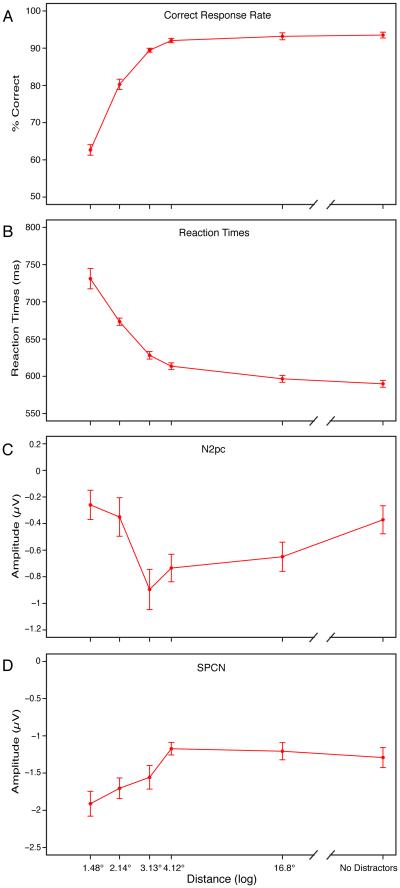
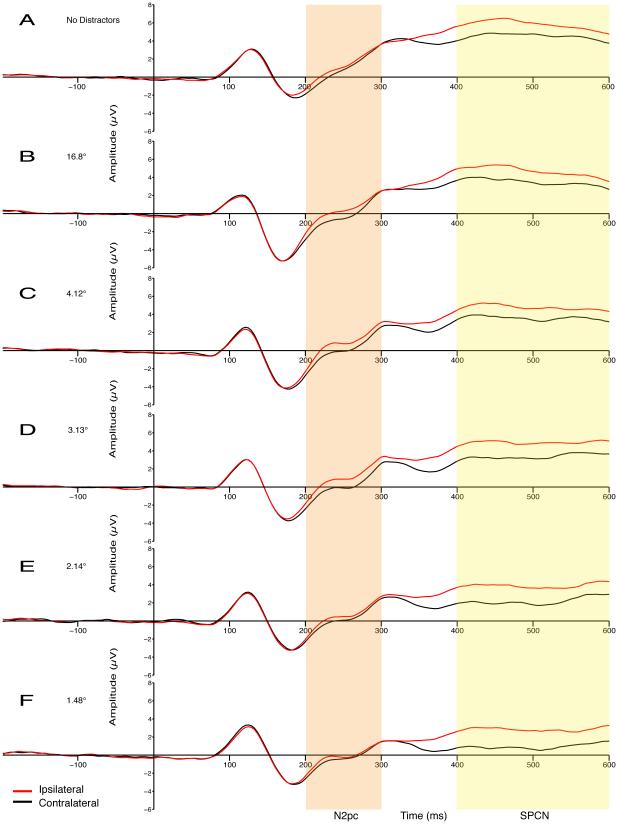
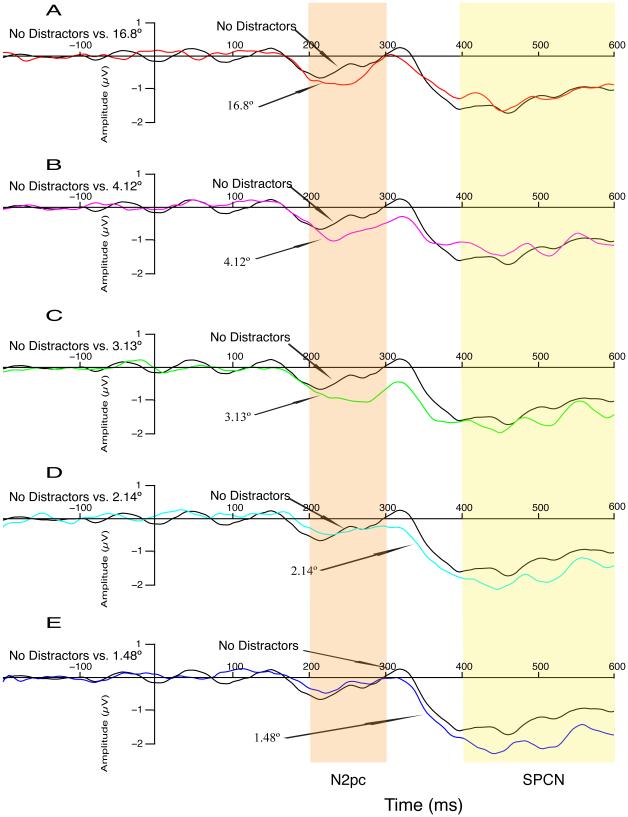
When the distance between a visual target and nearby flankers falls below a critical distance, target discrimination declines precipitously. This is called "crowding." Many researchers have proposed that selective attention plays a role in crowding. However, although some research has examined the effects of directing attention toward versus away from the targets, no previous research has assessed how attentional allocation varies as a function of target-flanker distance in crowding. Here, we used ERPs to assess the operation of attention during crowding, focusing on the attention-related N2pc component. We used a typical crowding task in which participants were asked to report the category (vowel/consonant) of a lateralized target letter flanked by distractor letters at different distances. We tested the hypothesis that attention fails when the target-flanker distance becomes too small for attention to operate effectively. Consistent with this hypothesis, we found that N2pc amplitude was maximal at intermediate target-flanker distances and decreased substantially when crowding became severe. In addition, we examined the sustained posterior contralateral negativity (SPCN), which reflects the amount of information being maintained in working memory. Unlike the N2pc component, the SPCN increased in amplitude at small target-flanker distances, suggesting that observers stored information about the target and flankers in working memory when attention failed to select the target. Together, the N2pc and SPCN results suggest that attention and working memory play distinctive roles in crowding: Attention operates to minimize interference from the flankers at intermediate target-flanker distances, whereas working memory may be recruited when attention fails to select the target at small target-flanker distances.
当视觉目标与附近的侧标之间的距离低于临界距离时,目标辨别力会急剧下降。这被称为“拥挤”。许多研究人员提出,选择性注意在拥挤中起作用。然而,尽管一些研究已经研究了将注意力引导到目标或远离目标的效果,但以前没有研究评估过在拥挤中,注意力分配如何随目标-侧标距离的变化而变化。在这里,我们使用 ERP 来评估拥挤期间注意力的运作,重点关注与注意力相关的 N2pc 成分。我们使用了一种典型的拥挤任务,参与者被要求报告一个侧化目标字母的类别(元音/辅音),该字母被不同距离的分心字母包围。我们假设当目标-侧标距离变得太小以至于注意力无法有效运作时,注意力就会失败。与这一假设一致,我们发现 N2pc 振幅在中间目标-侧标距离处最大,当拥挤变得严重时,N2pc 振幅会大幅下降。此外,我们还检查了持续的对侧后负变(SPCN),它反映了工作记忆中保持的信息量。与 N2pc 成分不同,SPCN 在小目标-侧标距离处的振幅增加,这表明当注意力无法选择目标时,观察者将目标和侧标信息存储在工作记忆中。总之,N2pc 和 SPCN 的结果表明,注意力和工作记忆在拥挤中起着不同的作用:注意力在中间目标-侧标距离处运作以最小化来自侧标的干扰,而当注意力无法在小目标-侧标距离处选择目标时,工作记忆可能会被招募。