Kochar Priyanka S, Dandona Rakhi, Kumar G Anil, Dandona Lalit
Public Health Foundation of India, Plot 47, Sector 44, Gurgaon, 122002, National Capital Region, India.
Institute for Health Metrics and Evaluation, University of Washington, Seattle, WA, USA.
BMC Pregnancy Childbirth. 2014 Dec 17;14:413. doi: 10.1186/s12884-014-0413-z.
We report population-based data on still birth, induced abortion and miscarriage from the Indian state of Bihar to assess the magnitude of the problem and to inform corrective action.
A representative sample of women from all districts of Bihar with a pregnancy outcome in the last 12 months was obtained through multistage sampling in early 2012. Still birth rate was calculated as fetuses born with no sign of life at 7 or more months of gestation per 1,000 births. Induced abortion and miscarriage rates were defined as expulsion of dead fetuses at less than 7 months of gestation induced by any means or without inducement, respectively, per 1000 pregnancies that had an outcome. Multiple regression models were used to explore possible associations with stillbirths, induced abortions and miscarriages. Multi-level models were developed for the relatively less developed north zone and for the south zone of Bihar to examine contextual factors associated with still births, induced abortions and miscarriages.
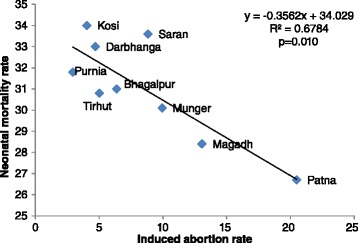
Still birth rate was estimated as 20 per 1,000 births (95% CI 15.6-24.5), and induced abortion and miscarriage rates as 8.6 (6.6-10.6), and 46 (40.8-51.3) per 1,000 pregnancies with outcome, respectively. The odds of induced abortion and miscarriage were significantly higher in the south zone (odds ratio 2.53 [95% CI 1.79-3.57] and 1.27 [95% CI 1.10-1.47], respectively). In the multi-level model for the north zone, the odds of induced abortion were higher for women with husband's having mean years of education higher than the state mean (2.62; 95% CI 1.47-4.69). Among the nine divisions of Bihar, comprising of groups of districts, higher induced abortion rate was associated with lower neonatal mortality rate (R(2) = 0.68, p = 0.01).
These population-based data show a significant burden of still births in Bihar, suggesting that addressing these must become an important part of maternal and child health initiatives. The higher induced abortion in the more developed districts, and the inverse trend between induced abortion and neonatal mortality rates, have programmatic implications.
我们报告了印度比哈尔邦基于人群的死产、人工流产和自然流产数据,以评估该问题的严重程度并为纠正措施提供依据。
2012年初通过多阶段抽样获取了比哈尔邦所有地区过去12个月有妊娠结局的妇女的代表性样本。死产率的计算方法是每1000例出生中妊娠7个月及以上出生时无生命迹象的胎儿数。人工流产率和自然流产率分别定义为每1000例有结局的妊娠中因任何方式或无诱因导致妊娠不足7个月时排出死胎的比例。使用多元回归模型探讨与死产、人工流产和自然流产的可能关联。针对比哈尔邦相对欠发达的北部地区和南部地区建立了多层次模型,以研究与死产、人工流产和自然流产相关的背景因素。
估计死产率为每1000例出生20例(95%可信区间15.6 - 24.5),人工流产率和自然流产率分别为每1000例有结局的妊娠8.6例(6.6 - 10.6)和46例(40.8 - 51.3)。南部地区人工流产和自然流产的几率显著更高(优势比分别为2.53 [95%可信区间1.79 - 3.57]和1.27 [95%可信区间1.10 - 1.47])。在北部地区的多层次模型中,丈夫平均受教育年限高于该邦平均水平的妇女进行人工流产的几率更高(2.62;95%可信区间1.47 - 4.69)。在比哈尔邦由多个区组成的九个分区中,较高的人工流产率与较低的新生儿死亡率相关(R² = 0.68,p = 0.01)。
这些基于人群的数据显示比哈尔邦死产负担沉重,表明解决这些问题必须成为母婴健康举措的重要组成部分。较发达地区人工流产率较高以及人工流产率与新生儿死亡率之间的反向趋势具有规划意义。