Rehan Sandra M, Berens Ali J, Toth Amy L
Department of Biological Sciences, University of New Hampshire, Durham, New Hampshire, USA.
Program in Bioinformatics and Computational Biology, Iowa State University, Ames, Iowa, USA.
BMC Evol Biol. 2014 Dec 17;14:260. doi: 10.1186/s12862-014-0260-6.
There is great interest in understanding the genomic underpinnings of social evolution, in particular, the evolution of eusociality (caste-containing societies with non-reproductives that care for siblings). Subsociality is a key precursor for the evolution of eusociality and characterized by prolonged parental care and parent-offspring interaction. Here, we provide the first transcriptomic data for the small carpenter bee, Ceratina calcarata. This species is of special interest because it is subsocial and in the same family as the highly eusocial honey bee, Apis mellifera. In addition, some C. calcarata females demonstrate alloparental care without reproduction, which provides a unique opportunity to study worker behaviour in a non-eusocial species.
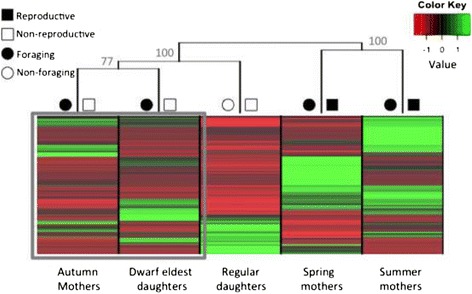
We uncovered similar gene expression patterns related to maternal care and sibling care in different groups of females. This agrees with the maternal heterochrony hypothesis, specifically, that changes in timing of offspring care gene expression are related to worker behaviour in incipient insect societies. In addition, we also detected some similarity to caste-related gene expression patterns in highly eusocial honey bees, and uncovered large lifetime changes in gene expression that accompany shifts in reproductive and maternal care behaviour.
For Ceratina calcarata, we found that transcript expression profiles were most similar between sibling care and maternal care females. The maternal care behaviour exhibited post-reproductively by Ceratina mothers is concordant in terms of transcript expression with the alloparental care exhibited by workers. In line with theoretical predictions, our data are consistent with the maternal heterochrony hypothesis for the evolutionary development of worker behaviour in subsocial bees.
人们对理解社会进化的基因组基础,特别是真社会性(包含不育个体照顾同胞的等级社会)的进化有着浓厚兴趣。亚社会性是真社会性进化的关键先驱,其特征是亲代抚育和亲子互动时间延长。在此,我们提供了小木匠蜂(Ceratina calcarata)的首个转录组数据。该物种具有特殊意义,因为它是亚社会性的,且与高度真社会性的蜜蜂(Apis mellifera)同属一个科。此外,一些小木匠蜂雌性个体表现出无繁殖行为的异亲抚育,这为研究非真社会性物种中的工蜂行为提供了独特机会。
我们在不同雌性群体中发现了与母性照顾和同胞照顾相关的相似基因表达模式。这与母性发育异时性假说相符,具体而言,即后代照顾基因表达时间的变化与早期昆虫社会中的工蜂行为有关。此外,我们还检测到与高度真社会性蜜蜂中与等级相关的基因表达模式存在一些相似之处,并发现了伴随生殖和母性照顾行为转变的基因表达在整个生命周期中的巨大变化。
对于小木匠蜂,我们发现同胞照顾和母性照顾雌性之间的转录表达谱最为相似。小木匠蜂母亲在生殖后表现出的母性照顾行为在转录表达方面与工蜂表现出的异亲抚育行为一致。与理论预测相符,我们的数据与亚社会性蜜蜂中工蜂行为进化发展的母性发育异时性假说一致。