Jemielita Matthew, Taormina Michael J, Burns Adam R, Hampton Jennifer S, Rolig Annah S, Guillemin Karen, Parthasarathy Raghuveer
Department of Physics, University of Oregon, Eugene, Oregon, USA.
Institute of Ecology and Evolution, University of Oregon, Eugene, Oregon, USA.
mBio. 2014 Dec 16;5(6):e01751-14. doi: 10.1128/mBio.01751-14.
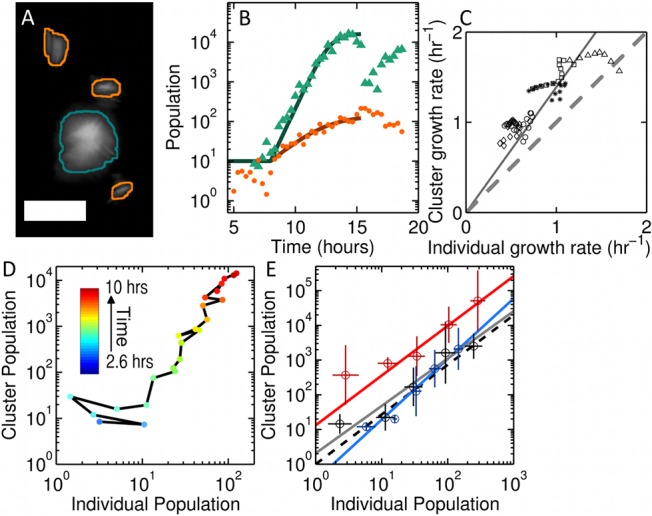
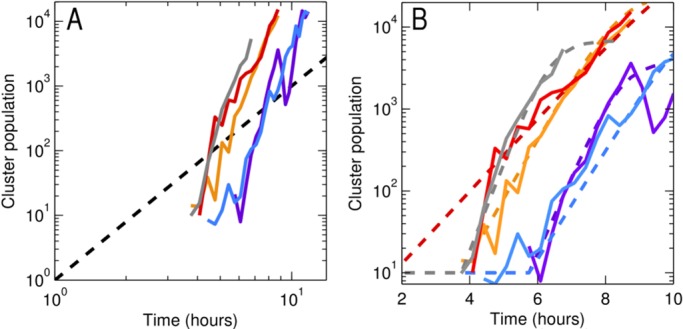
The vertebrate intestine is home to microbial ecosystems that play key roles in host development and health. Little is known about the spatial and temporal dynamics of these microbial communities, limiting our understanding of fundamental properties, such as their mechanisms of growth, propagation, and persistence. To address this, we inoculated initially germ-free zebrafish larvae with fluorescently labeled strains of an Aeromonas species, representing an abundant genus in the zebrafish gut. Using light sheet fluorescence microscopy to obtain three-dimensional images spanning the gut, we quantified the entire bacterial load, as founding populations grew from tens to tens of thousands of cells over several hours. The data yield the first ever measurements of the growth kinetics of a microbial species inside a live vertebrate intestine and show dynamics that robustly fit a logistic growth model. Intriguingly, bacteria were nonuniformly distributed throughout the gut, and bacterial aggregates showed considerably higher growth rates than did discrete individuals. The form of aggregate growth indicates intrinsically higher division rates for clustered bacteria, rather than surface-mediated agglomeration onto clusters. Thus, the spatial organization of gut bacteria both relative to the host and to each other impacts overall growth kinetics, suggesting that spatial characterizations will be an important input to predictive models of host-associated microbial community assembly.
Our intestines are home to vast numbers of microbes that influence many aspects of health and disease. Though we now know a great deal about the constituents of the gut microbiota, we understand very little about their spatial structure and temporal dynamics in humans or in any animal: how microbial populations establish themselves, grow, fluctuate, and persist. To address this, we made use of a model organism, the zebrafish, and a new optical imaging technique, light sheet fluorescence microscopy, to visualize for the first time the colonization of a live, vertebrate gut by specific bacteria with sufficient resolution to quantify the population over a range from a few individuals to tens of thousands of bacterial cells. Our results provide unprecedented measures of bacterial growth kinetics and also show the influence of spatial structure on bacterial populations, which can be revealed only by direct imaging.
脊椎动物的肠道是微生物生态系统的家园,这些微生物生态系统在宿主发育和健康中发挥着关键作用。人们对这些微生物群落的时空动态知之甚少,这限制了我们对其基本特性的理解,比如它们的生长、繁殖和存续机制。为了解决这个问题,我们用荧光标记的气单胞菌属菌株接种最初无菌的斑马鱼幼体,该菌属是斑马鱼肠道中的优势菌属。利用光片荧光显微镜获取跨越肠道的三维图像,我们对整个细菌载量进行了量化,因为初始种群在数小时内从数十个细胞增长到数万个细胞。这些数据首次测量了活体脊椎动物肠道内一种微生物的生长动力学,并显示出符合逻辑斯蒂增长模型的动态变化。有趣的是,细菌在整个肠道内分布不均匀,细菌聚集体的生长速度明显高于离散的个体。聚集体生长形式表明,聚集的细菌本身具有更高的分裂率,而不是通过表面介导聚集到聚集体上。因此,肠道细菌相对于宿主以及彼此之间的空间组织会影响整体生长动力学,这表明空间特征将是宿主相关微生物群落组装预测模型的重要输入信息。
我们的肠道中存在大量影响健康和疾病诸多方面的微生物。虽然我们现在对肠道微生物群的组成有了很多了解,但对它们在人类或任何动物体内的空间结构和时间动态却知之甚少:微生物种群如何建立、生长、波动和存续。为了解决这个问题,我们利用模式生物斑马鱼和一种新的光学成像技术——光片荧光显微镜,首次以足够的分辨率可视化特定细菌在活体脊椎动物肠道中的定殖情况,从而能够在从几个个体到数万个细菌细胞的范围内对菌群进行量化。我们的结果提供了前所未有的细菌生长动力学测量数据,还显示了空间结构对细菌种群的影响,而这只有通过直接成像才能揭示。